Si deseas distinguir tus productos, servicios o ambos de los de otra empresa, es posible que necesites una marca o nombre comercial. Descubre qué son, en qué consiste su procedimiento de registro y qué implica.

Información sobre los plazos de presentación de solicitudes de transformación de marcas de la Unión Europea en marca nacional española. Más información


Si tienes un nuevo dispositivo, producto o procedimiento que resuelva un problema técnico o tenga una ventaja práctica, existen distintas formas de protegerlo en España y en otros países. Descubre cómo hacerlo.

¿Tu innovación reside en la estética, la ornamentación o la apariencia de tu producto? Protégela mediante un diseño industrial. Descubre qué derechos confiere el registro y cómo realizar la tramitación.

Las indicaciones geográficas protegen el nombre de un producto originario de una zona geográfica, a la cual le debe una determinada calidad, reputación u otra característica. Descubre qué son, en qué consiste su procedimiento de registro y qué beneficios conceden.

Las patentes publicadas en todo el mundo son una valiosa fuente de información científica, técnica y comercial.

Si eres emprendedor/a o una empresa y quieres potenciar y mejorar la rentabilidad de tu negocio protegiendo de forma adecuada los activos intangibles de tu organización, en este espacio encontrarás lo necesario.


 145
resultados
145
resultados
 Última actualización
22/10/2026 [06:47:00]
Última actualización
22/10/2026 [06:47:00]


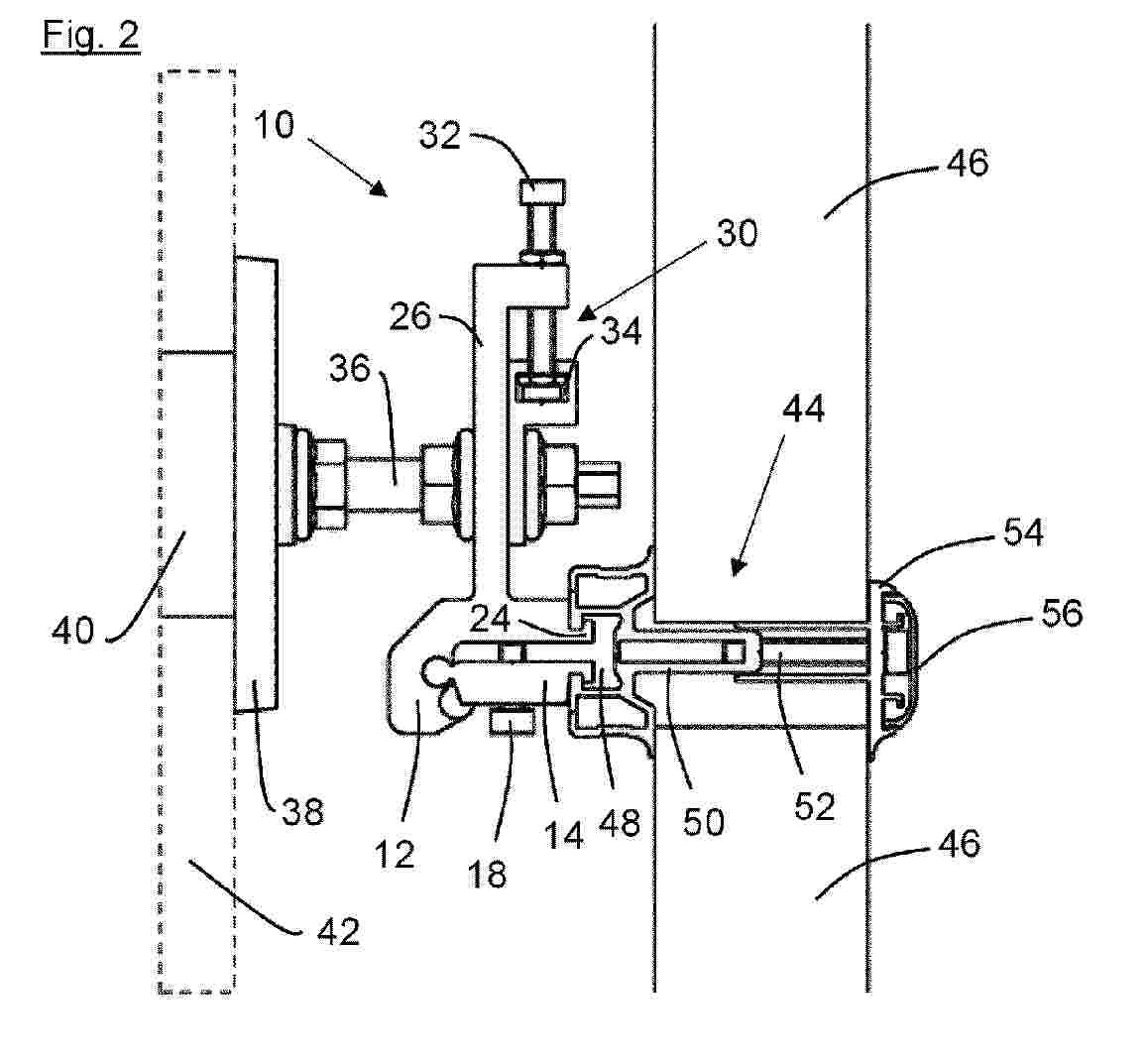
Resumen de: WO2025223901A1
The invention relates to a surface fastening device (10) for fastening a fastening device (44), preferably for fastening at least one solar or photovoltaic module (46), to an inclined or vertical surface (42), having a clamping unit (12) for clamping the fastening device (44) and a height adjustment device (30) for adjusting the height position of the fastening device (44).

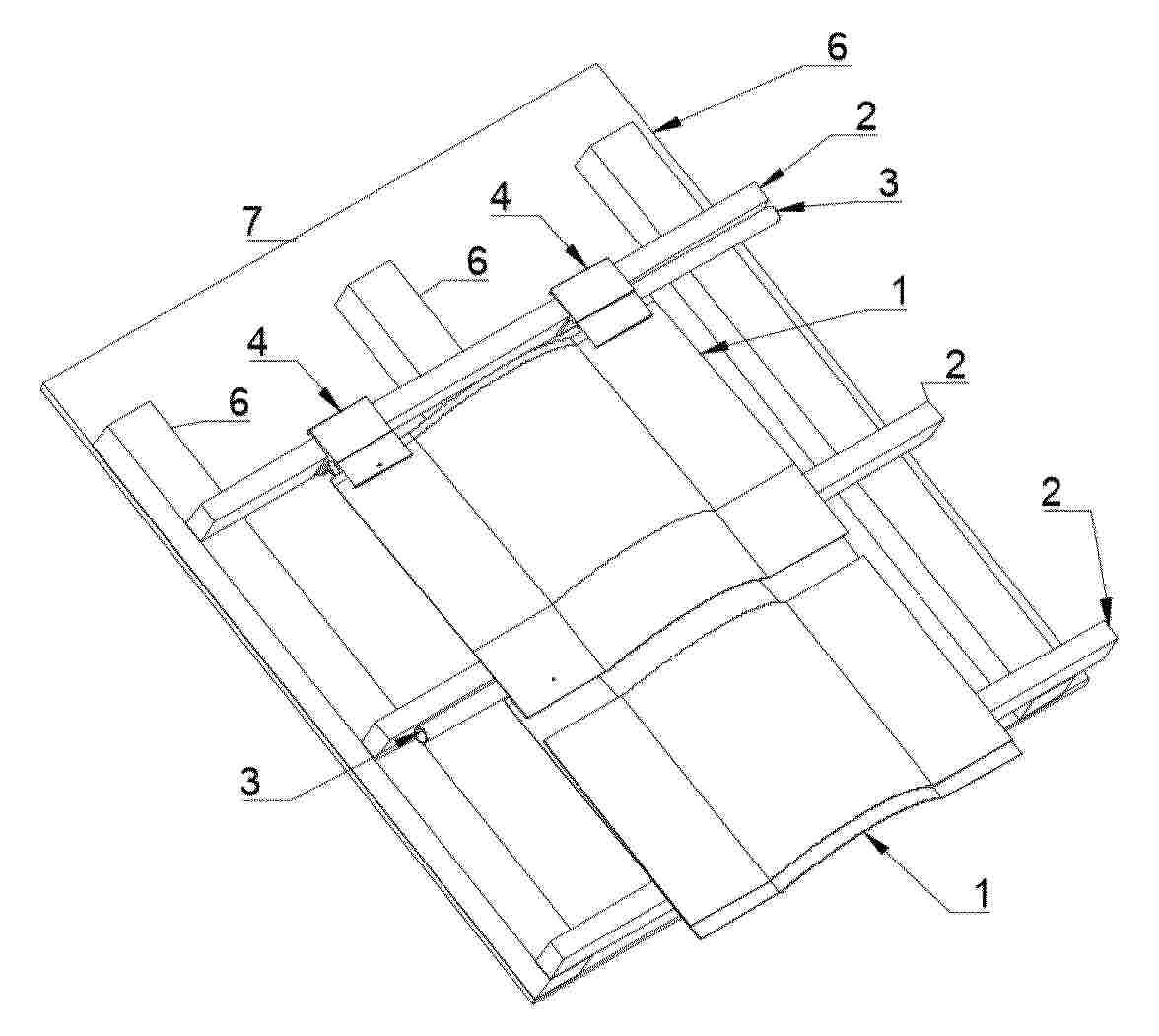
Resumen de: EP4826990A1
This innovation simplifies the Photovoltaic Thermal (PVT) Panel concept for tilted roofs by applying a clip that uses the PV carrier also as a heat collector. The clip (4) transfers collected heat into a conduit (3). The invention allows for cost effective tailoring of PVT panels to different sizes originating from roof integration needs for a single layer roof. The invention allows for thermal expansion of the panel while fixing it to the roof and facilitates quick installation of a conduit.The innovation makes a tilted PVT roof substantially more cost effective than traditional PVT panels, that typically have a separate PV carrier and heat collector in standard sizes only.
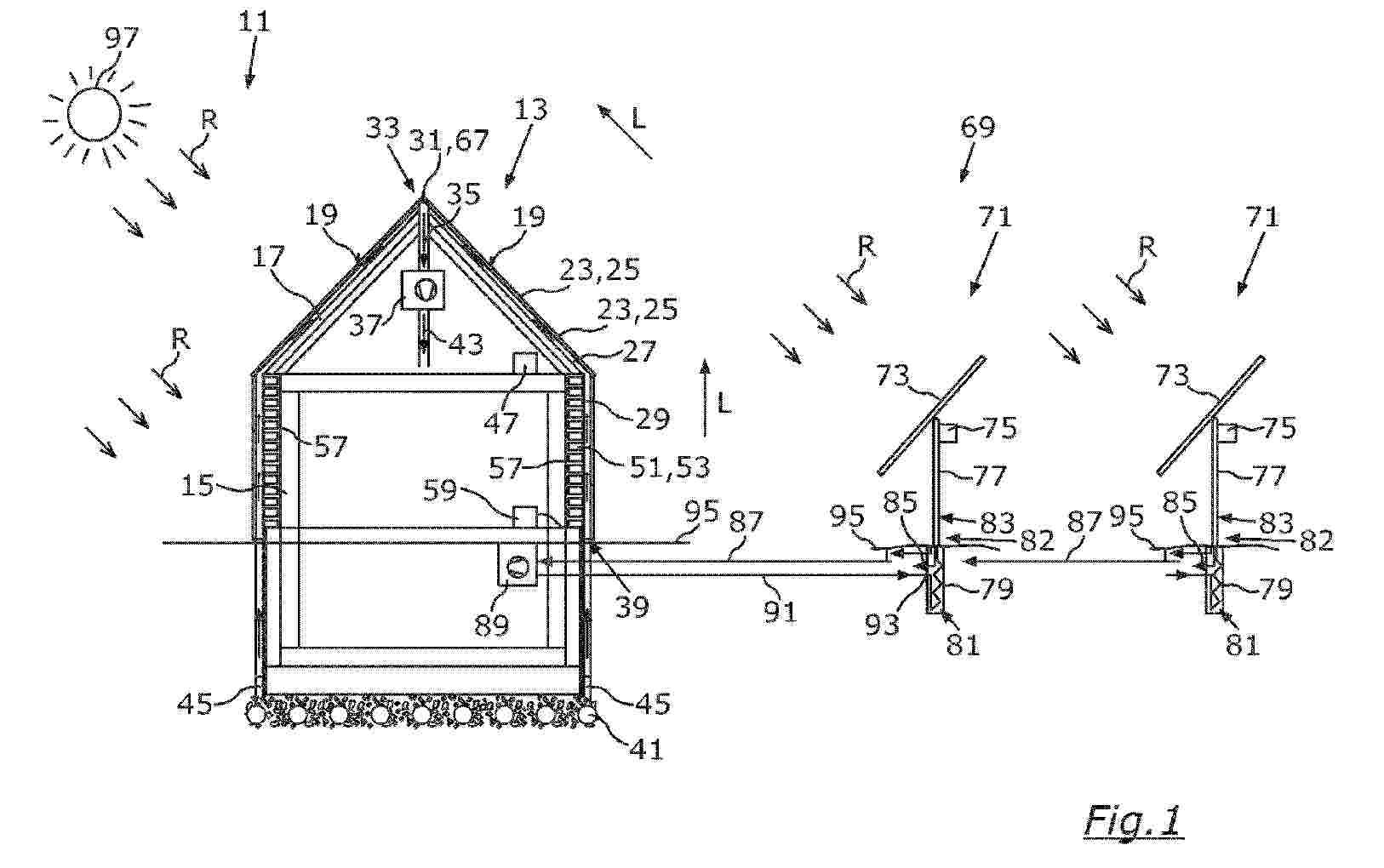
Resumen de: WO2025132166A1
A system (11) for achieving an efficient energy management in a building (13), in particular for a highly efficient use of renewable energies, comprises at least one module array (19, 20) which can be attached to the building (13) and which forms an air duct (29) on the building (13) for enclosing an air cushion (27). The system (11) achieves previously unused synergistic effects by means of an absolutely innovative use, in particular by means of a unique combination of possibly already known or existing technologies, in that energy losses occurring on the building (13) can be reduced to a minimum and used in order to increase the efficiency of devices for generating or converting renewable energies. Embodiments can have an air duct (29) enclosing the building (13) in order to use synergistic effects explained in the description in conjunction with one another. In particular, such an air duct (29) can be connected to an air-to-soil collector (41), a roof ridge draw-off point and a heat pump (37) in order to be able to improve the operating point of the heat pump (37) by supplying heated air. In addition, a systematic construction of insulating layers (for example, with reflective elements on the roof and with controllable insulating materials on the facade) in conjunction with a module array (19, 20) can provide an energy management that is as efficient as possible. Any additional energy requirement can be compensated for by a supplementary innovative system (69) comprising e
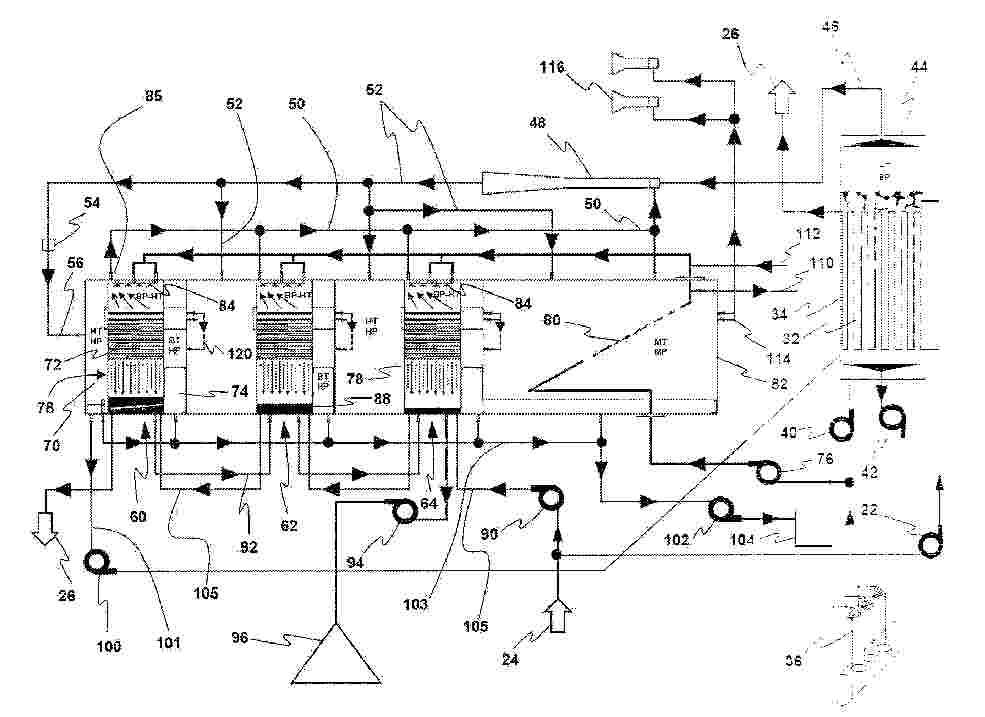
Resumen de: WO2025141256A1
The present invention relates to a plant for desalinating seawater of the type made up of a succession of cells (60, 62, 64) each provided with a tank (78), the plant comprising: a condenser (72) consisting of a bundle of tubes open at their two ends; a first pump (40) capturing the seawater by suction ducts (36) and supplying a boiler (34) capable of heating this seawater in order to generate a primary pure steam (46) sent via a circuit (44, 52, 56) to the inlet of each of the condensers (72); a second pump (76) supplying the tanks (78) of the cells (60, 62, 64) with seawater which is sprayed onto the condensers (72) via nozzles (84) arranged at the top of the tanks (78); nozzles (85) also arranged at the top of the tanks (78) to discharge the secondary pure steam (50) resulting from the contact between the sprayed seawater and the condensers (72). Such a plant is characterised in that: it further comprises a heat exchanger device (32) inside the boiler (34) allowing the latter to generate a primary pure steam (46) at a temperature of at least 300°C; in that the cells (60, 62, 64) include partitioned steam circuits which are separated from one another and do not deliver steam from one to the other; and in that it also comprises means for supplying the cells (60, 62, 64) with primary pure steam (46) and seawater, respectively.
Resumen de: CN122943409A
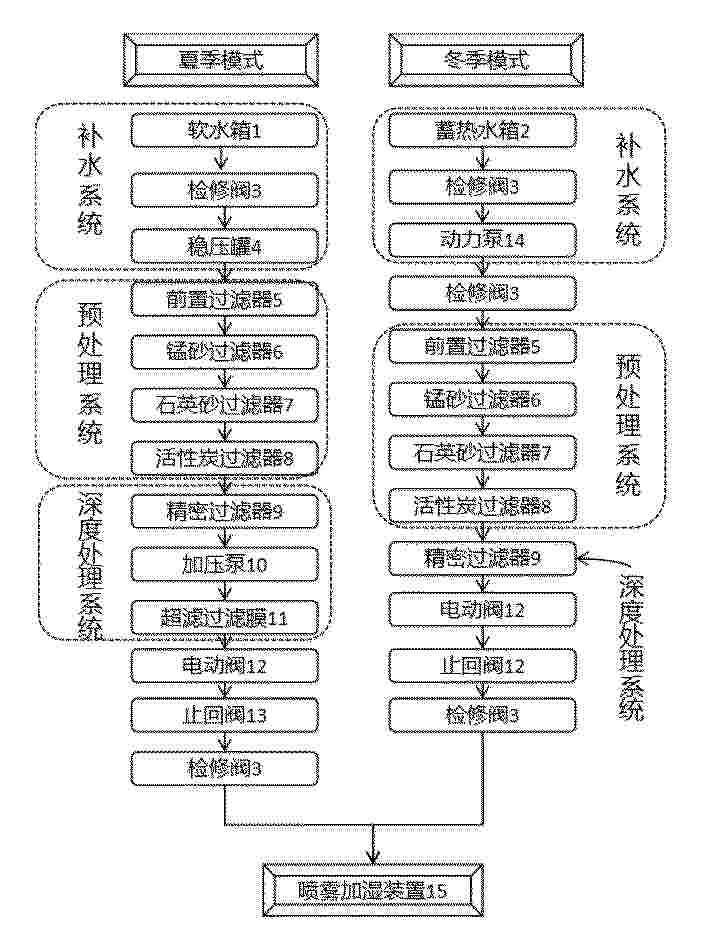
本发明公开了一种空调机组喷雾加湿系统,包含管路控制系统及并联的夏季和冬季补水支路。两支路均依次串联补水系统、预处理系统、深度处理系统、管路阀组,汇流至微雾加湿装置,管路控制系统与微雾加湿装置配合实现加湿状态自动调控。夏季补水系统含软水箱、检修阀、稳压罐;预处理系统为前置过滤器、锰砂过滤器、石英砂过滤器、活性炭过滤器;深度处理系统含精密过滤器、加压泵、超滤过滤膜;管路阀组包括电动阀、止回阀、检修阀。冬季补水系统含蓄热水箱、检修阀、动力泵;深度处理系统为精密过滤器,预处理系统、管路阀组与夏季支路相同。本系统分季节设置差异化水处理流程,多级过滤,避免喷嘴结垢堵塞,利用蓄热热水加湿降低蒸汽使用能耗。
Resumen de: CN122943494A
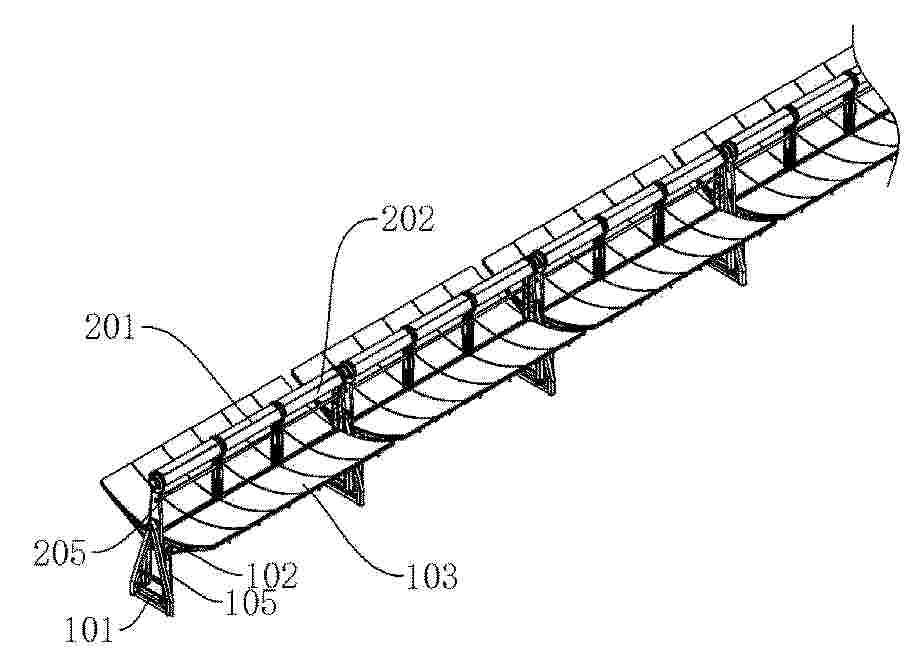
本发明涉及太阳能应用技术领域,具体涉及一种复合结构的太阳能热收集器。一种复合结构的太阳能热收集器包括集热机构和调节机构,集热机构包括热收集管和多个反射板,调节机构包括反射组件,反射组件包括调节板。反射组件具有第一位置和第二位置,反射组件处于第二位置时,调节板用于将反射板反射的太阳光二次反射至反射板上,对反射板上的冰棱和顽固积雪进行集中加热融化。本发明提供一种复合结构的太阳能热收集器,以解决现有太阳能热收集器在清雪时清雪不彻底的问题。
Resumen de: CN122937593A
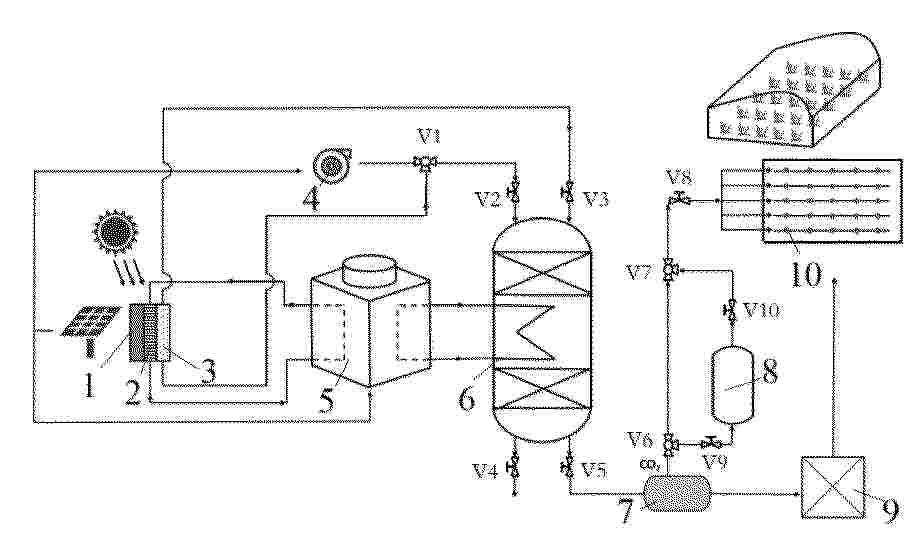
本发明公开了一种用于温室大棚的直接空气碳捕集系统及捕集方法,系统集成光伏单元、动力热源单元、CO2吸附再生单元、CO2利用单元及水资源回收单元,利用光伏太阳能板实现自供电自供热,通过风机分两路送风完成CO2吸附与热再生,回收再生冷凝水用于灌溉,增设热泵稳定热源,采用多反应器并联交替运行实现连续捕集。本发明能够实现光伏光热协同自供能、碳捕集与气肥供给一体化、水资源循环利用,降低碳捕集成本和温室大棚综合运行成本。
Resumen de: CN122943580A
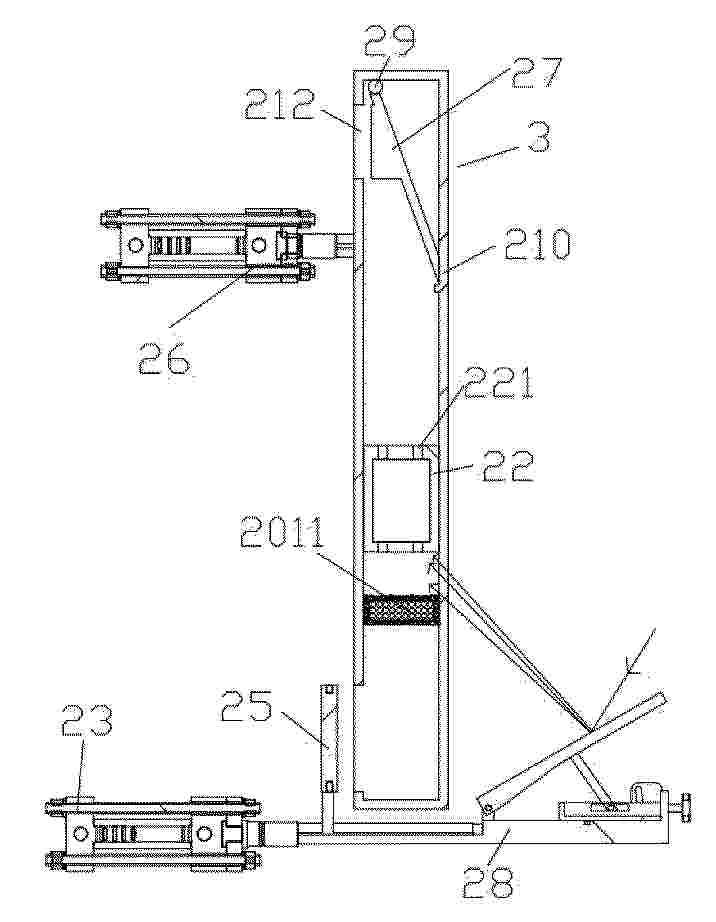
本发明涉及一种电缆分支箱内部除潮装置,包括:箱体,具有箱体出口和箱体进口,且箱体出口位于箱体进口的下侧;除潮组件,包括除潮箱、除潮件、干燥剂、第一动力件、反射器、进气盖、第二动力件、出气盖,除潮箱固定于箱体的外侧面,除潮箱具有进气口和出气口,进气口能够与箱体出口连通,出气口能够与箱体进口连通,除潮件固定设置于除潮箱内,且位于进气口和出气口之间,第一动力件的输出端与反射器和进气盖固定,反射器位于箱体外,进气盖能够与进气口连接,第二动力件的输出端与出气盖固定,出气盖能够与出气口连接;无需频繁人工维护的前提下,以较低能耗实现电缆分支箱内部长期、稳定的除潮,并确保除潮介质能够循环使用。
Resumen de: CN122942065A
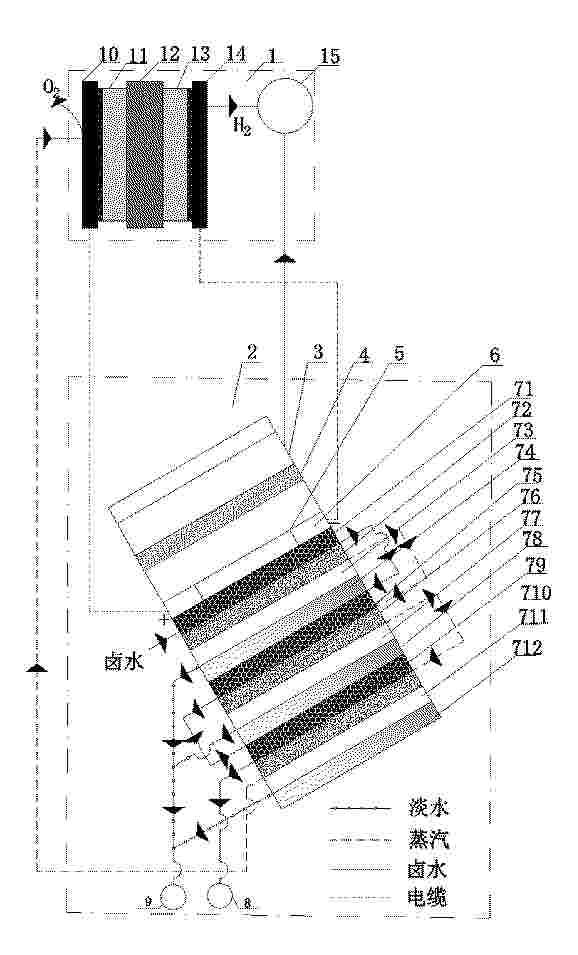
一种太阳能驱动高原盐湖卤水浓缩制氢系统及方法,属于太阳能海水淡化和太阳能制氢技术领域,本发明无需外界提供的电能、化石燃料和淡水即可实现紫外光制氢、红外光盐湖卤水蒸发浓缩和可见光光伏发电制氢,通过对太阳能全光谱的协同利用,降低了盐湖卤水提锂蒸发浓缩成本,提高了太阳能光催化制氢和光伏电解水制氢的效率,为盐湖提锂提供低成本氢能从而解决了高原盐湖提锂夜间难以连续生产的难题。利用红外光和未转化为电能的可见光能量对盐湖卤水进行多效蒸发,通过对太阳能光热的多次利用,提高了太阳能光热的利用效率和盐湖卤水蒸发浓缩的锂离子浓度,节省了盐湖卤水蒸发浓缩的能耗。
Resumen de: US20250317092A1
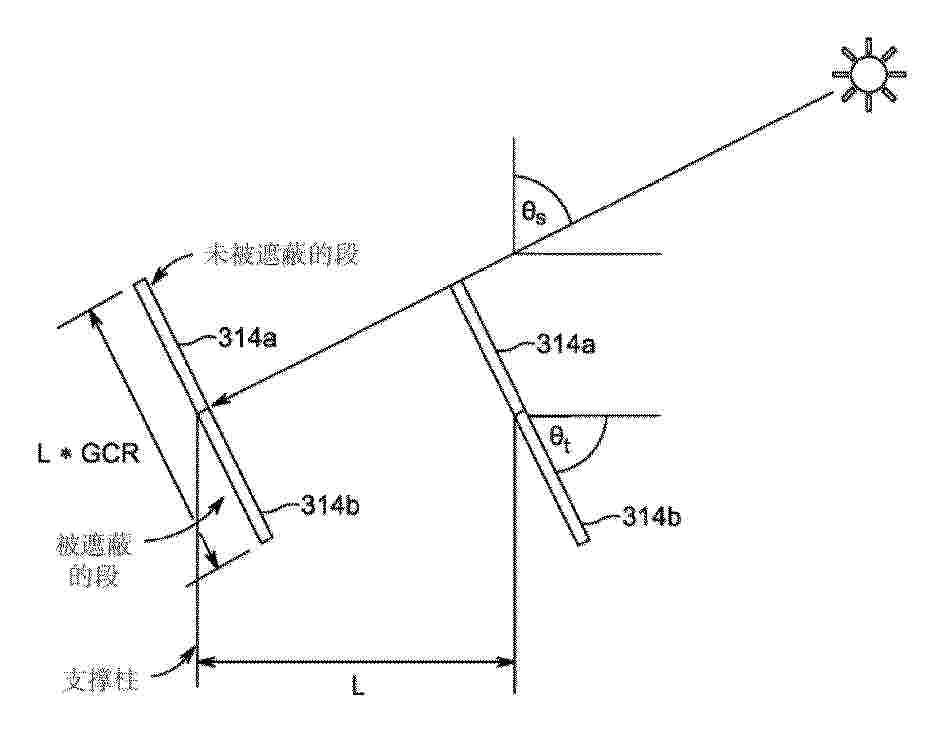
Split-cell and multi-panel photovoltaic backtracking control systems and methods allow for increased total power generation during low sun elevation conditions by shading a percentage of panel modules, thereby allowing for a lower angle of incidence on unshaded modules. The control systems and methods involve determining a sun elevation angle, a traditional backtracking angle, a split-cell or multi-panel backtracking angle, a single-cell or single-panel relative light transmission (RLT) based on the single-cell or single-panel backtracking angle, and a split-cell or multi-panel RLT based on the split-cell or multi-panel backtracking angle. If twice the single-cell or single-panel RLT is greater than the split-cell or multi-panel RLT, the split-cell or multi-panel backtracking angle is used; otherwise, the single-cell or single-panel backtracking angle is used. The control systems and methods may further involve determining a diffuse fraction index (DFI) and, if the DFI is greater than a DFI limit, using a DFI tracking angle.
Resumen de: CN122920649A
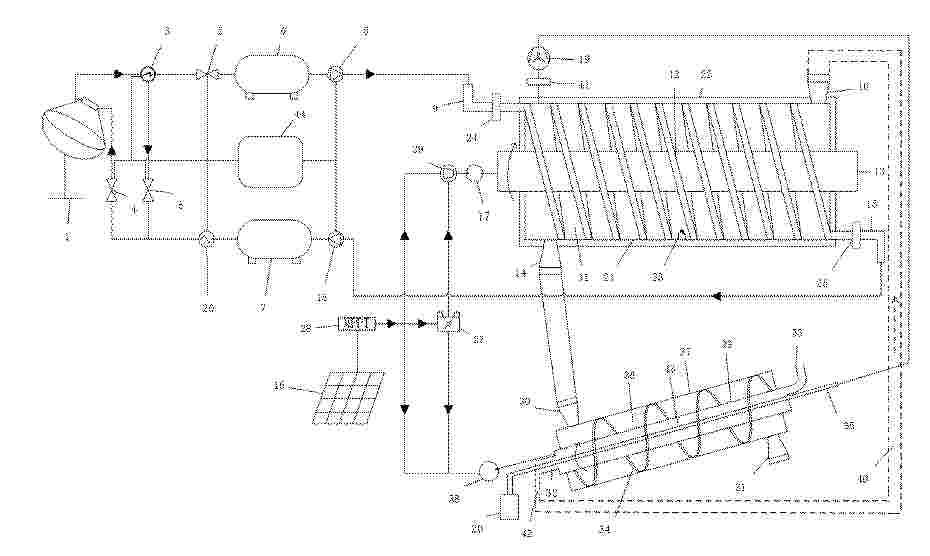
本发明涉及矿物资源综合利用以及太阳能光伏光热综合利用技术领域,公开了一种面向矿化固碳的固体矿物太阳能低能耗连续热活化装置及其运行方法,本发明装置主要包括太阳能聚光集热系统、高温热载体储热供热系统、连续热活化系统、固固气耦合热交换系统及光伏储能供电系统。各系统通过管路分别构建闭环热载体循环回路与物料循环回路,实现热量与物料的循环利用,光伏储能供电系统为设备运行提供电能。本发明结合太阳能聚光集热储热与光伏储能技术,依托多级循环结构实现固体矿物连续热活化加工,有效降低活化过程能耗,提升能源利用效率与矿物活化处理效率,适用于固体矿物规模化、低能耗资源化利用场景。
Resumen de: CN122919445A
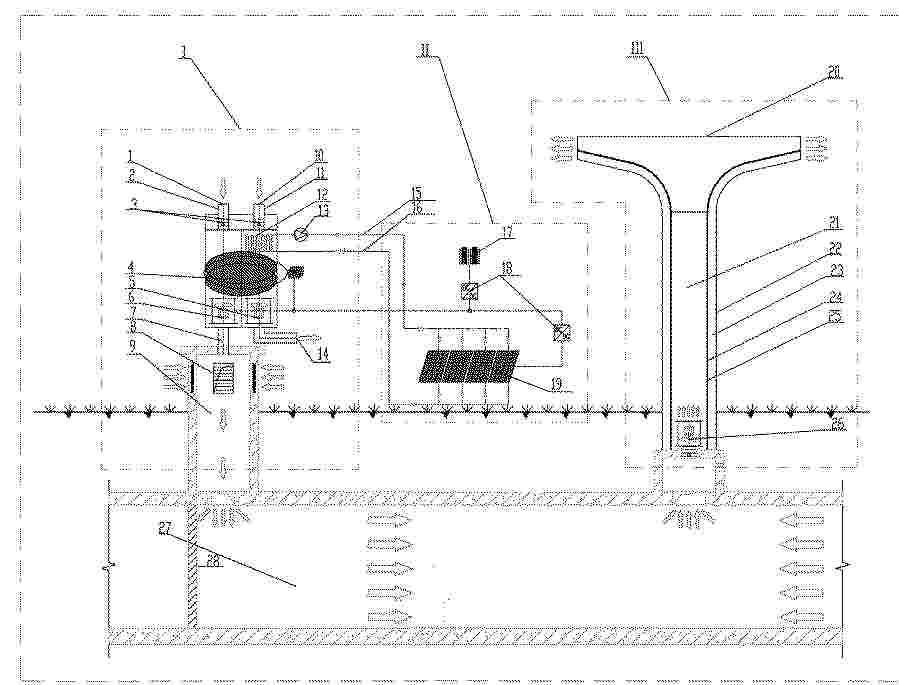
本发明公开了一种基于低温再生转轮与全向吸热烟囱的管廊除湿系统及方法,包括转轮除湿单元、供能储能单元、全向吸热型太阳能烟囱排风单元及智能热湿调控单元,转轮除湿单元设有新风除湿、再生排湿及直接自然进风三条可切换路径;供能储能单元同时输出直流电与低温热水,直流电驱动系统设备并可经储能电池调峰,低温热水通过换热器加热再生风,满足高分子转轮低温再生需求。全向吸热型太阳能烟囱利用太阳辐射形成热压排风,辅以双速轴流风机应急运行。智能调控单元根据管廊内外热湿参数及光照状态,自动切换除湿通风、自然通风、密闭防潮及应急排风模式。本发明可实现太阳能自供能运行,降低管廊结露与腐蚀风险,减少市电依赖。
Resumen de: CN122920650A
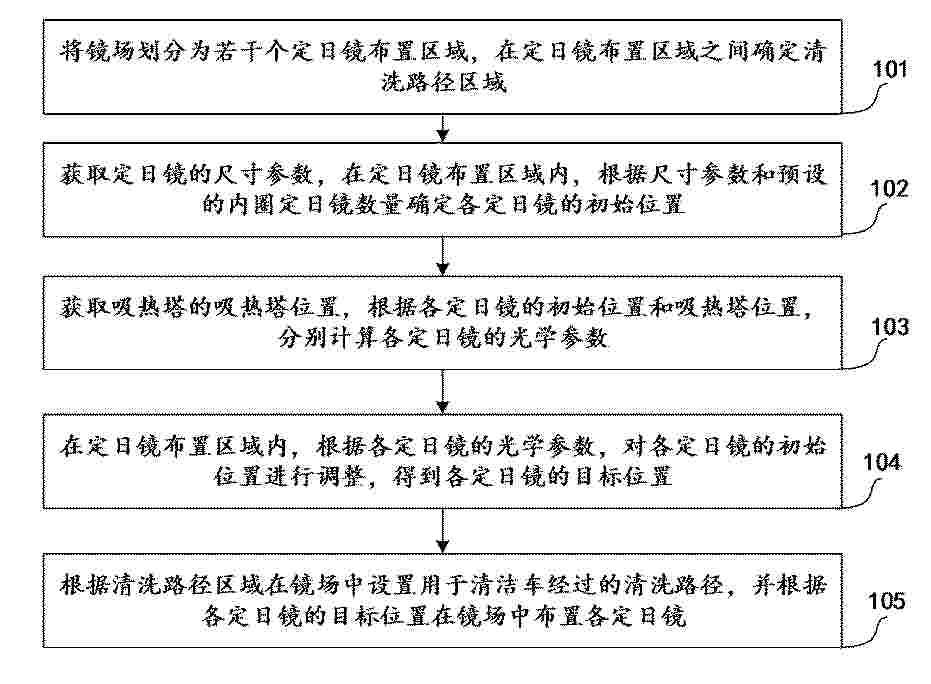
本申请公开了一种镜场布置方法、装置、电子设备和介质,该方法包括:将镜场划分为若干个定日镜布置区域,在定日镜布置区域之间确定清洗路径区域,根据定日镜的尺寸参数和预设的内圈定日镜数量确定各定日镜的初始位置,根据各定日镜的初始位置和吸热塔位置,分别计算各定日镜的光学参数,在定日镜布置区域内,根据各定日镜的光学参数,对各定日镜的初始位置进行调整,得到各定日镜的目标位置,根据清洗路径区域在镜场中设置用于清洁车经过的清洗路径,并根据各定日镜的目标位置在镜场中布置各定日镜。能满足清洗需求,保证定日镜的清洁度和反射率,还能将各定日镜布置在依据光学参数调整过的目标位置上,提高光热电站的反射热量和输出电量。
Resumen de: CN122920538A
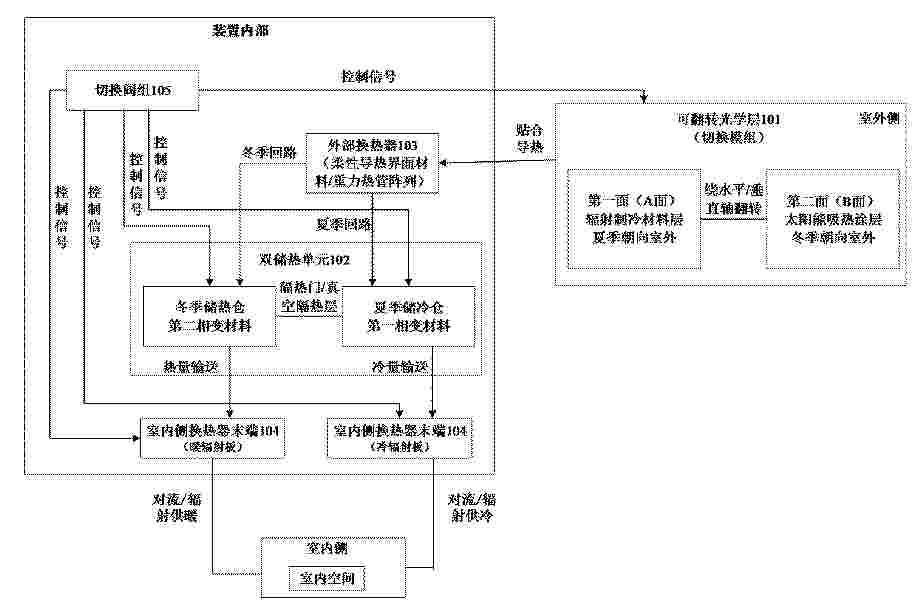
本发明涉及建筑节能与被动式建筑技术领域,公开了基于辐射制冷材料的双模式末端装置及运行方法,该装置包括:可翻转光学层,具有相对的第一面和第二面,第一面设置有辐射制冷材料层,第二面设置有太阳能吸热涂层;双储热单元包括相互隔离的夏季储冷仓和冬季储热仓,夏季储冷仓内填充有第一相变材料,冬季储热仓内填充有第二相变材料,外部换热器和室内侧换热末端分别与夏季储冷仓和冬季储热仓连通;以及切换阀组,用于选择性地将外部换热器和室内侧换热末端与夏季储冷仓或冬季储热仓连通,本发明在同一紧凑型装置内集成了可翻转光学层‑双储热单元‑室内换热末端的完整冷热联供链路,解决了辐射制冷与太阳能集热的时间错配问题。
Resumen de: FR3174204A1
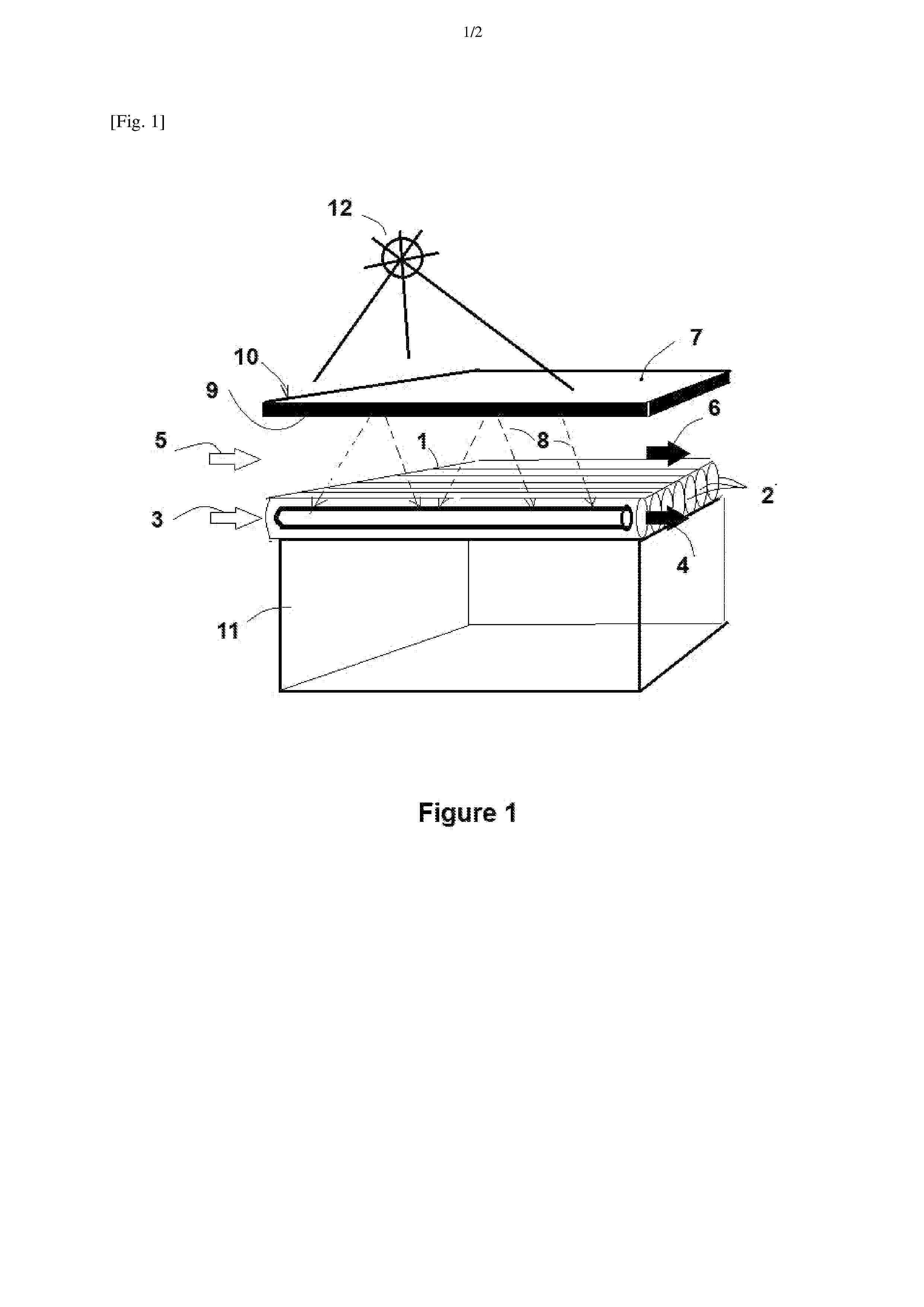
Panneau solaire isolant (1) composé d’une pluralité de tubes solaires sous vide (2) disposés parallèlement et accolés les uns aux autres de manière à former un panneau (1) globalement étanche à l’air ambiant et isolant thermiquement. Des panneaux solaires photovoltaïques (10) sont disposés au-dessus du panneau solaire isolant (1) de manière à recevoir le rayonnement solaire (12), à ombrager ledit panneau solaire isolant (1) et à laisser un espace entre les deux panneaux (1 et 10) pour permettre la circulation d’un flux d’air (5) qui s’échauffe (6) au contact de la face du dessous (9) du panneau photovoltaïque (10). Les tubes solaires (2) reçoivent par ailleurs le rayonnement infra-rouge (8) émis par la face du dessous (9) du panneau photovoltaïque (10) ce qui permet le chauffage du flux d’air (3) qui traverse lesdits tubes solaires (2). Au final le dispositif a capturé l’énergie solaire sous forme photovoltaïque (10), thermique par conduction (5,6) et thermique par irradiation (3,4) cela avec un minimum de déperdition et avec l’utilisation de surfaces très isolantes (1) qui permettent par ailleurs l’isolation thermique efficace d’espaces de stockage. Figure pour l’abrégé: Fig.2
Resumen de: US20260322315A1
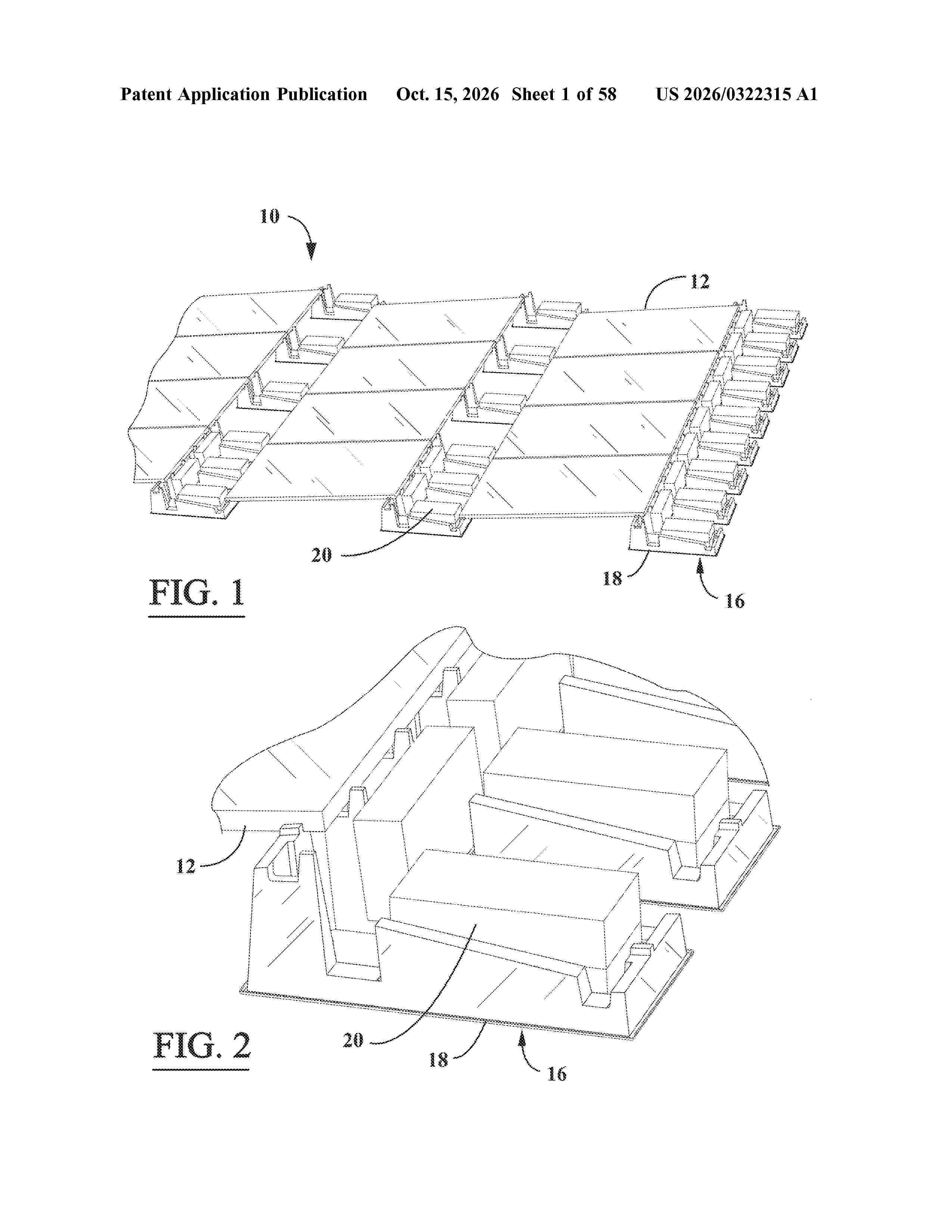
0000 A support assembly for mounting photovoltaic modules on a support surface and a mounting system including the same are disclosed herein. The support assembly may comprise a the body portion including a base portion and at least one upright support member coupled to the base portion, the at least one upright support member comprising an integrally formed ballast tray slot in one side thereof for receiving an upturned edge of a ballast tray; and at least one clamp subassembly coupled to the at least one upright support member of the body portion, the at least one clamp subassembly configured to be coupled to one or more photovoltaic modules. In addition to a plurality of support assemblies, the mounting system may further comprise at least one ballast tray support bracket, the ballast tray support bracket supporting a portion of a ballast tray on the support surface.
Resumen de: US20260316041A1
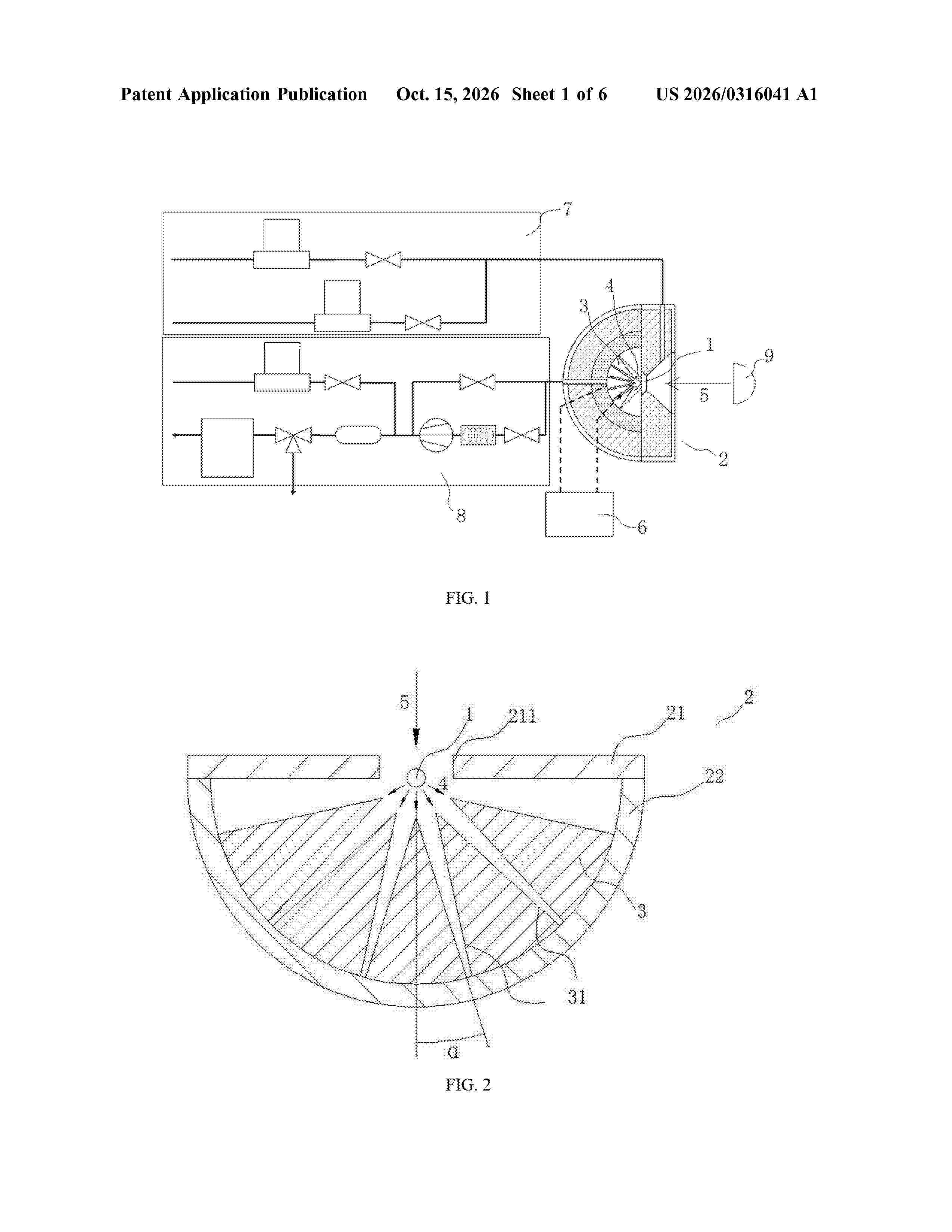
Provided is a solar reactor, including: a main body, including a light transmission port for accommodate incident light entering a reaction chamber, the incident light is formed by light converged from outside of the reaction chamber, the incident light is diverged in the reaction chamber to form divergent light diverging in the reaction chamber; and a solid component provided in the reaction chamber, where the solid component includes a protrusion portion protruding toward a middle of the reaction chamber, at least part of a light facing surface of the protrusion portion facing the divergent light forms a non 90° angle with a projection direction of the divergent light, so that the divergent light extends along a thickness direction of the solid component. The solid component is made of a material used as oxygen carrier or catalyst in chemical reactions using solar energy as a heat source.
Resumen de: US20260322313A1
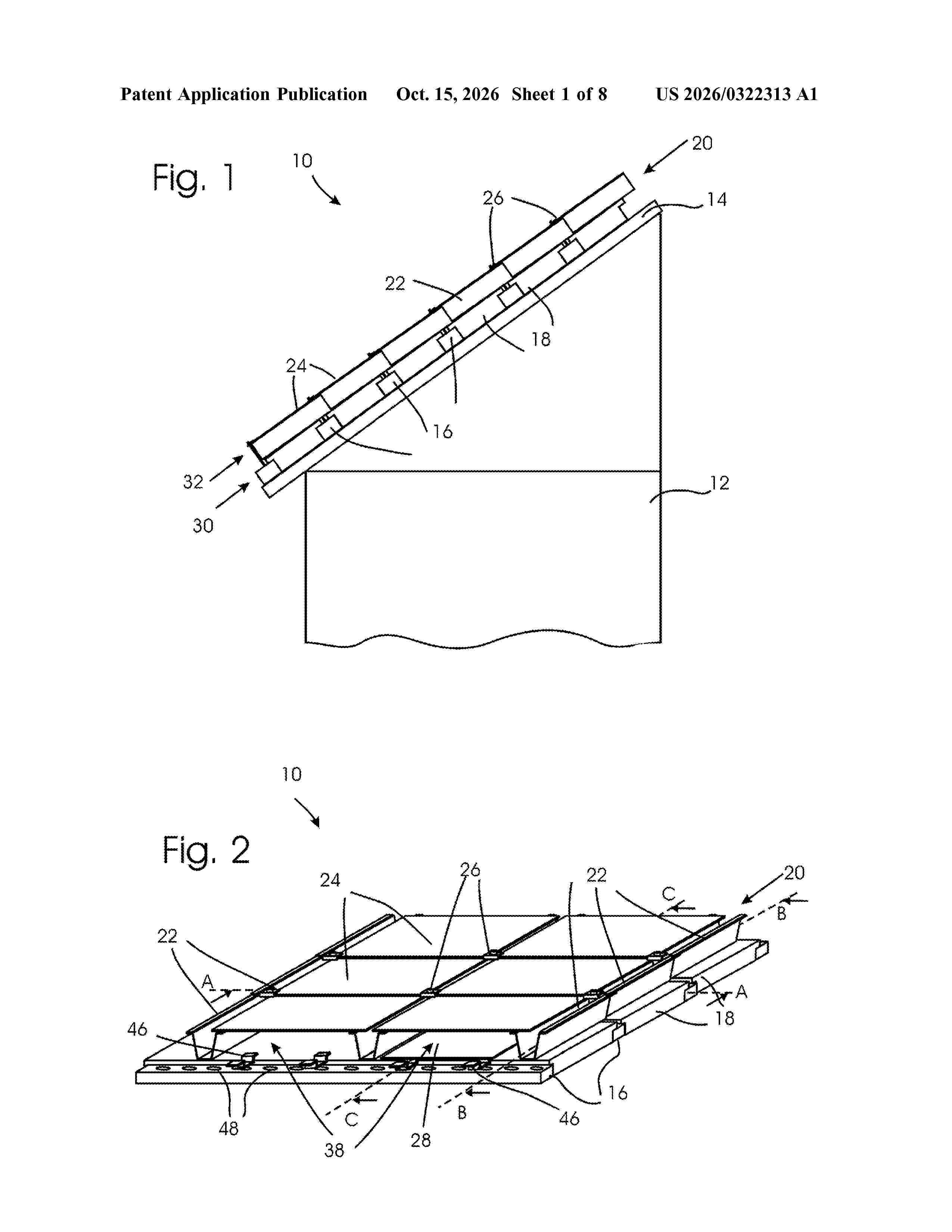
The invention relates to a roof structure 10 and a method of manufacturing the same. The roof structure 10 comprises a plurality of parallel supporting gutters 20, each formed from aligned supporting gutter sections 22, wherein ends of the supporting gutter sections 22 are arranged to overlap each other. Panel elements 24, 124 are each arranged between two supporting gutters 20 and rest on support areas 34 of the supporting gutter sections 22. The panel elements 24, 124 are arranged to overlap in the longitudinal direction of the supporting gutters 20. The panel elements 24 are transparent covers and photovoltaic modules 28 are arranged below the panel elements 24 and/or the panel elements 124 are photovoltaic modules.
Resumen de: WO2025120642A1
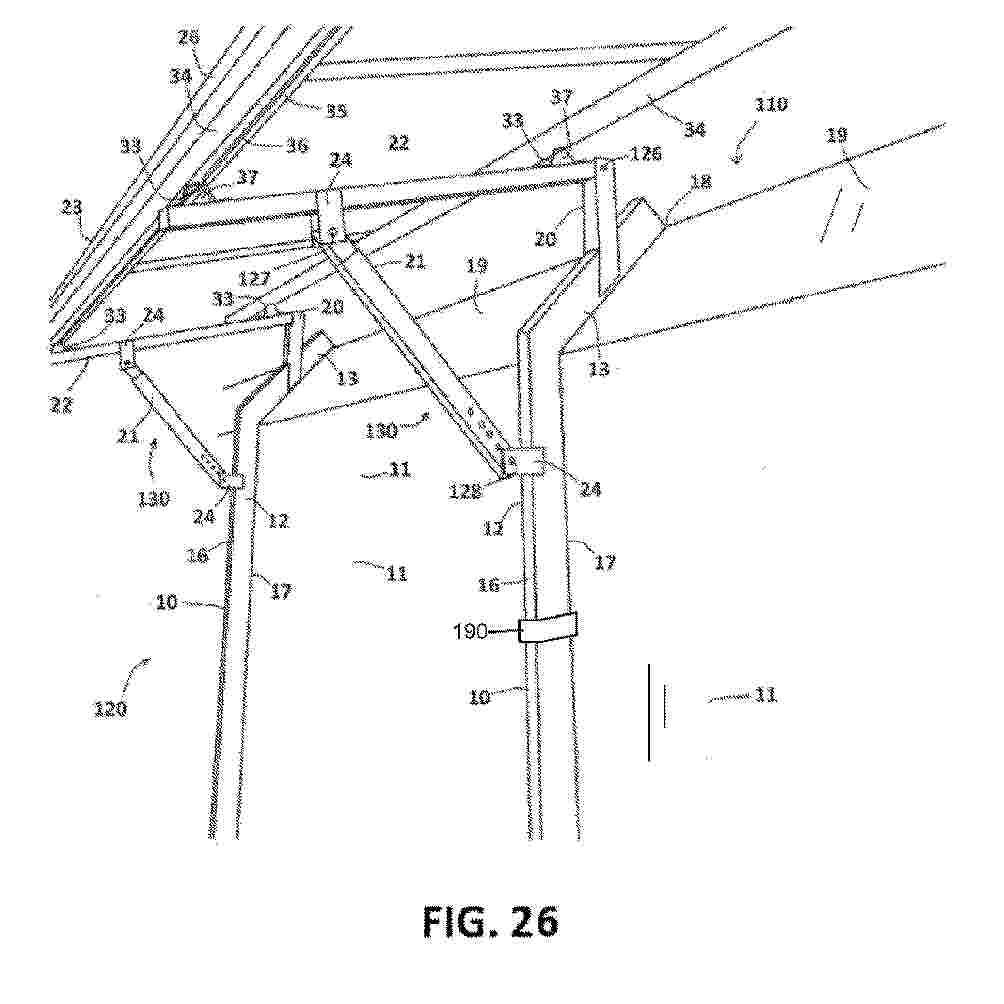
A solar panel support system for use with a security fence including fence posts, each fence post including a vertical fence post portion and an upper fence post portion extending at an oblique angle relative to the vertical fence post portion, the solar panel support system comprising at least two solar panel support arrangements configured to support at least one solar panel, each solar panel support arrangement being configured for attachment to a corresponding fence post in spaced relation relative to one another along the security fence, wherein each solar panel support arrangement comprises a first support member configured to be attached to the upper fence post portion of the corresponding fence post, and a second support member configured to be attached to the vertical fence post portion of the corresponding fence post.
Resumen de: CN122899313A
本发明提供一种乡村建筑光伏屋面安装方法,包括以下步骤,判断屋顶破败程度,区分平坡屋顶;当乡村中的屋顶能够正常使用时,包括以下步骤,在水泥屋面/空余立面上开膨胀螺栓孔,孔深根据屋面厚度而定;向膨胀栓孔内注入密封胶;放入膨胀螺栓,将弯钩固定在水泥屋面上;弯钩与屋面结合面涂上密封胶;弯钩周围用水泥填充并做好防水处理,将瓦片复原;根据瓦片类型选择相应的挂钩,用螺栓将挂钩固定在屋顶/空余立面上。并利用屋顶天窗或通过反宇向阳的方式,直射太阳光进入屋内或当冬季太阳高度角底,可以将光照反射入屋内。本方案通过修缮破败的屋面,嵌光伏瓦的方式,美化屋面,增加采光同时提供太阳能,扩大光伏板的面积,拓展太阳能利用角度,改善村容村貌,美化村庄第五立面,多余电量并入电网,为农村居民创收额外收入,并解决保温隔热的同时使屋面更美观。
Resumen de: CN122908701A
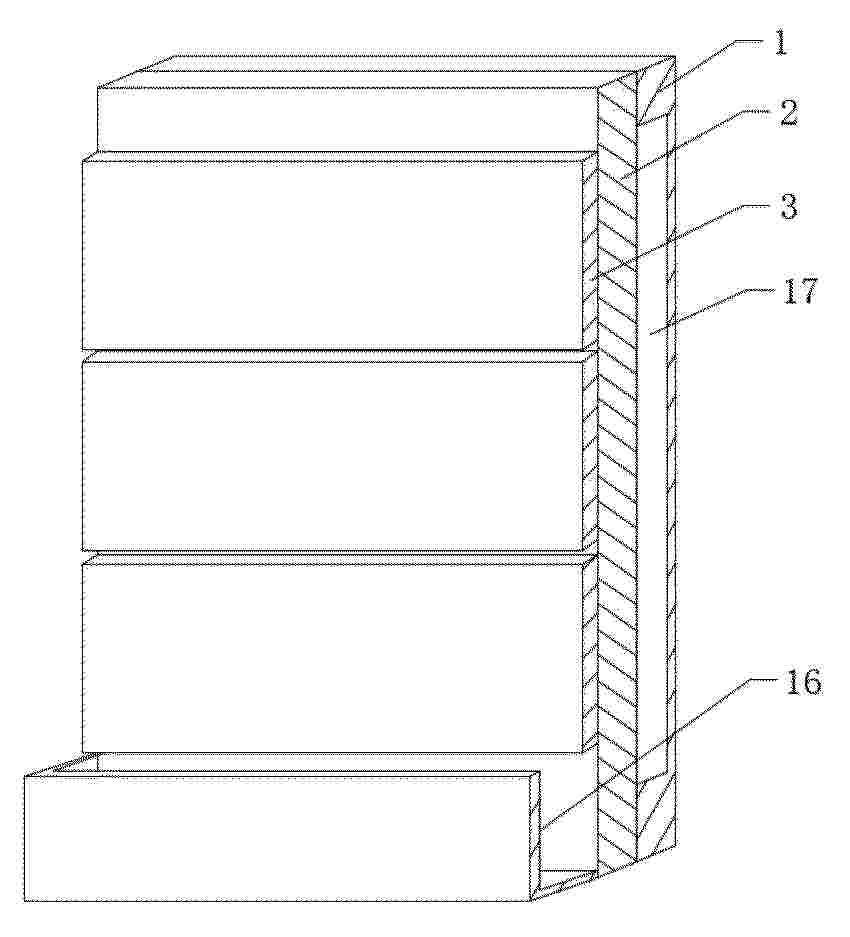
本发明公开了涉及外墙构件领域的太阳能集热型外墙构件,包括用于隔绝热量的隔热层,隔热层内开有用于收集热量的集热槽,集热槽一侧设有用于向室内输送热量的输送组件,隔热层远离输送组件一侧固定连接有用于吸收和释放热量的相变层,相变层远离隔热层一侧滑动配合有若干用于吸收太阳能的太阳能板,相变层上设有用于调节太阳能板角度的调节组件,室外设有图像采集组件。本发明结构完善,功能全面,能够有效提高太阳能的利用率,提高室内保温效果。
Resumen de: CN122900183A
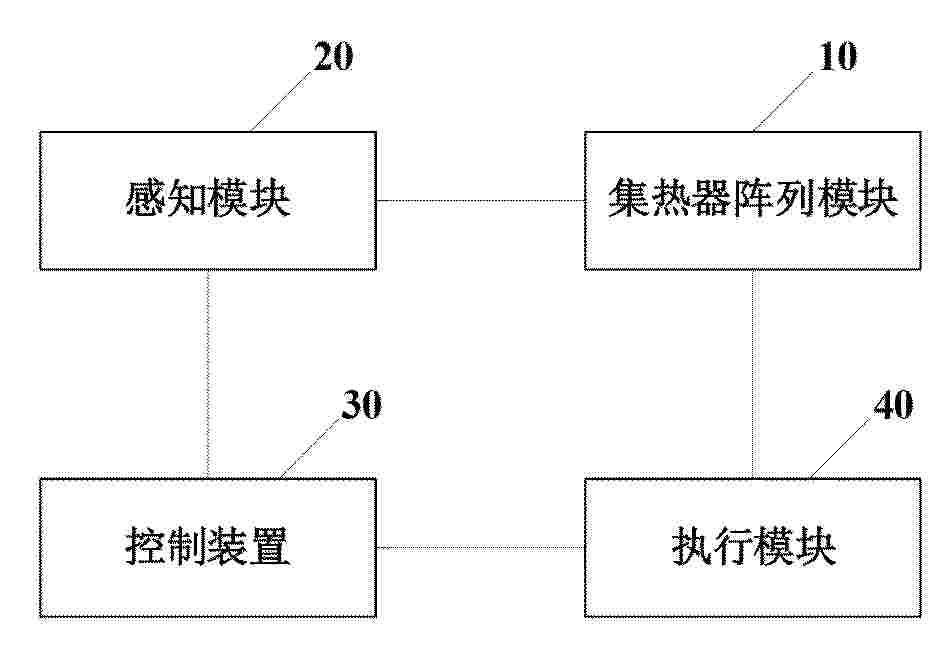
本公开提供了一种光伏光热系统、控制方法、装置、存储介质和程序产品。光伏光热系统包括:集热器阵列模块,包括多个集热器;感知模块,用于采集周围环境的当前辐照度;控制装置,用于基于当前辐照度和映射表确定当前辐照度所对应的当前档位,并基于当前档位输出控制指令;和执行模块,包括动态切换阀组,动态切换阀组用于响应于控制指令,执行动态切换阀组中的每个阀门的操作,以使得该多个集热器按照与当前档位相对应的组合方式进行串并联组合,其中,每个阀门的操作包括打开或关闭。这提高了系统在小流量工况下的控制精度和稳定性。这样使得光伏光热系统可以作为节能产品,起到高效节能的效果。
Resumen de: CN122880699A
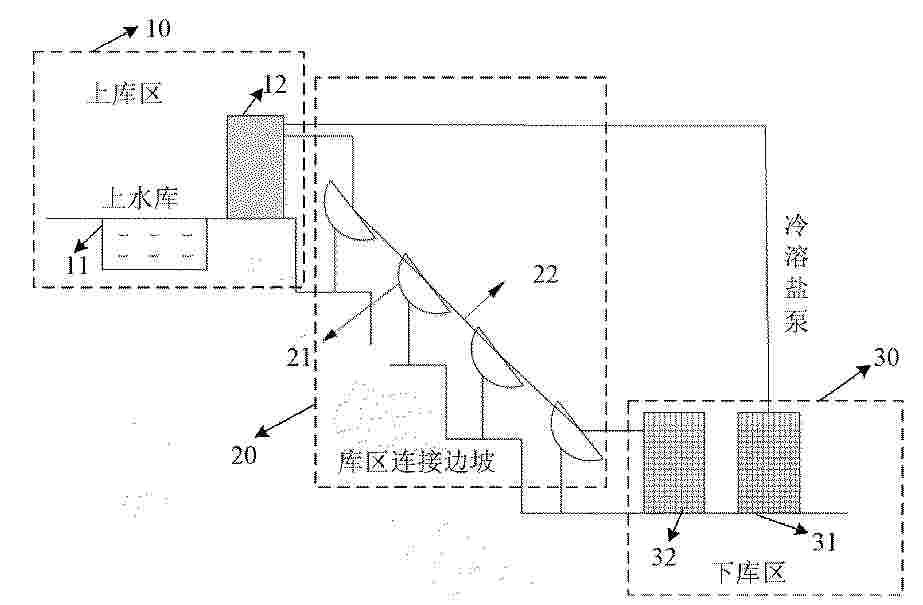
本申请公开了一种光热与抽水蓄能耦合的发电系统及控制方法,涉及发电技术领域,该系统包括:上库区、库区连接边坡、下库区和控制系统;库区连接边坡的坡面上设置有聚光集热系统;下库区布设有储能发电设备;控制系统用于:获取光热发电的实际输出功率和电网计划出力值,并计算富余功率值;当富余功率值为正值且大于预设阈值、电网无冗余消纳通道时,生成耦合运行指令,并控制储能发电设备执行闭环功率分配操作,以使富余电力就地消纳;当实际输出功率偏离电网计划出力值时,基于实际输出功率与电网计划出力值的偏差,控制储能发电设备执行平抑波动与模式切换操作。本申请提升了能量利用效率,满足新能源并网场景电力平稳调控的需求。
Resumen de: CN122890972A
本申请公开了一种月基光伏‑光热耦合储热的可逆SOC双模闭环系统,通过同一可逆固体氧化物电池在月昼与月夜期间分别运行不同的工作模式。其中,月昼期间运行第一工作模式,可选择纯水电解或水‑CO2共电解,制取H2和O2,或H2、CO和O2,月夜期间运行第二工作模式,利用储存的燃料气与助燃气发电供给生活区,实现昼夜连续供能,产物H2O或CO2经冷凝分离后回收,用于月昼电解原料供给。系统将能源与生命保障深度耦合,统一整合原位取水、产物水回收以及生活区CO2捕集,实现水与CO2的循环利用,并协同满足O2供应与燃料制备需求,从而达成水、O2、CO2等生保资源的闭环循环。
Nº publicación: CN122881118A 09/10/2026
Solicitante:
临沂蓝天热力有限公司
Resumen de: CN122881118A
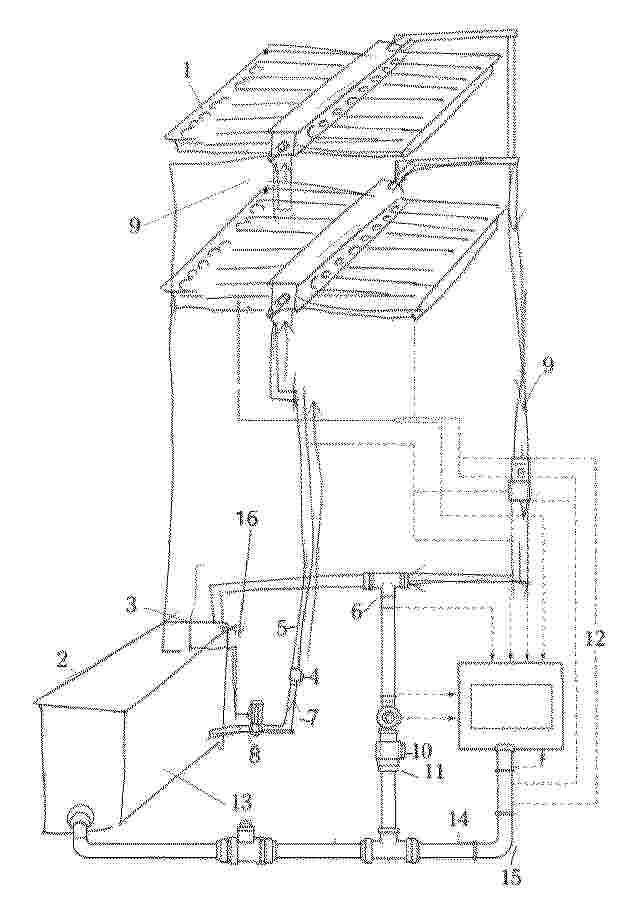
本发明公开了一种三重联锁防逆向换热站太阳能补水预热系统及方法,系统包括架设于换热站顶部的太阳能集热模组、补水稳压水箱、进水循环管路与回水循环管路、进水电动电磁阀、出水电动电磁阀、循环增压泵、水箱温度传感器、集热腔温度传感器、光照传感器及PLC控制主机;太阳能集热模组通过循环管路连通补水稳压水箱,各执行元件与传感部件均电性连接PLC控制主机。本发明搭建了闭式太阳能预热循环水路与多参数统一电控架构,有效解决了传统预热设备缺少多维度协同监测部件、无集中控制中枢、集热水路集成度低的技术缺陷,可实现换热站补水自动化预热,节能性与运行稳定性显著提升。
 BOPI
BOPI
 Sede Electrónica