Si deseas distinguir tus productos, servicios o ambos de los de otra empresa, es posible que necesites una marca o nombre comercial. Descubre qué son, en qué consiste su procedimiento de registro y qué implica.

Información sobre los plazos de presentación de solicitudes de transformación de marcas de la Unión Europea en marca nacional española. Más información


Si tienes un nuevo dispositivo, producto o procedimiento que resuelva un problema técnico o tenga una ventaja práctica, existen distintas formas de protegerlo en España y en otros países. Descubre cómo hacerlo.

¿Tu innovación reside en la estética, la ornamentación o la apariencia de tu producto? Protégela mediante un diseño industrial. Descubre qué derechos confiere el registro y cómo realizar la tramitación.

Las indicaciones geográficas protegen el nombre de un producto originario de una zona geográfica, a la cual le debe una determinada calidad, reputación u otra característica. Descubre qué son, en qué consiste su procedimiento de registro y qué beneficios conceden.

Las patentes publicadas en todo el mundo son una valiosa fuente de información científica, técnica y comercial.

Si eres emprendedor/a o una empresa y quieres potenciar y mejorar la rentabilidad de tu negocio protegiendo de forma adecuada los activos intangibles de tu organización, en este espacio encontrarás lo necesario.


 32
resultados
 Última actualización
07/11/2026 [06:52:00]


 Resultados 25 a 32 de 32
Resumen de: EP3170872A1
The current invention presents the development of innovative nanocomposite fouling release paints resulting from the mixing of one type epoxy resin and one type suitably modified hardener. These modified hardeners comprise hydrophobic nanoparticles based on functionalized dendritic polymers with symmetrical or asymmetrical architecture or based on functionalized inorganic nanoparticles (metal or metal oxide nanoparticles or mixed metal oxide nanoparticles). Both the polymeric nahoparticles and the inorganic nanoparticles are functionalized with appropriate lipophilic groups. These nanocomposite paints presented in the current invention, exhibit micro slime layer control properties and can be effectively applied to objects submerged in sea water as fouling release coatings.

Resumen de: DE202026000667U1
Tragbares Duftmodul, umfassend eine Trägermatrix aus porösem, flexiblem oder elastischem Material, in welcher eine Vielzahl von Mikro- oder Makrokapseln mit Duftstoff eingebettet ist, dadurch gekennzeichnet, dass die Kapseln durch wiederholte mechanische Einwirkung, insbesondere durch Druck, Reibung und/oder durch Wärmeeinwirkung, zumindest teilweise aktiviert werden, wobei bei jeder Aktivierung eine kontrollierte Teilmenge des Duftstoffes freigesetzt wird, sodass das Duftmodul mehrfach aktivierbar ist.
Resumen de: US2021147694A1
0001 According to an example aspect of the present invention, there is provided a non-toxic bio-based fire-retardant composition and fire-protective coating comprising high consistency nanofibrillated cellulose together with mineral component(s).
Resumen de: EP4779006A1
0001 A fragrance delivery particle for a textile product is provided. 0002 A fragrance delivery particle containing (A) a water-soluble solid hereinafter component (A) and (B) a fragrance hereinafter component (B), wherein component (B) includes (B1) a microencapsulated fragrance hereinafter component (B1) and (B2) a non-microencapsulated fragrance hereinafter component (B2), and a moisture content of the fragrance delivery particle according to the Karl Fischer gas-phase method (JIS K 0113) is 1 mass% or more and 35 mass% or less.
Resumen de: WO2019003095A1
A process for the production of a multiple-walled carbon nanotube (MWCNTs) suspension in a polymeric matrix is described, the suspension being obtained by the process, and different uses of the suspension, including use for impregnation of fabrics and pre-preg products and for formation of electrically conductive coatings or coatings which have vibration damping properties of mechanical parts to which they are applied.
Resumen de: US20260201181A1
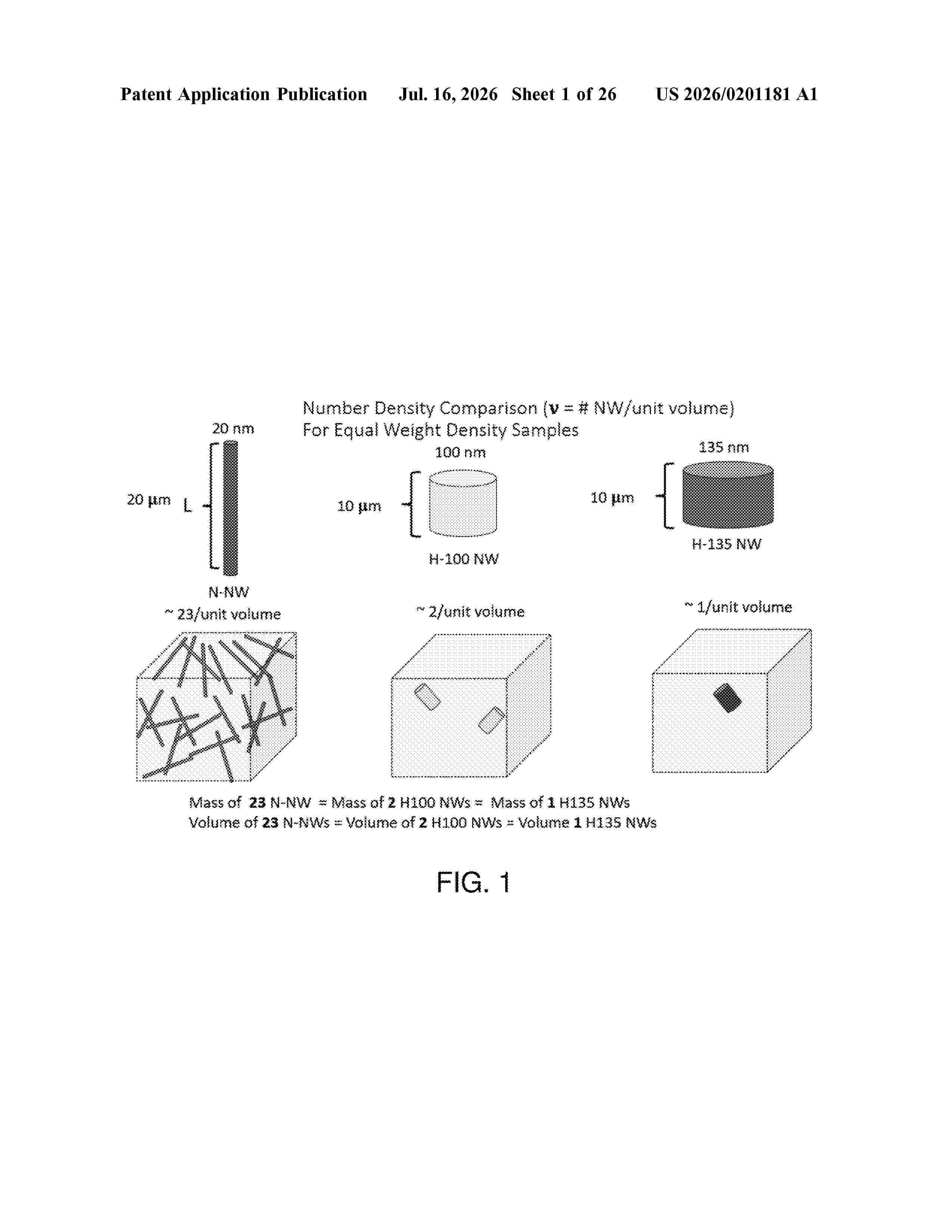
0000 Concentrated dispersions of silver nanowires are used to prepare qualitatively distinct silver structures with a range of properties. The concentrated dispersions can have a high weight percent of silver nanowires and can be formulated to be flowable liquids or non-flowing pastes. The concentrated dispersions can be stable with no visible settling over the course of a week, can have non-Newtonian rheology, and can be diluted to a desired weight percent of silver nanowires without detrimental effects on the uniformity of the dispersions. The concentrated dispersions can be formulated with or without polymers or pre-polymer components. The concentrated dispersions can be formulated with silver salts to adjust dispersion of the silver nanowires and to improve electrical conductivity of cured silver structures formed from the dispersions. Methods for forming the concentrated dispersions are described as are methods to form silver structures from the dispersions.
Nº publicación: US20260201175A1 16/07/2026
Solicitante:
KUPRION INC [US]
Kuprion, Inc.
Resumen de: US20260201175A1
0000 Metal nanoparticle agglomerates may render the surface of an article biocidal toward microorganisms. Articles having a biocidal surface may comprise a coating comprising metal nanoparticle agglomerates adhered via an adhesive to at least a portion of a surface of the article. A coating formulation comprising metal nanoparticle agglomerates may be applied to the surface of an article to accomplish the foregoing.
 BOPI
 Sede Electrónica