Si deseas distinguir tus productos, servicios o ambos de los de otra empresa, es posible que necesites una marca o nombre comercial. Descubre qué son, en qué consiste su procedimiento de registro y qué implica.

Información sobre los plazos de presentación de solicitudes de transformación de marcas de la Unión Europea en marca nacional española. Más información


Si tienes un nuevo dispositivo, producto o procedimiento que resuelva un problema técnico o tenga una ventaja práctica, existen distintas formas de protegerlo en España y en otros países. Descubre cómo hacerlo.

¿Tu innovación reside en la estética, la ornamentación o la apariencia de tu producto? Protégela mediante un diseño industrial. Descubre qué derechos confiere el registro y cómo realizar la tramitación.

Las indicaciones geográficas protegen el nombre de un producto originario de una zona geográfica, a la cual le debe una determinada calidad, reputación u otra característica. Descubre qué son, en qué consiste su procedimiento de registro y qué beneficios conceden.

Las patentes publicadas en todo el mundo son una valiosa fuente de información científica, técnica y comercial.

Si eres emprendedor/a o una empresa y quieres potenciar y mejorar la rentabilidad de tu negocio protegiendo de forma adecuada los activos intangibles de tu organización, en este espacio encontrarás lo necesario.


 292
resultados
292
resultados
 Última actualización
24/10/2026 [09:06:00]
Última actualización
24/10/2026 [09:06:00]


 Resultados 75 a 100 de 292

Resumen de: US20260270053A1
A communication system according to one aspect of the present disclosure includes a plurality of communication devices, wherein the communication device includes: a key generation unit configured to generate a shared key for performing encrypted communication with another communication device and second identification information for identifying the shared key, by using one or more keys shared with the another communication device by one or more key sharing methods and first identification information for identifying each of the one or more keys; a verification unit configured to verify whether or not a shared key identified by the second identification information is same as a shared key of the another communication device; and an encrypted communication unit configured to perform encrypted communication with the another communication device by using the shared key when it is verified that the shared key identified by the second identification information is the same as the shared key of the another communication device.

Resumen de: US20260270088A1
Various embodiments of the teachings herein include a verification unit. An example includes: a capture unit to capture an authentication and key agreement protocol sequence; a generation unit to derive data associated with the sequence from the sequence by including a notarization guideline; and an authentication unit to protect the integrity of the data by forming integrity-protected data. The authentication unit comprises a signature unit to deliver the integrity-protected data in signed form using: a post-quantum secure signature method or a post-quantum secure key encapsulation mechanism or a classical cryptographic digital signature method. The system includes a delivery unit to deliver the integrity-protected data.
Resumen de: NL2036178B1
0001 ABSTRACT A photonic integrated system (100) for generating random numbers, comprising a non- coherent light source (112) and a light scattering medium (116) configured to receive light from the non-coherent light source (112) and output scattered light to be processed together with non-scattered light from the light source (1 12) to produce light signals for generating the random numbers. The light scattering medium is configured to scatter light received from a first light splitter to obtain scattered light and to output the scattered light to a second light splitter. +Fig. 1
Resumen de: US20250148071A1
0000 A system performs a set of cryptographic operations at least by utilizing an API to cause execution of a set of one or more secure element (SE) applications within the SE platform runtime environment of a first computing entity. The set of cryptographic operations include generating a first shared secret, generating a ciphertext at least by encapsulating the first shared secret with a first public key associated with a second computing entity in accordance with an encapsulation algorithm, and transmitting the ciphertext from the first computing entity to the second computing entity. The second computing entity derives the first shared secret by decapsulating the ciphertext with a private key corresponding to the first public key. The first computing entity and the second computing entity then exchange at least one encrypted message, encrypted with an encryption key that includes, or is based at least in part on, the first shared secret.
Resumen de: EP4804456A1
0001 A quantum key distribution (QKD) receiving device includes N input ports connected to N transmission lines, respectively, the N transmission lines being relevant to a specific QKD link and respectively transmitting N divided optical signals obtained by division of an optical signal in a QKD transmission device and being connected to the QKD transmission device, a QKD receiving unit that performs at least quantum key distillation processing, a switch that switches a connection line connected to the QKD receiving unit via one of the input ports, among the N transmission lines, and a control unit that selects a switching destination line of the connection line from at least one transmission line excluding a first transmission line among the N transmission lines in a case where the first transmission line among the N transmission lines is the connection line and a communication failure of the first transmission line has occurred.
Resumen de: CN122250032A
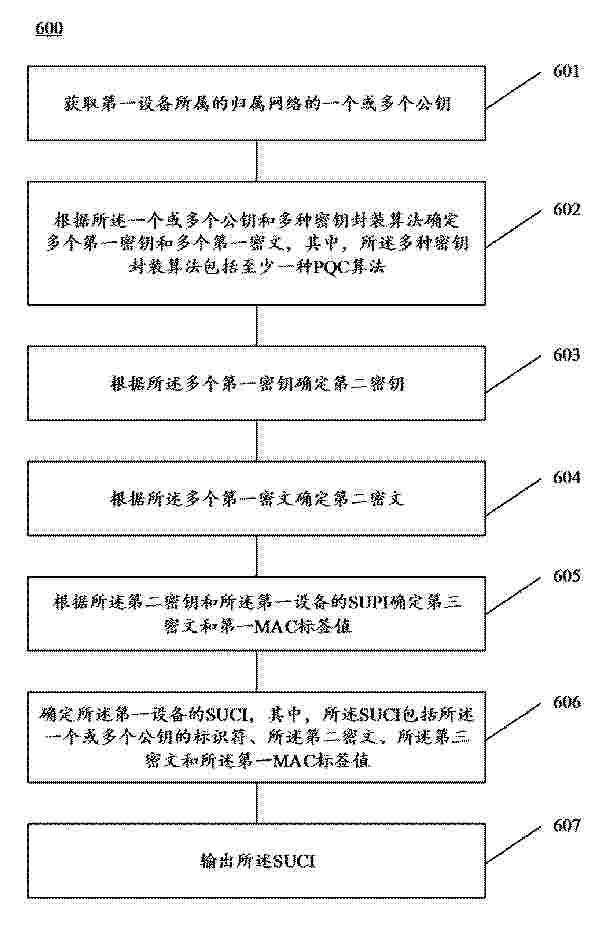
The embodiment of the invention provides a method and a device for performing communication by adopting post quantum cryptography. In the present application, key materials such as a temporary shared key can be derived from a plurality of keys/mixed keys by using a variety of post-quantum security algorithms. As long as one of a plurality of different post-quantum security algorithms is secure, the combination of the algorithms can be secure. Thus, the method and apparatus facilitate providing privacy protection in a post-quantum environment. Further, the plurality of post-quantum security algorithms include at least one quantum security algorithm, such that the method and apparatus can protect SUPI encapsulation and de-encapsulation from quantum attacks.
Resumen de: EP4568170A1
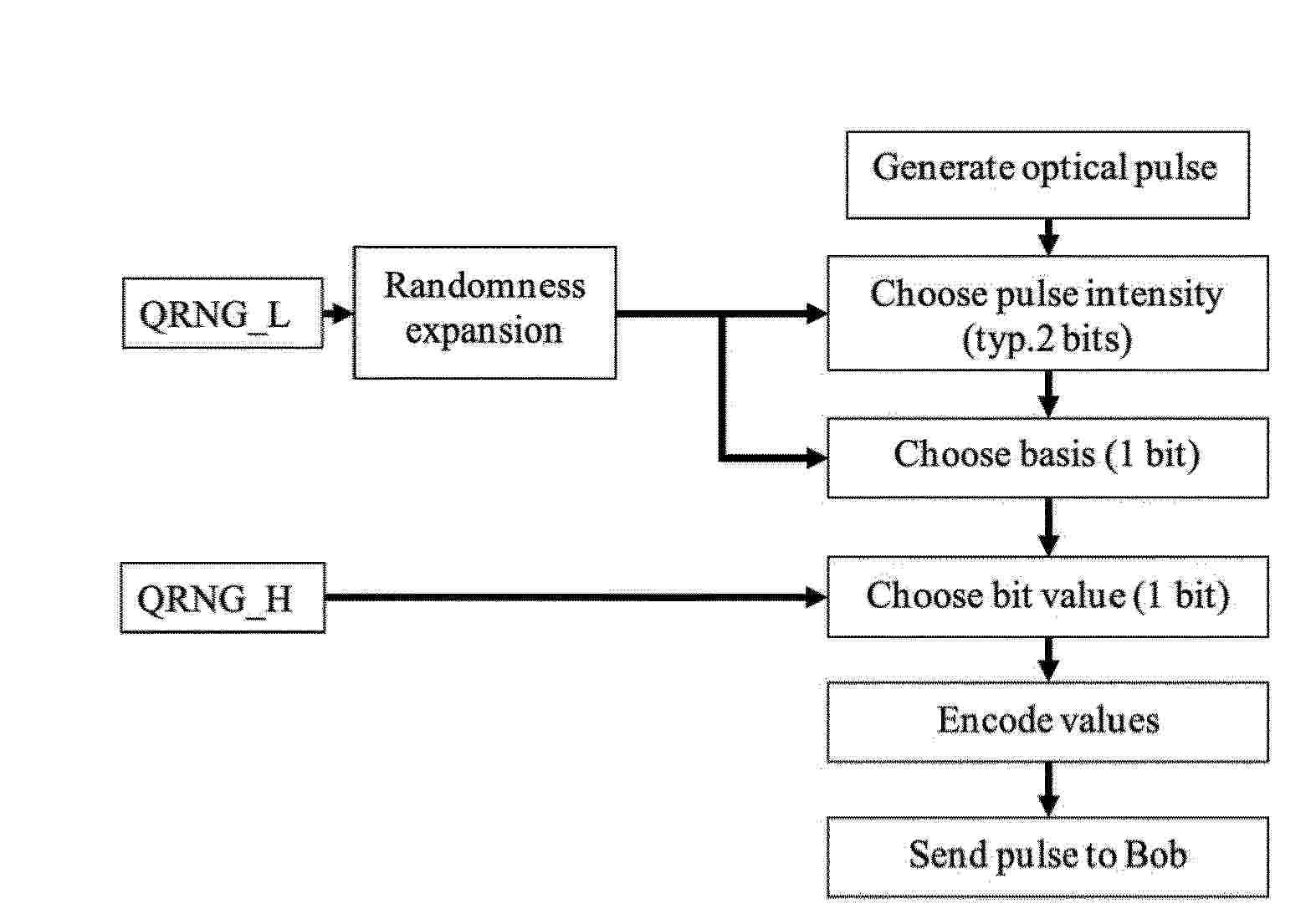
The present invention relates to a Quantum Key Distribution System comprising an emitter and a receiver adapted to communicate, wherein the emitter comprises an optical pulse source adapted to generate an optical pulse to be sent to the receiver, and at least one random bit generator adapted to set a bit value, a basis value and an intensity value of said optical pulse, wherein said at least one random bit generator comprises a bit value source adapted to generate full entropy to set said bit value of said optical pulse, a basis value source and an intensity value source, characterized in that said basis value source and said intensity value source are adapted to process entropy with expanded randomness to set said basis and said intensity of said optical pulse.
Resumen de: EP4575427A1
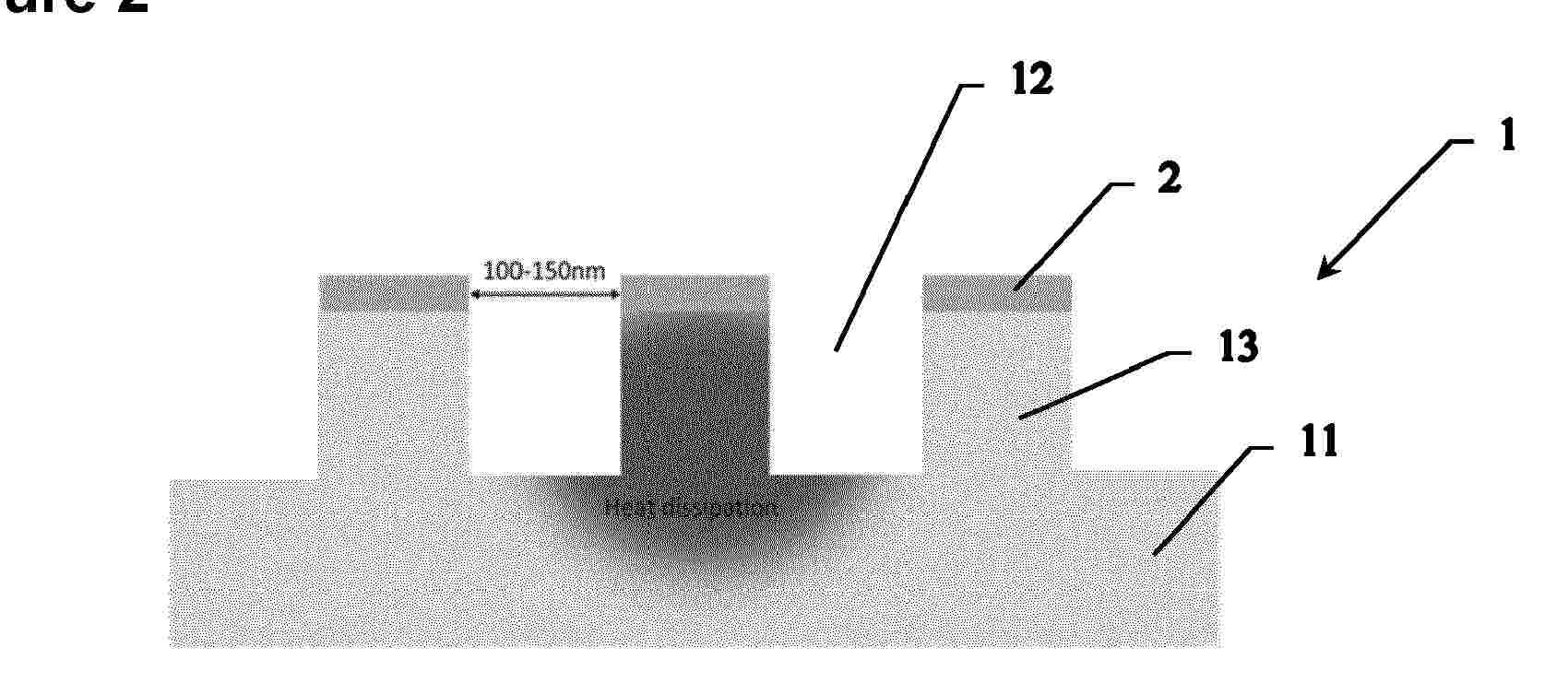
The present invention relates to Superconducting Nanowire Photon Detector comprising a substrate, and a plurality of pixels provided on said substrate, wherein the pixels are separated from each other by a first linear distance, and characterized in that said substrate presents a concave surface profile between two pixels to present a length greater than said first linear distance.
Resumen de: WO2025146833A1
According to various embodiments of the present disclosure, an operation method for a second node in a communication system is provided, the method comprising the steps of: receiving, from a first node, a first quantum message and a second quantum signature based on the first quantum message, signature information related to the first quantum message being divided into a first quantum signature and the second quantum signature, and the first quantum signature being transmitted from the first node to a third node; using a secret symmetric key shared with the third node so as to transmit, to the third node, a first message encrypted on the basis of the second quantum signature and the first quantum message; receiving a second message based on the first quantum signature, the second quantum signature and the first quantum message from the third node; and determining, on the basis of the second message, whether the first quantum message has been forged.
Resumen de: US20260261431A1
0000 A system (100) for authenticating digital communications comprises a sender layer (102) and a receiver layer (104). The sender layer (102) comprises a signing layer (110) configured to intercept outbound communications from a verified human identity prior to transmission, wherein the verified human identity is registered to a public identity record (109), an identity anchor (108) binding a signing key to the verified human identity, and a verification artifact generated by the signing layer (110), the verification artifact encoding the identity anchor (108) of the verified human identity. The receiver layer (104) comprises a public verification protocol (114) enabling a receiving system to receive the outbound communications and validate the verification artifact against the public identity record (109) to confirm authenticity of the outbound communications.
Resumen de: WO2026179321A1
The present disclosure relates to the technical field of communications, and provides a user identity information protection method and apparatus, and a related device. The method comprises: in response to an identity registration request of a terminal, selecting a target protection strategy from among a plurality of information protection strategies, wherein the target protection strategy uses a key agreement algorithm and/or a quantum key algorithm to generate a shared key between the terminal and a network side; generating a first shared key on the basis of the target protection strategy, and using the first shared key to encrypt plaintext user identity information of the terminal to obtain encrypted user identity information; and sending the encrypted user identity information, an identifier of the target protection strategy, and corresponding parameters to the network side, so that the network side generates a second shared key on the basis of the identifier of the target protection strategy and the corresponding parameters, and uses the second shared key to decrypt the encrypted user identity information to obtain the plaintext user identity information. The present disclosure can not only effectively avoid the security risk brought by quantum computing, but also solve the problem of insufficient quantum keys.
Resumen de: US20260260199A1
0000 The present disclosure provides a method of facilitating automated regulatory compliance determination. Further, the method may include receiving, using a communication device, a compliance input data from a regulatory data source. Further, the method may include receiving, using the communication device, an operational input data from an enterprise system. Further, the method may include determining, using a processing device, a compliance status data by processing the compliance input data and the operational input data using a quantum-inspired neural network. Further, the method may include generating, using the processing device, a compliance output data based on the compliance status data. Further, the method may include storing, using a storage device, the compliance output data. Further, the method may include transmitting, using the communication device, the compliance output data to a client system.
Resumen de: US20260261410A1
The present disclosure provides a method for a transmitting terminal to transmit information on a quantum channel in a quantum communication system. More specifically, the method comprises generating a single photon pair related to a polarization coding for transmission of the information; generating a transmission information sequence including (i) a message sequence related to the information and (ii) a checking sequence related to a quantum bit error rate (QBER) estimation for determining whether there is eavesdropping on a quantum channel, the checking sequence being randomly inserted between sequence elements of the message sequence; performing either (i) an encryption or (ii) a scrambling on the information sequence; transmitting, to a receiving terminal, quantum information generated based on the polarization coding for the information sequence, to which either (i) the encryption or (ii) the scrambling is applied, on the quantum channel; performing the QBER estimation with the receiving terminal; and transmitting, to the receiving terminal, information for restoring the information sequence, to which either (i) the encryption or (ii) the scrambling is applied, based on a result of the QBER estimation.
Resumen de: EP4800968A1
The disclosure relates to a method for establishing a plurality of secret cryptographic keys shared between a sending unit and a plurality of receiving units, wherein the sending unit is connected to the plurality of receiving units by a plurality of communication channels. The method comprises transmitting, at the sending unit, at least one first electromagnetic test pulse to a first receiving unit among the plurality of receiving units via a first communication channel among the plurality of communication channels, and determining a first signal loss in the first communication channel based on the at least one first electromagnetic test pulse detected at the first receiving unit. The method further comprises transmitting, at the sending unit, a first sequence of electromagnetic signal pulses to the first receiving unit via the first communication channel for establishing a first cryptographic key shared between the sending unit and the first receiving unit, wherein each electromagnetic signal pulse of the first sequence of electromagnetic signal pulses corresponds to a bit of a random bit sequence according to a key distribution protocol. The method further comprises transmitting, at the sending unit, at least one second electromagnetic test pulse to a second receiving unit among the plurality of receiving units via a second communication channel among the plurality of communication channels, and determining a second signal loss in the second communication channel based on
Resumen de: US20250131317A1
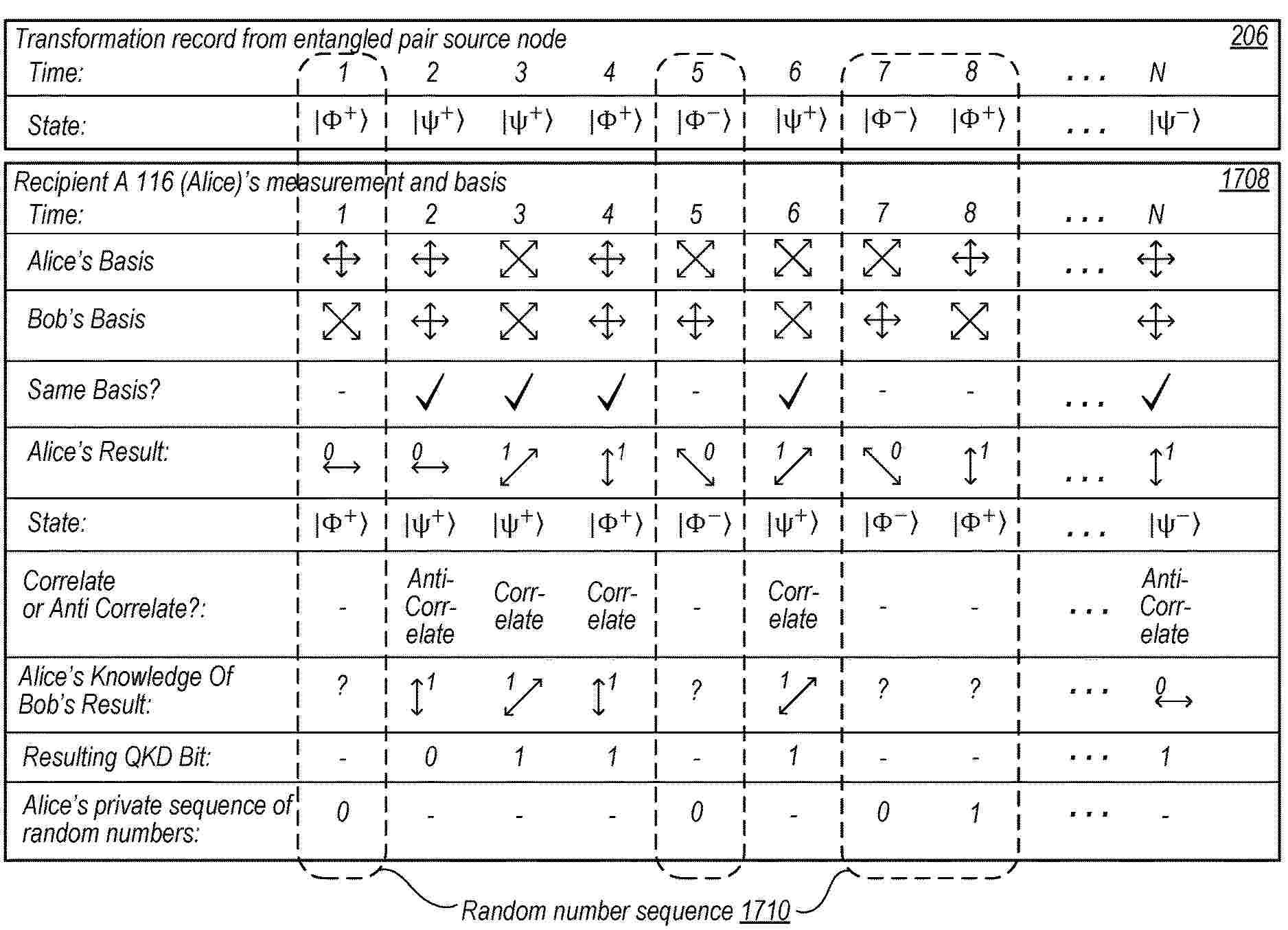
A system and method for providing quantum entanglement-as-a-service and simultaneously producing verifiably random sequences of numbers are described. When distributing quantum entanglement between customers Alice and Bob, Alice and Bob may exchange information pertaining to a measurement basis that they respectively used when performing measurements using respective halves of entangled particles. When customer Alice, for example, determines that both Alice and Bob have performed a given measurement in a same measurement basis, said result may be used in a quantum key distribution (QKD) code. When customer Alice determines that they have not performed the given measurement in the same measurement basis, Alice may concatenate said portion of the results into a private and verifiable sequence of random numbers. Providing distributed quantum entanglement therefore results in both a QKD code between said customers and in respective private and verifiably random sequences of numbers.
Resumen de: EP4800972A1
0001 A method of monitoring an encrypted message received by a computing device using an application is provided. The method comprises the computing device receiving an encrypted message comprising cryptographic handshake data. The application determines a cryptographic algorithm of the encrypted message based on the cryptographic handshake data. The application determines whether the encrypted message is quantum-secure based on the determined cryptographic algorithm. The application generates an indication on the computing device that the encrypted message is quantum secure or an indication on the computing device that the encrypted message is not quantum secure.
Resumen de: EP4800970A1
0001 The present invention relates to a receiver module for use in continuous-variable quantum key distribution, the receiver module comprising: a symmetric 3x3 optical coupler having three input ports and three output ports; a quantum channel for providing a quantum signal to the symmetric 3x3 optical coupler; an optical switch means arranged between the quantum channel and a first input port of the symmetric 3x3 optical coupler and configured to block or attenuate the quantum signal; a first single-ended photodetector and a second single-ended photodetector; and a signal processing unit configured to process the outputs of the single-ended photodetectors, wherein the first single-ended photodetector is coupled to a first output port of the symmetric 3x3 optical coupler and the second single-ended photodetector is coupled to a second output port of the symmetric 3x3 optical coupler.
Resumen de: WO2025087609A1
There is herein described a method of performing Quantum Key Distribution (QKD), the method comprising generating a first quantum key by performing QKD between a first quantum transmitter at a first quantum node and a quantum receiver at a second quantum node, generating a second quantum key by performing QKD between the quantum receiver at the second quantum node and a second quantum transmitter at a third quantum node, encrypting data using the second quantum key, transmitting the encrypted data from the second quantum node to the third quantum node, wherein the data comprises, the first quantum key; and/or data received at the second quantum node from the first quantum node.
Resumen de: EP4800967A1
The disclosure relates to a method and a communication system for establishing a plurality of secret cryptographic keys shared between a sending unit and a plurality of receiving units, wherein the sending unit is connected to the plurality of receiving units by a plurality of communication channels. The method comprises transmitting, at the sending unit, a first sequence of electromagnetic signal pulses to a first receiving unit among the plurality of receiving units via a first communication channel among the plurality of communication channels for establishing a first cryptographic key shared between the sending unit and the first receiving unit, wherein each electromagnetic signal pulse of the first sequence of electromagnetic signal pulses corresponds to a bit of a first random bit sequence according to a key distribution protocol. The method further comprises transmitting, at the sending unit, a second sequence of electromagnetic signal pulses to a second receiving unit among the plurality of receiving units via a second communication channel among the plurality of communication channels for establishing a second cryptographic key shared between the sending unit and the second receiving unit, wherein each electromagnetic signal pulse of the second sequence of electromagnetic signal pulses corresponds to a bit of a second random bit sequence according to the key distribution protocol. The method further comprises determining a first key bandwidth share for the first sequ
Resumen de: CN122660874A
本申请涉及一种基于量子密钥种子的数据传输方法、通信系统及存储介质,所述方法包括:将原始数据流切分为数据帧,对每个数据帧进行喷泉码编码生成编码符号流,生成真随机的量子密钥种子,以量子密钥种子为输入通过加密安全伪随机数生成器生成跳时控制序列,按照跳时控制序列将所述编码符号流发送至接收端,由接收端根据喷泉码编码、量子密钥种子及从编码符号流恢复出原始数据流的数据帧;该技术方案,避免了量子密钥速率与数据速率的“剪刀差”缺陷,满足实时通信需求,并且量子密钥种子驱动的跳时图案生成,使得安全性同时建立在量子随机性和时间不确定性两个维度上,提升了数据通信的安全性。
Resumen de: CN122660872A
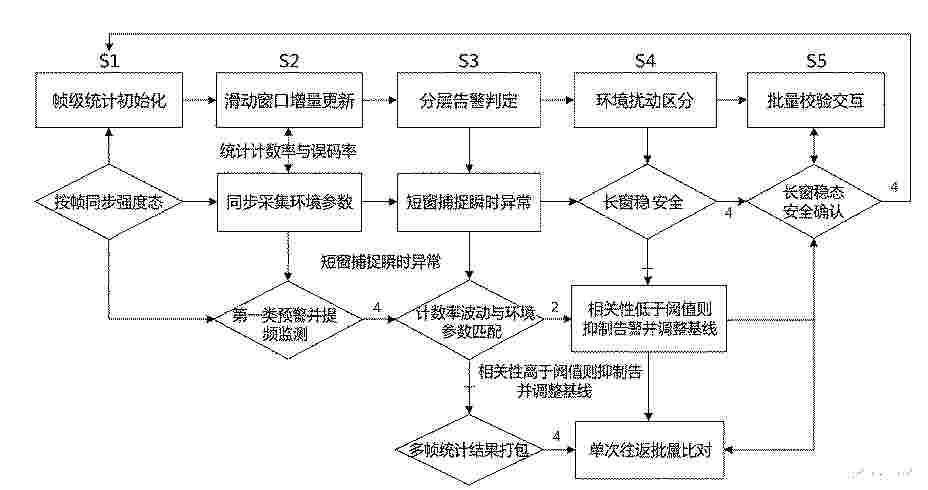
0001 本申请公开一种深空大时延弱反馈场景下的诱骗态安全快速校验方法及装置,属于深空量子保密通信领域。该方法在接收端设置长短两级滑动窗口进行帧级增量统计,短窗捕捉瞬时异常并触发预警、提频监测,长窗结合同步采集的环境参数进行扰动区分,排除环境因素后确认攻击并终止密钥分发。方案将安全响应的快速性落实在接收端本地自主决策,克服深空往返时延的限制,同时采用批量打包校验模式提升天地交互效率,可有效降低深空环境下诱骗态校验的虚警率,提升响应速度。
Resumen de: CN122660989A
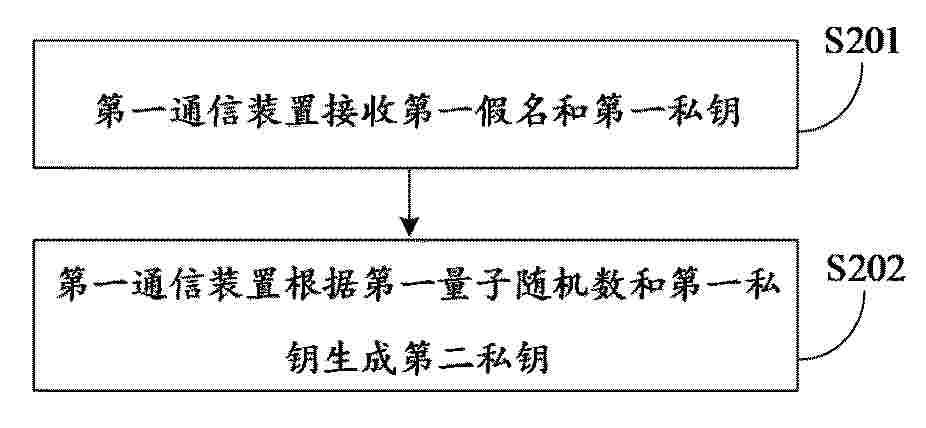
本公开提供一种认证方法、装置、车辆、程序产品和存储介质,涉及信息安全技术领域,能够提升认证的安全性。该方法包括:第一通信装置接收第一假名和第一私钥,并在第一假名和第一私钥认证通过的情况下,根据第一量子随机数和第一私钥生成第二私钥。其中,第一假名是根据第一通信装置的标识信息生成的,第一私钥是根据第一假名生成的,第二私钥为第一通信装置的私钥。
Resumen de: CN122660870A
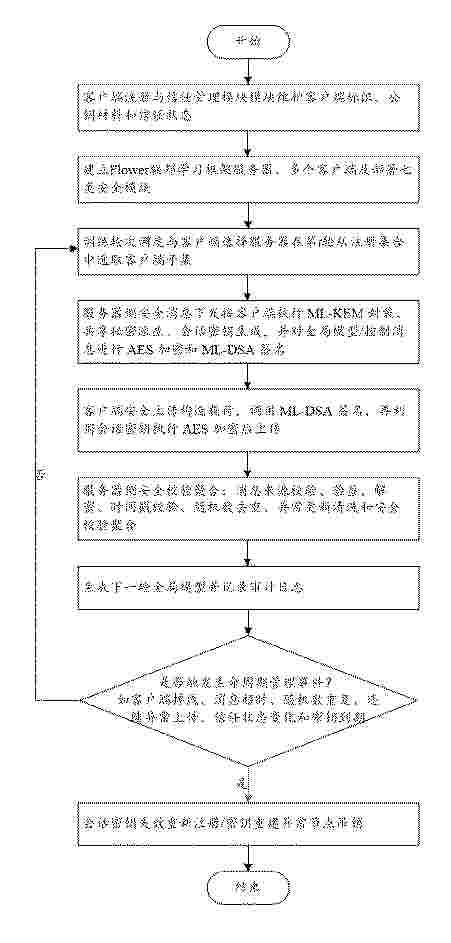
本发明涉及分布式机器学习和网络安全技术领域,具体涉及一种抗量子联邦学习框架及训练安全处理方法,所述抗量子联邦学习框架,包括:至少一个服务器和与各服务器对应的至少一个客户端;以及分别部署于各服务器和各客户端的联邦训练调度模块、后量子密钥封装模块、后量子数字签名算法模块、对称加密保护模块和安全校验聚合模块。该框架可通过扩展Flower的gRPC传输层集成后量子安全通信能力,在不传输原始数据的前提下,提高联邦学习系统在量子计算威胁场景下的消息机密性、消息完整性、身份可认证性以及多轮训练过程的连续性、安全性和可控性,适用于医疗、金融、政务和工业互联网等对通信安全与长期密码强度要求较高的分布式协同建模场景。
Resumen de: CN122660868A
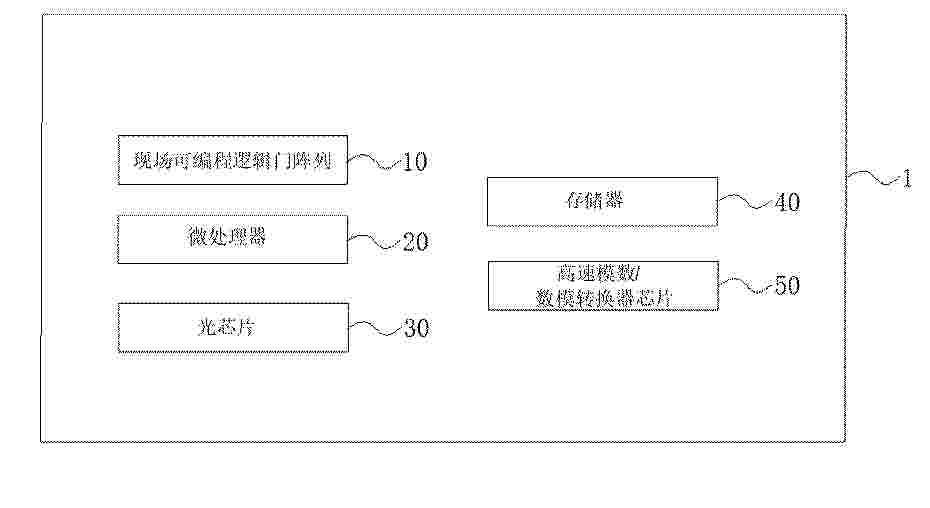
0001 本发明公开了一种光芯片加密通讯模块,涉及量子加密通信技术领域,该方法包括:现场可编程逻辑门阵列、微处理器、光芯片、存储器和高速模数/数模转换器芯片;所述现场可编程逻辑门阵列分别与所述存储器、光芯片、高速模数/数模转换器芯片和微处理器建立通信连接,且所述现场可编程逻辑门阵列、微处理器、光芯片、存储器、高速模数/数模转换器芯片和无源阻容器件集成为一体;所述光芯片内置量子真随机数发生器,通过量子物理现象生成不可预测的真随机数,并基于所述真随机数生成加密密钥,有助于解决现有技术无法实现小型化集成且高安全等级光芯片加密通讯的问题。
Nº publicación: US20260254622A1 27/08/2026
Solicitante:
ACCENTURE GLOBAL SOLUTIONS LTD [IE]
ACCENTURE GLOBAL SOLUTIONS LIMITED
Resumen de: US20260254622A1
Systems and methods for implementing a multi-axis measurement protocol to protect quantum information are disclosed herein. A method includes generating at least one input qubit data for transmission. Further, the method includes determining one or more qubit measurement operations to be performed on the qubit data. The method then include generating one or more entangled pairs of qubits comprising first set of qubits and second set of qubits. Also, the method includes creating entangled data by entangling the input qubit data with the first set of qubits. The method then includes performing the determined at least one appropriate qubit measurement operation on the created entangled data to orientate a state of the created entangled data before transmission. Further, the method includes generating two classic bits for the created entangled data based on the performed appropriate qubit measurement operation and transmitting to the receiver via a classic communication channel.
 BOPI
BOPI
 Sede Electrónica