Si deseas distinguir tus productos, servicios o ambos de los de otra empresa, es posible que necesites una marca o nombre comercial. Descubre qué son, en qué consiste su procedimiento de registro y qué implica.

Información sobre los plazos de presentación de solicitudes de transformación de marcas de la Unión Europea en marca nacional española. Más información


Si tienes un nuevo dispositivo, producto o procedimiento que resuelva un problema técnico o tenga una ventaja práctica, existen distintas formas de protegerlo en España y en otros países. Descubre cómo hacerlo.

¿Tu innovación reside en la estética, la ornamentación o la apariencia de tu producto? Protégela mediante un diseño industrial. Descubre qué derechos confiere el registro y cómo realizar la tramitación.

Las indicaciones geográficas protegen el nombre de un producto originario de una zona geográfica, a la cual le debe una determinada calidad, reputación u otra característica. Descubre qué son, en qué consiste su procedimiento de registro y qué beneficios conceden.

Las patentes publicadas en todo el mundo son una valiosa fuente de información científica, técnica y comercial.

Si eres emprendedor/a o una empresa y quieres potenciar y mejorar la rentabilidad de tu negocio protegiendo de forma adecuada los activos intangibles de tu organización, en este espacio encontrarás lo necesario.


 644
resultados
644
resultados
 Última actualización
22/03/2026 [06:48:00]
Última actualización
22/03/2026 [06:48:00]


 Resultados 475 a 500 de 644

Resumen de: KR20260034521A
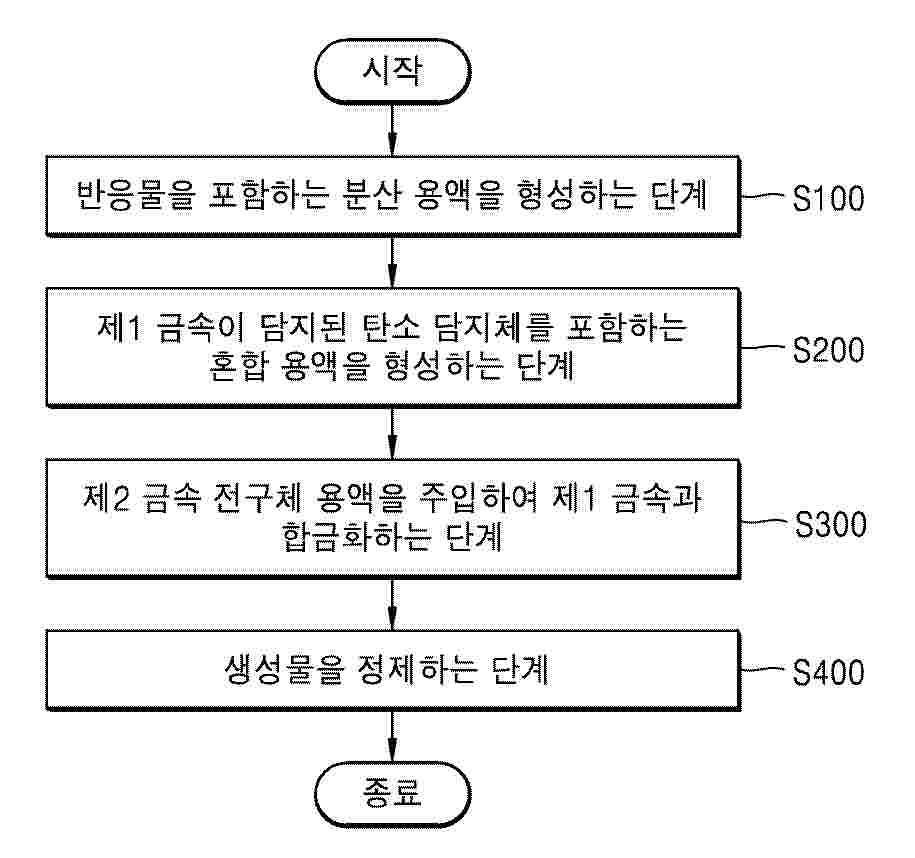
본 발명은 연료전지 및 수전해용 촉매에 관한 것으로, 중공형 합금 나노입자가 담지된 복합 촉매와 그 제조방법을 제공한다. 본 발명에 따른 중공형 합금 나노입자가 담지된 복합 촉매 및 그 제조방법은 액상 환원법을 통해 대량 합성이 용이하며, 기존의 폴리올 공정에 비해 낮은 반응 온도와 짧은 반응 시간으로 간소화된 제조가 가능하다. 또한, 백금 사용량을 줄이면서도 높은 촉매 활성을 유지하고, 전이금속 산화물의 형성을 억제하여 입자 크기를 제어할 수 있으며, 촉매 활성 면적을 증가시켜 높은 촉매 활성도를 구현할 수 있다.

Resumen de: JP2026042480A
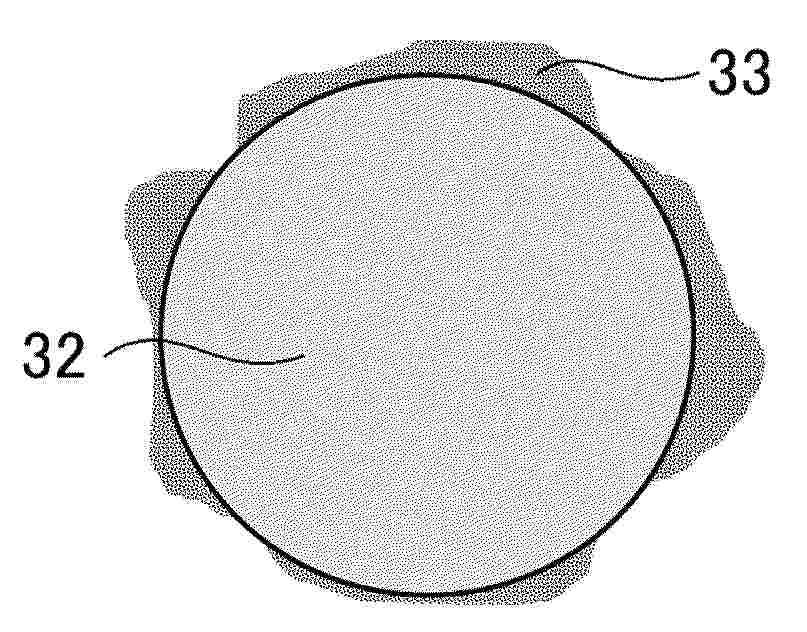
【課題】高いプロトン伝導性を示す電解質膜を作製可能な多孔質支持体及びその製造方法、並びに、該多孔質支持体を備える電解質膜及びその製造方法の少なくともいずれかを提供する。【解決手段】繊維からなる多孔質膜と、親水性フィラーと、を有し、気孔率が50%以上であり、なおかつ、前記繊維の外周面の60%以上に前記親水性フィラーが付着していること、を特徴とする多孔質支持体。【選択図】図1
Resumen de: JP2026042562A
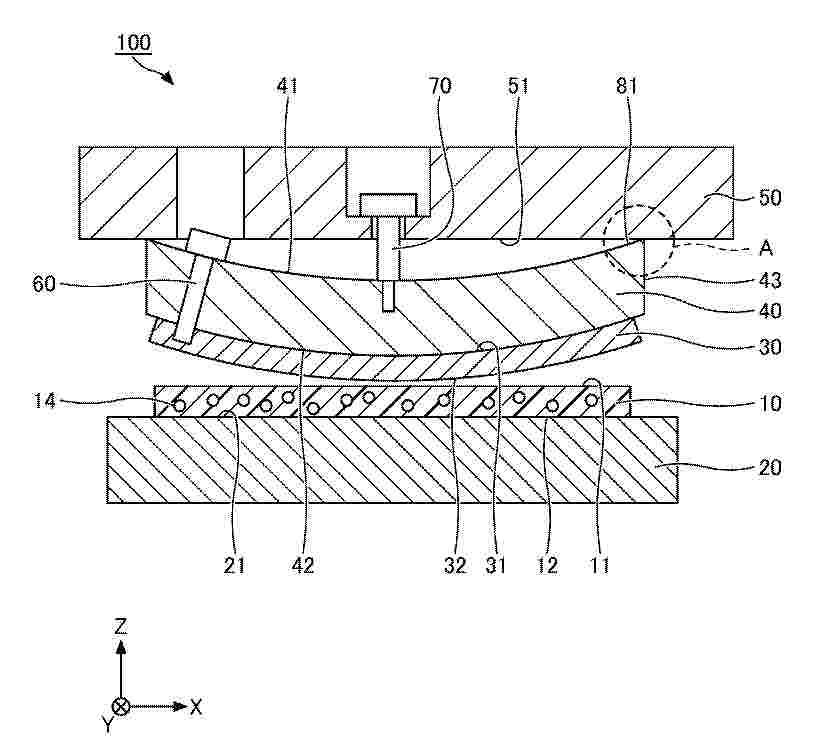
【課題】ばねプレートとベースプレートとの接触による摩耗を抑制する。【解決手段】成形装置100は、燃料電池用の樹脂セパレータである樹脂シート10をプレス成形する成形装置であって、樹脂シートを載置する下型20と、下型と対向して配置される上型30と、板厚方向に対向する第1面及び第2面を有し、板厚方向に交差する第1方向の中央部が第2面とは反対側に張り出すように湾曲し、第1面に接するように上型が取り付けられるばねプレート40と、下型に上型を接近させるようにばねプレートを押圧するベースプレート50と、を備え、第1方向においてばねプレートの第1面の両端部には、R加工が施されたR構造が形成され、ばねプレートを押圧するプレス荷重が増加するに従い、湾曲している第1面及び第2面が平面に近づくように変形し、第2面とベースプレートとの接触点が、第1方向において、中央部から遠い第1位置から、中央部に近い第2位置に変位する。【選択図】図1
Resumen de: CN120958614A
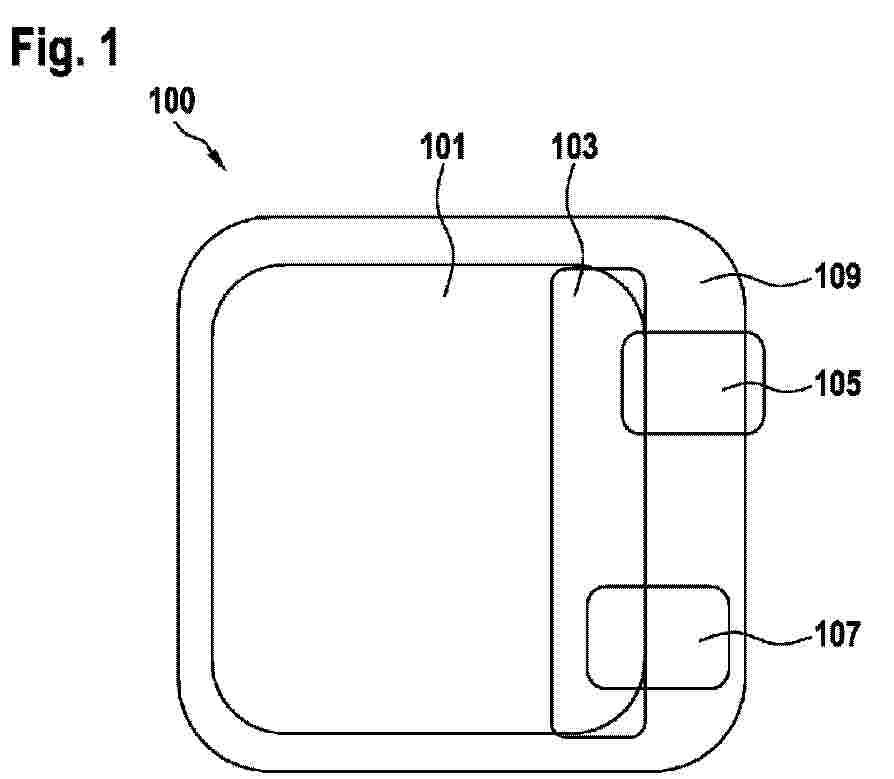
The invention relates to a fuel cell system (100) for converting energy, said fuel cell system (100) comprising:-a fuel cell stack (101),-an anode branch (103) for supplying fuel to the fuel cell stack (101),-a bleed valve (105) for bleeding anode gas from the anode branch (103),-a metering valve (107) for metering fuel into the anode branch (103),-a computing unit (109), the computing unit (109) is configured to actuate the metering valve (107) in a pulsed manner, and wherein the computing unit (109) is further configured to actuate the discharge valve (105) in a pulsed manner as a function of the actuation of the metering valve (107).
Resumen de: WO2026048495A1
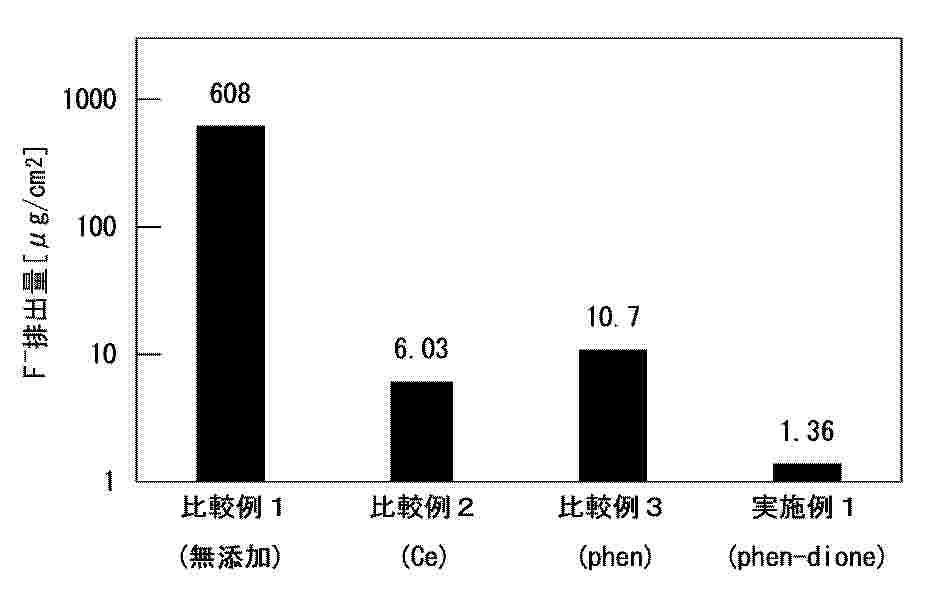
Provided are a solid polymer fuel cell and a water electrolysis device which each include: a membrane/electrode/gas diffusion layer assembly (MEGA) comprising a solid polymer electrolyte membrane, catalyst layers bonded to both surfaces of the solid polymer electrolyte membrane, and a gas diffusion layer disposed on the outer side of each catalyst layer; and a deterioration inhibitor added to any portion of the MEGA. The deterioration inhibitor includes a complex comprising an Fe ion and ligands coordinated thereto. The ligands include 1,10-phenanthroline-5,6-dione and/or a derivative thereof. The content of the deterioration inhibitor is preferably 0.0001-10.0 mol%.
Resumen de: JP2024177305A
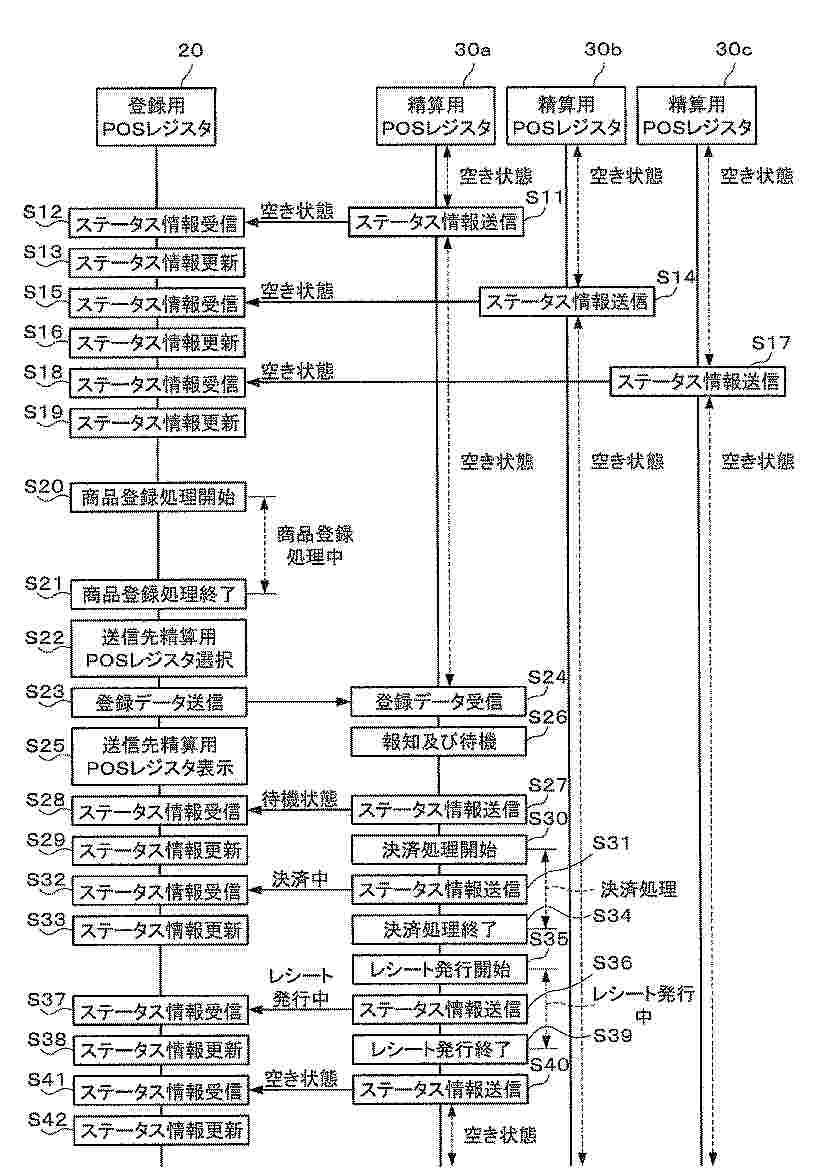
To provide a POS system capable of reducing a settlement time of a customer.SOLUTION: A POS system includes a registration device that registers a commodity to be purchased by a customer, and a plurality of settlement devices that perform settlement processing by the customer being operated based on registration data of the commodity. The registration device includes transmission means for transmitting information on a settlement method using any or all of a cash, a credit card and electronic money for settling a payment in settlement processing of the customer in one settlement device of the plurality of settlement devices. The settlement device includes settlement means for receiving information on a settlement method and performing the settlement processing on the basis of the received settlement method.SELECTED DRAWING: Figure 5
Resumen de: JP2026042172A
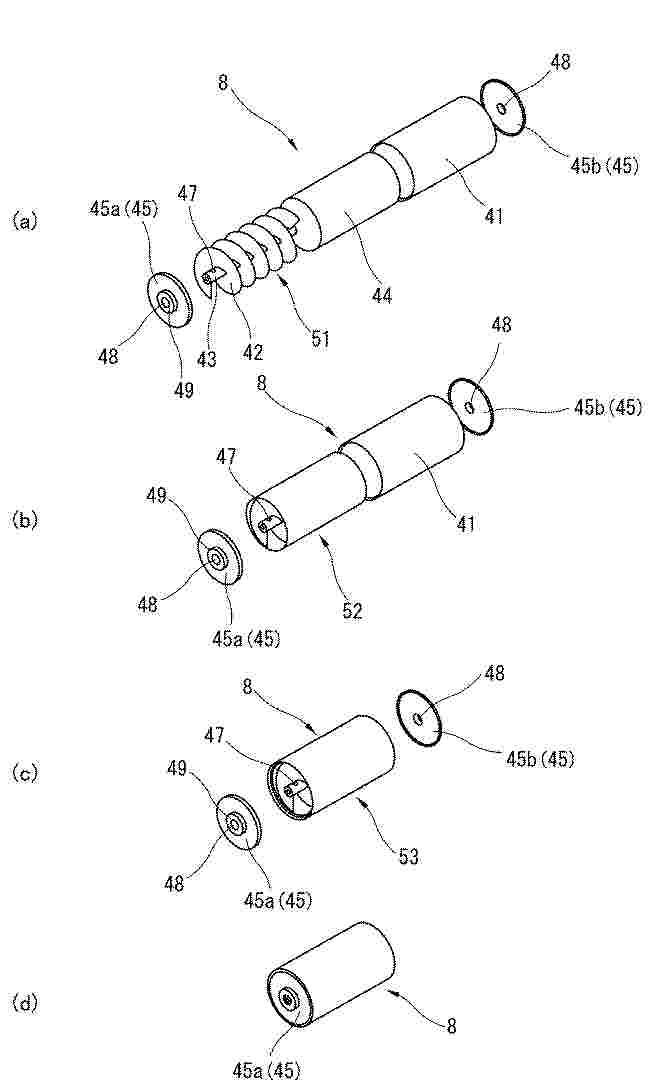
【課題】設置される際の姿勢によらず脱硫効果が得られる脱硫装置を提供する。【解決手段】脱硫器8は、円筒状のケーシング41と、ケーシング41に収容される仕切り部材42、軸部材43及びシール部材44と、ケーシング41の軸方向の端部を塞ぐ蓋部材45と、を有している。また、脱硫器8は、ケーシング41の内部に図示せぬ粒状の脱硫剤が大量に封入されている。上記脱硫剤は、個々の形状が例えば円柱形状(ペレット状)を呈している。脱硫器8は、ケーシング41の長手方向に沿った軸心が車両1に対して水平で、車両1の前後方向に沿うように車両に横向きに搭載される。【選択図】図2
Resumen de: EP4708412A1
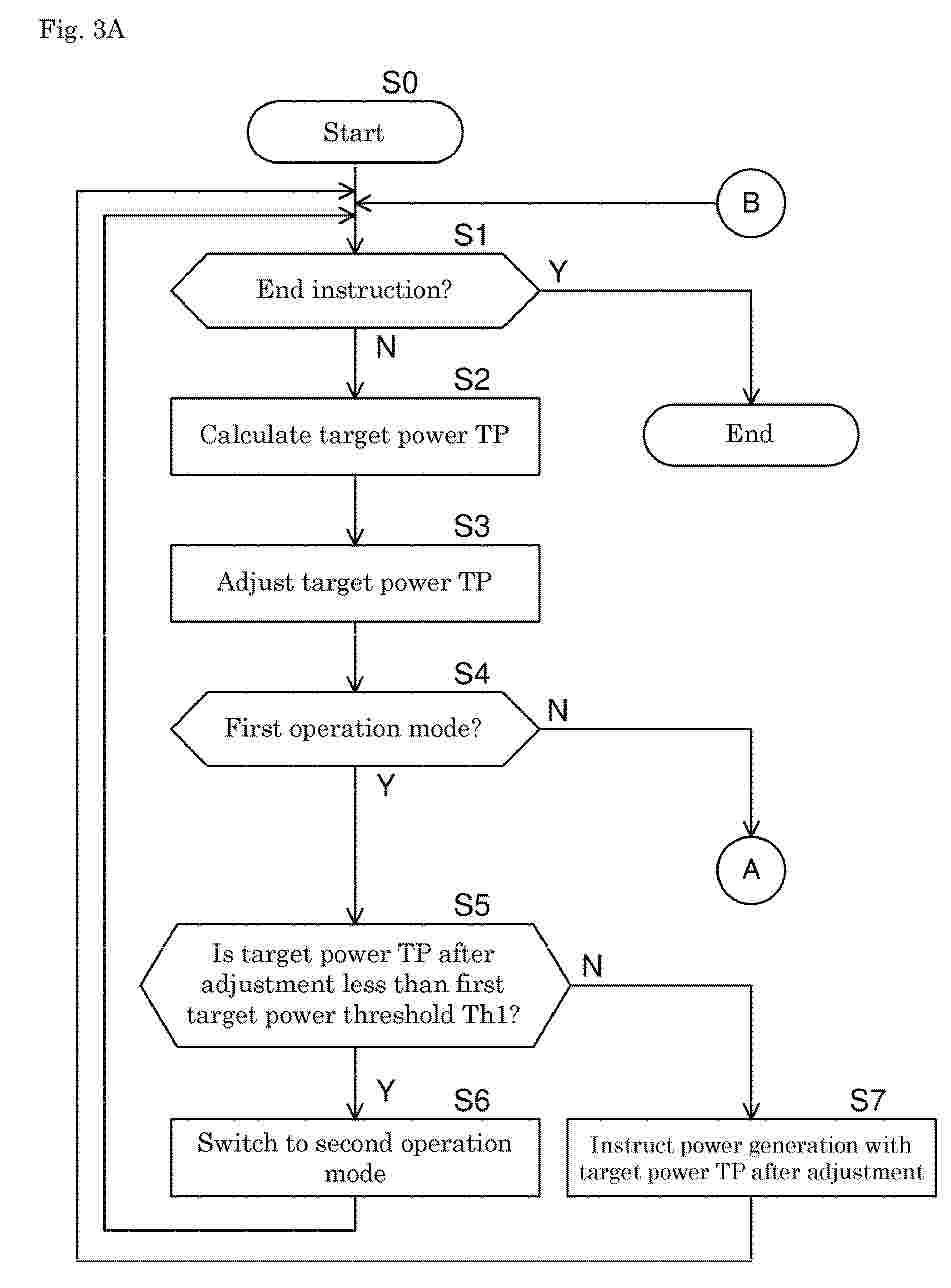
Problem Provided is a technique capable of expanding an output range of a fuel cell system while suppressing deterioration of a fuel cell.Solution A fuel cell system includes a fuel cell, and a battery that stores power output from the fuel cell, and has a first operation mode in which power output from the fuel cell is extracted to the outside, and a second operation mode including a discharge mode in which power output from the battery is extracted to the outside. A control method for a fuel cell system includes switching between the first operation mode and the second operation mode based on target power of the fuel cell.
Resumen de: EP4707471A1
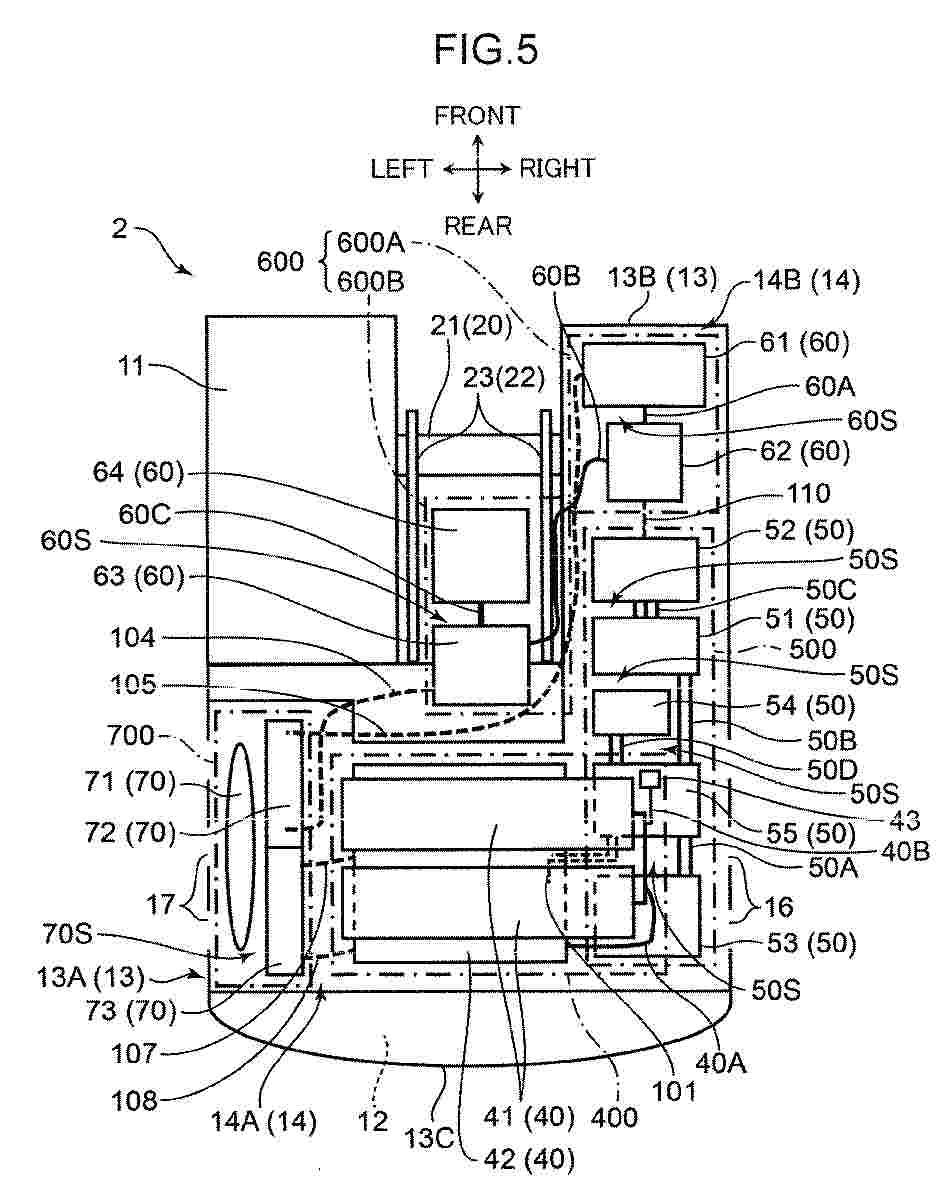
Provided is a work machine (100), wherein a fuel pipe (40A) is disposed at a position offset from a high-voltage inter-device space (50S) between a first high-voltage device (51) and a second high-voltage device (52) of a high-voltage device group (50) and a hydraulic inter-device space (60S) between a first hydraulic device (61) and a second hydraulic device (62) of a hydraulic device group (60), a high-voltage cable (50A) is disposed at a position offset from the inter-fuel device space (40S) between a fuel tank (41) and a fuel cell device (42) of the fuel device group (40) and the hydraulic inter-device space (60S), and a hydraulic pipe (60A) is disposed at a position offset from the inter-fuel device space (40S) and the high-voltage inter-device space (50S).
Resumen de: EP4708410A1
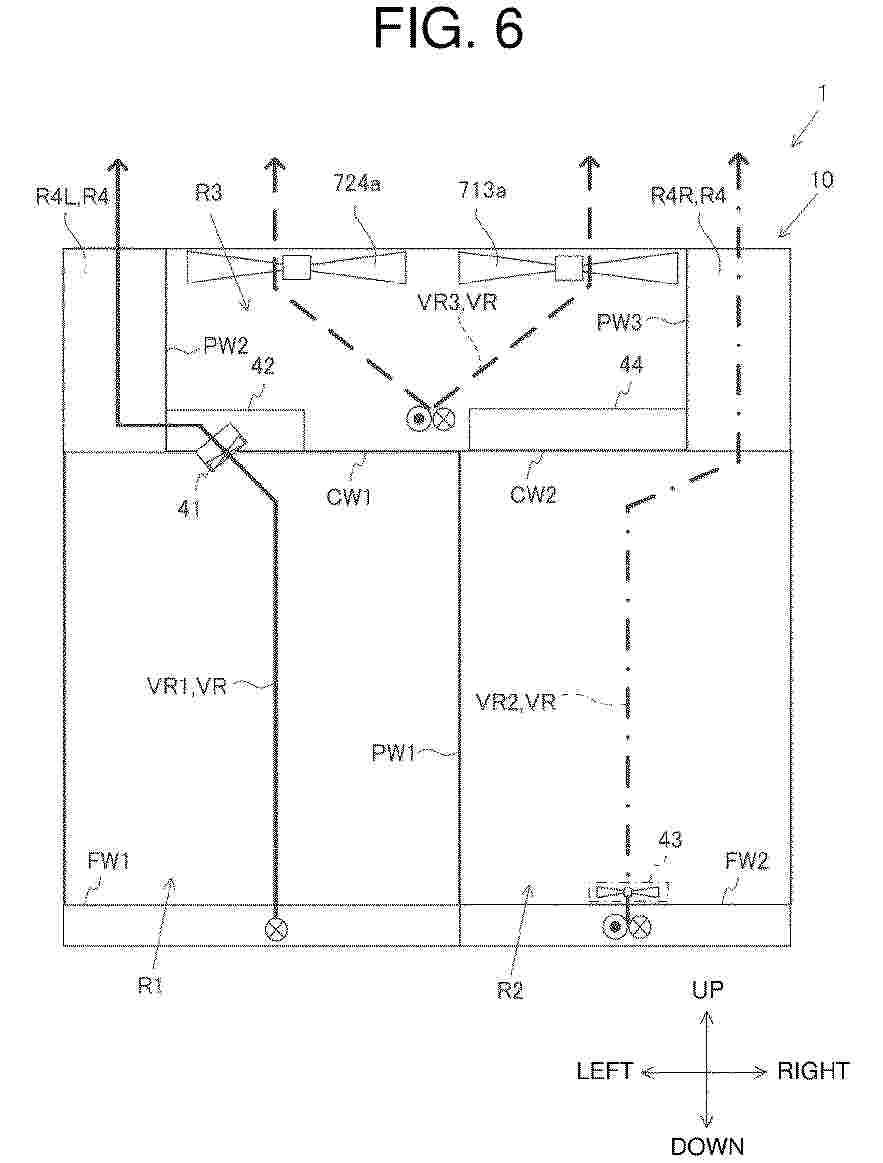
Problem To provide a technique capable of preventing an increase in fuel gas concentration at a place where an ignition source is present even if fuel gas leaks in a fuel cell system, a technique capable of easily optimizing a heat balance in the fuel cell system, or a technique capable of appropriately performing ventilation in the fuel cell system.Solution An exemplary fuel cell system includes a housing having a fuel cell room including a fuel cell module, and an electrical equipment room that is partitioned from the fuel cell room and that includes a plurality of electrical devices. The housing includes a fuel cell room ventilation route that ventilates the fuel cell room and a plurality of electrical equipment room ventilation routes that ventilate the electrical equipment room. Furthermore, the housing has a ventilation route that ventilates the inside, an inlet of the ventilation route is provided on a side surface of the housing, and an outlet of the ventilation route is provided on an upper surface of the housing.
Resumen de: EP4708411A1
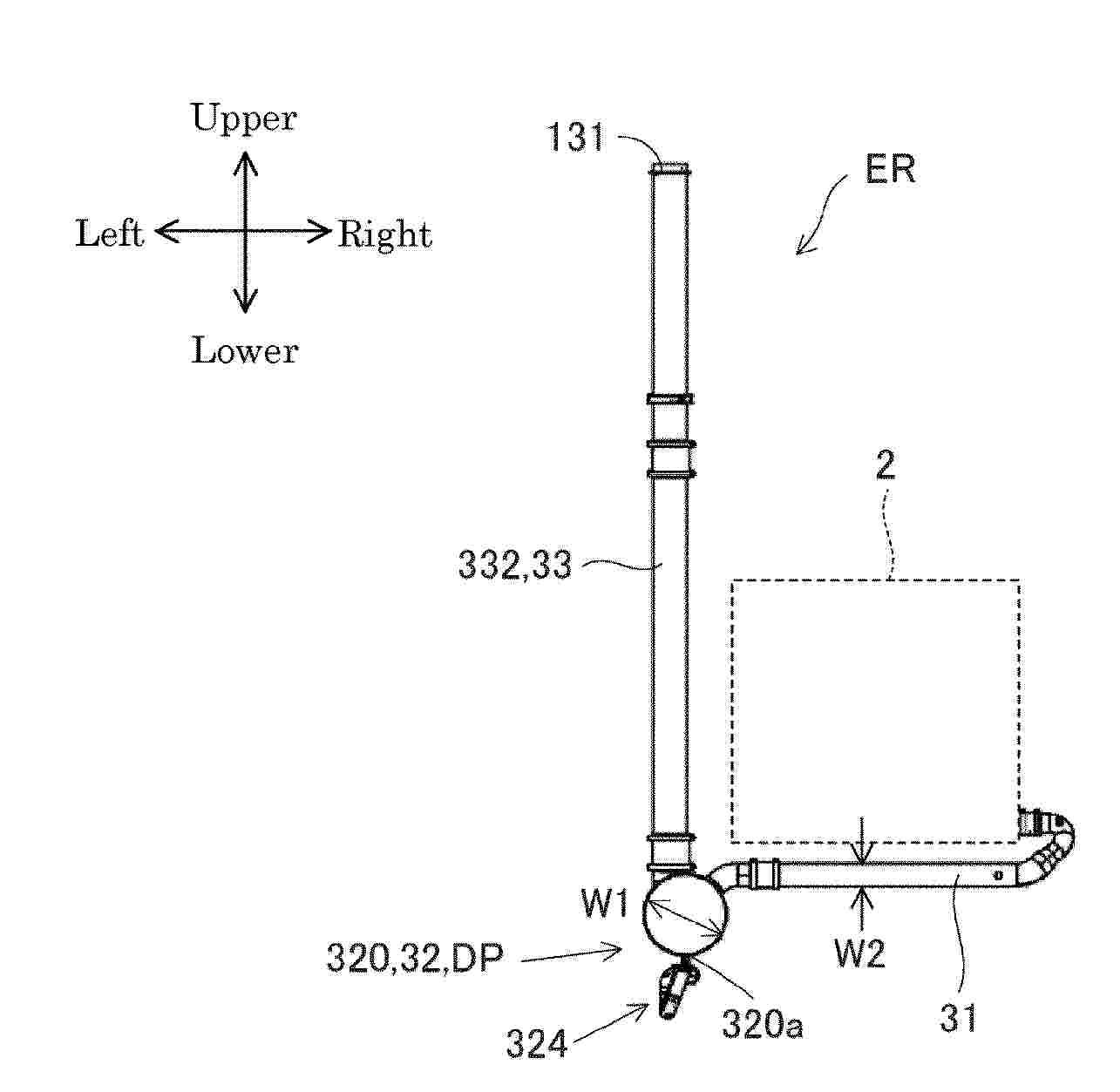
Problem Provided is a fuel cell system capable of reducing a risk that drain water is discharged from an exhaust path together with exhaust gas and scattered around.Solution A fuel cell system includes a fuel cell module and a drain portion. The drain portion is disposed to be branched from an exhaust path of the fuel cell module.
Resumen de: EP4708414A1
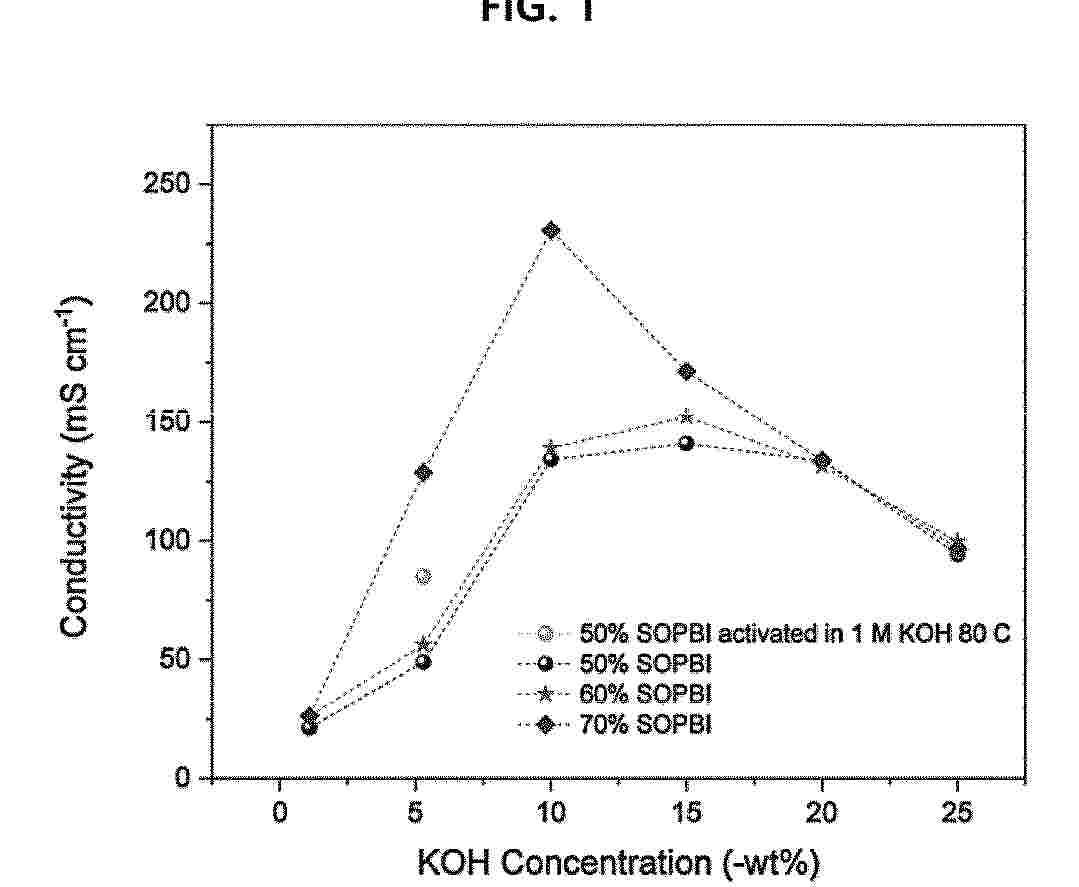
The present specification relates to a polymer electrolyte membrane and a method of preparing the same. The polymer electrolyte membrane according to one embodiment of the present invention may be mass-produced since crosslinking is not required, and exhibits significantly superior performance compared to commercially available AEM membranes.
Resumen de: EP4707209A1
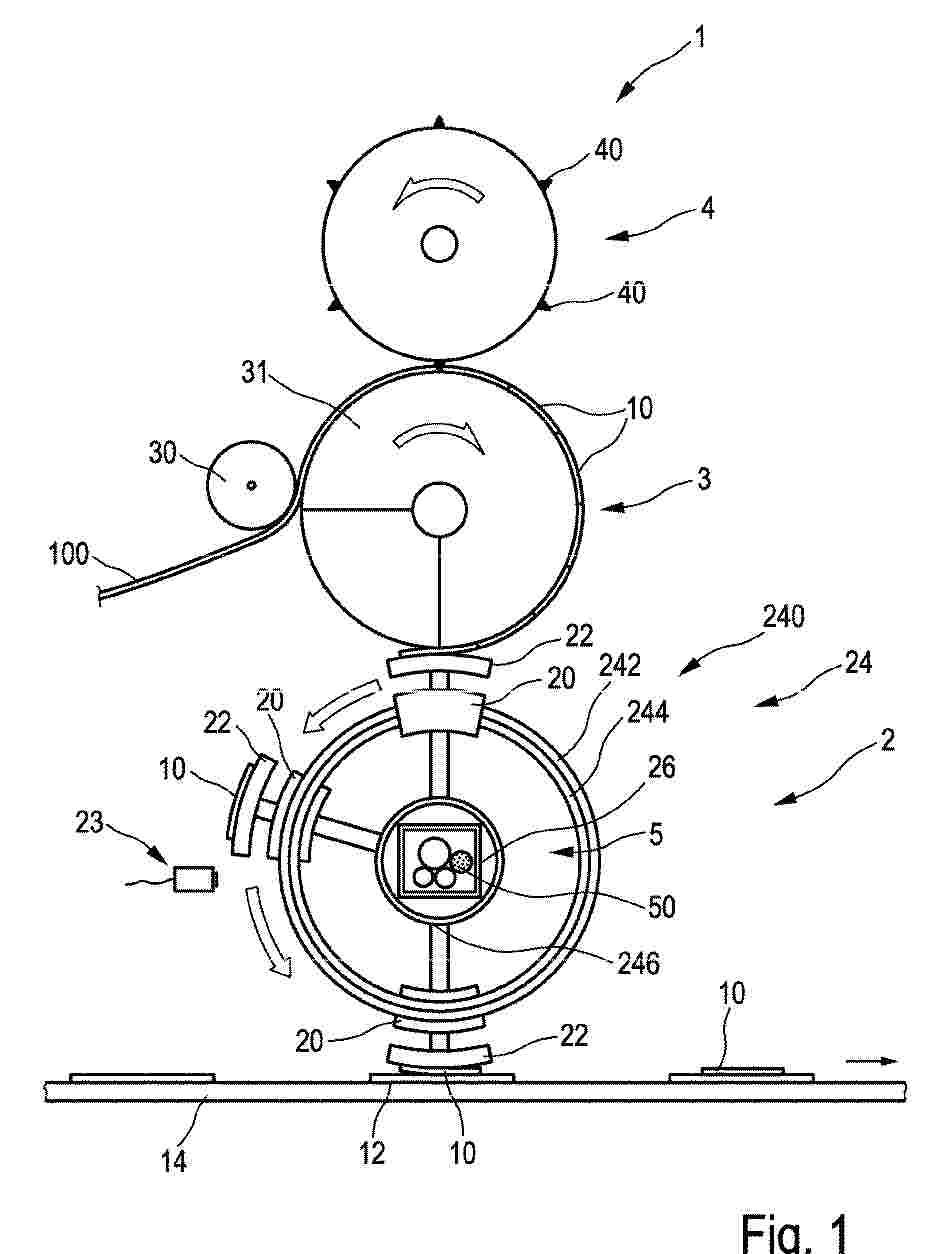
Die Erfindung betrifft eine Vorrichtung und ein Verfahren für eine Übergabe von Zuschnitten an eine Übergabestrecke, insbesondere für eine Übergabe von Zuschnitten (10) an eine Materialbahn, eine Transportbahn (14), eine rotierende Walze und/oder an entlang einer Transportstrecke transportierte Produkte (12), die Vorrichtung (1) umfassend ein Positioniersystem (2) mit mindestens zwei, insbesondere drei oder mehr, entlang einer umlaufenden Bahn bewegbaren Schlitten (20) und mit einem Antriebssystem (24), wobei die Schlitten (20) jeweils eine Produktaufnahme (22) aufweisen und eingerichtet sind, um jeweils einen Zuschnitt (10) an der Produktaufnahme (22) aufzunehmen, den Zuschnitt (10) ortsfest an der Produktaufnahme gehalten zu transportieren, und den Zuschnitt (10) an die Übergabestrecke zu übergeben, und wobei das Antriebssystem (24) eingerichtet ist, um die Schlitten (20) entlang der umlaufenden Bahn zumindest abschnittsweise unabhängig voneinander zu bewegen.
Resumen de: EP4708415A1
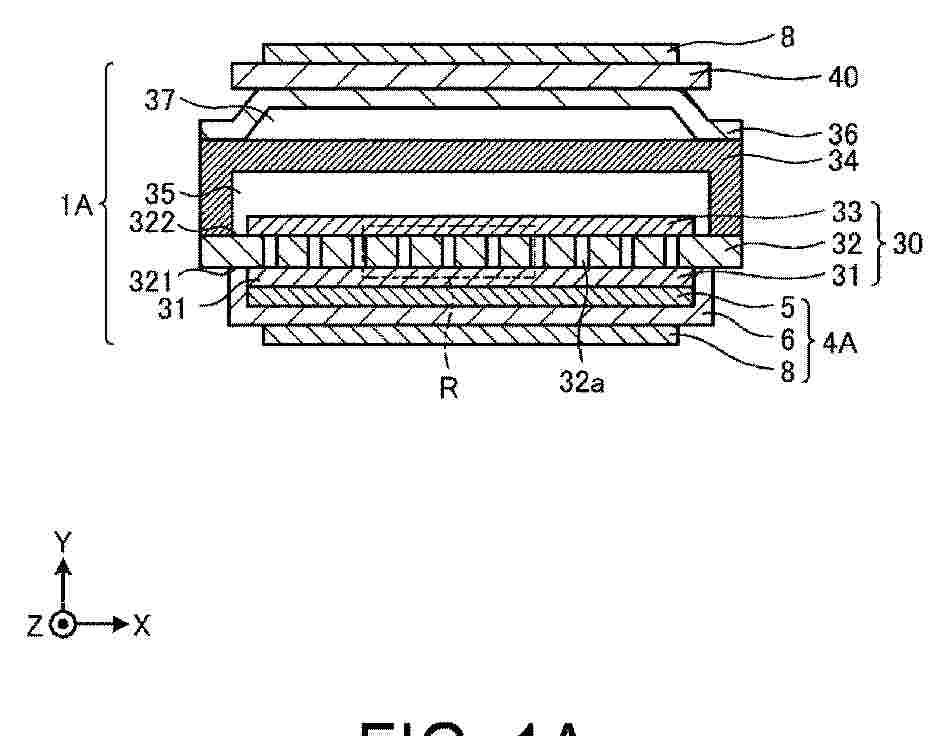
A conductive member includes a metal plate, a first porous layer, and a second porous layer. The metal plate includes a first surface and a second surface located on an opposite side to the first surface, and a gas can circulate between the first surface and the second surface. The first porous layer is located on the first surface. The second porous layer is located on the second surface. When a thermal expansion coefficient of the metal plate is α0, a thermal expansion coefficient of the first porous layer is α1, and a thermal expansion coefficient of the second porous layer is α2, there are relationships of α1 < α0 and α2 < α0, or α1 > α0 and α2 > α0.
Resumen de: GB2643863A
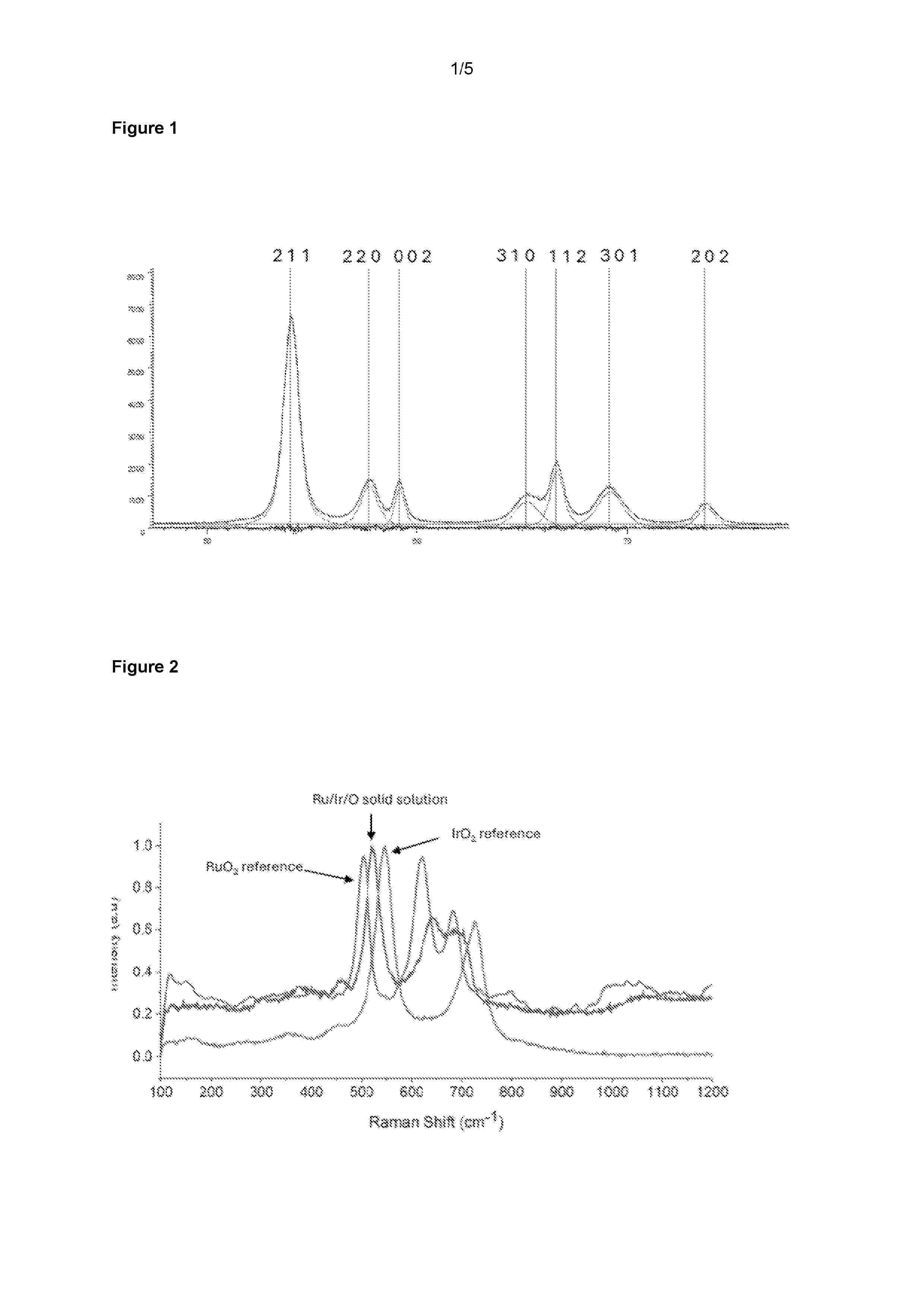
A proton exchange membrane fuel cell (PEM-FC) anode catalyst layer comprising a hydrogen oxidation reaction catalyst, an ion-conducting material, and an oxygen evolution reaction (OER) catalyst. The oxygen evolution reaction catalyst (OER) is an oxide material comprising iridium (Ir) and ruthenium (Ru). The loading of iridium is 0.02 mg/cm2 of the geometric area of the anode catalyst layer or less. The hydrogen oxidation reaction catalyst may comprise a platinum group metal supported on an electrically conductive carbon support material. The OER catalyst can comprise a tetragonal crystalline oxide phase and have a peak in the Raman spectra between 515 and 525cm-1. A process for producing an OER catalyst comprising iridium and ruthenium is also defined.
Resumen de: EP4707825A1
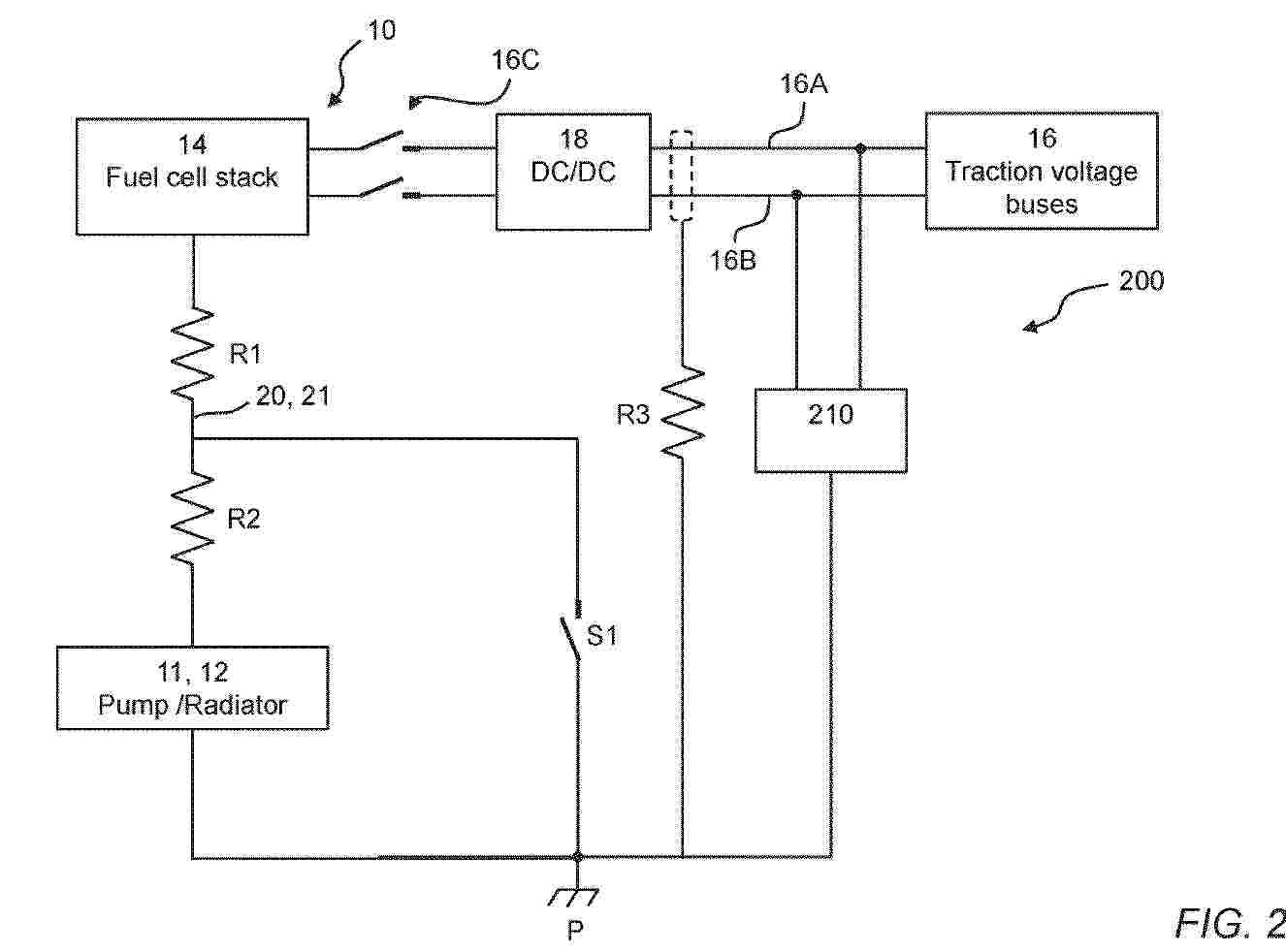
A computer system is provided. The computer system comprises processing circuitry configured to: electrically connect at least one vehicle subsystem (10) to a traction voltage pole (16, 16A, 16B) of a vehicle (1) and to a ground potential (P), said at least one vehicle subsystem (10) comprising at least a first electrically conducting fluid path (20, 21); obtain first isolation resistance data (224) between the traction voltage pole (16, 16A, 16B) and the ground potential (P); electrically short-circuit a first portion of the first fluid path (20, 21); obtain second isolation resistance data (228) between the traction voltage pole (16, 16A, 16B) and the ground potential (P) when the first portion of the first fluid path (20, 21) is shortcircuited; and determine the electrical resistance of the fluid of the first fluid path (20, 21) of the at least one vehicle subsystem (10) based on the first isolation resistance data (224) and the second isolation resistance data (228).
Resumen de: EP4708408A1
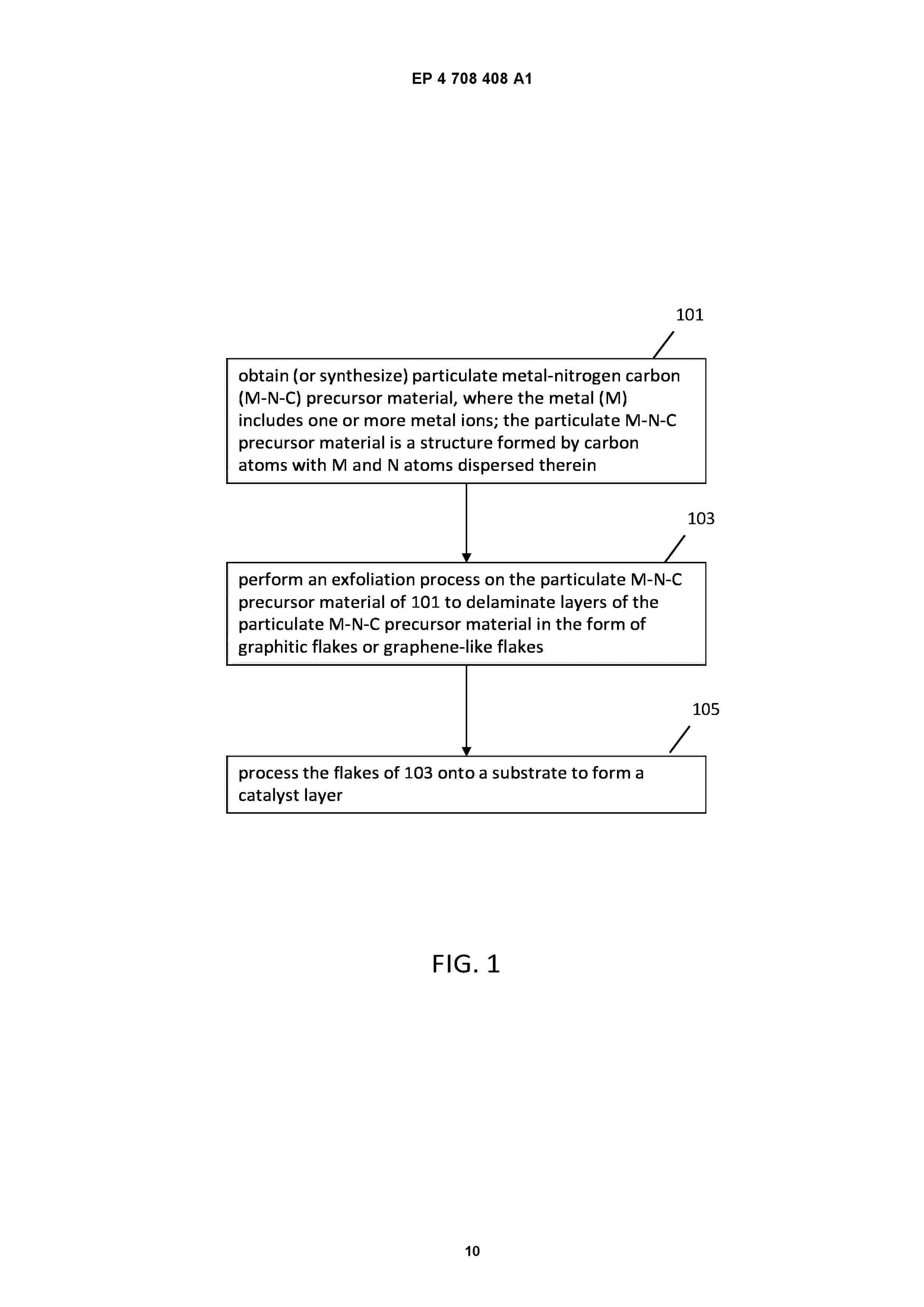
A method for making a carbon-based catalyst involves synthesizing or obtaining particulate precursor material having heteroatoms dispersed in a structure formed by carbon atoms. An exfoliation process is performed on the particulate precursor material to delaminate layers of the particulate precursor material in the form of graphitic flakes or graphene-like flakes. In embodiments, the graphitic flakes or graphene-like flakes can be atomically thin sheets with interstitial and/or edge heteroatoms.
Resumen de: WO2024229266A1
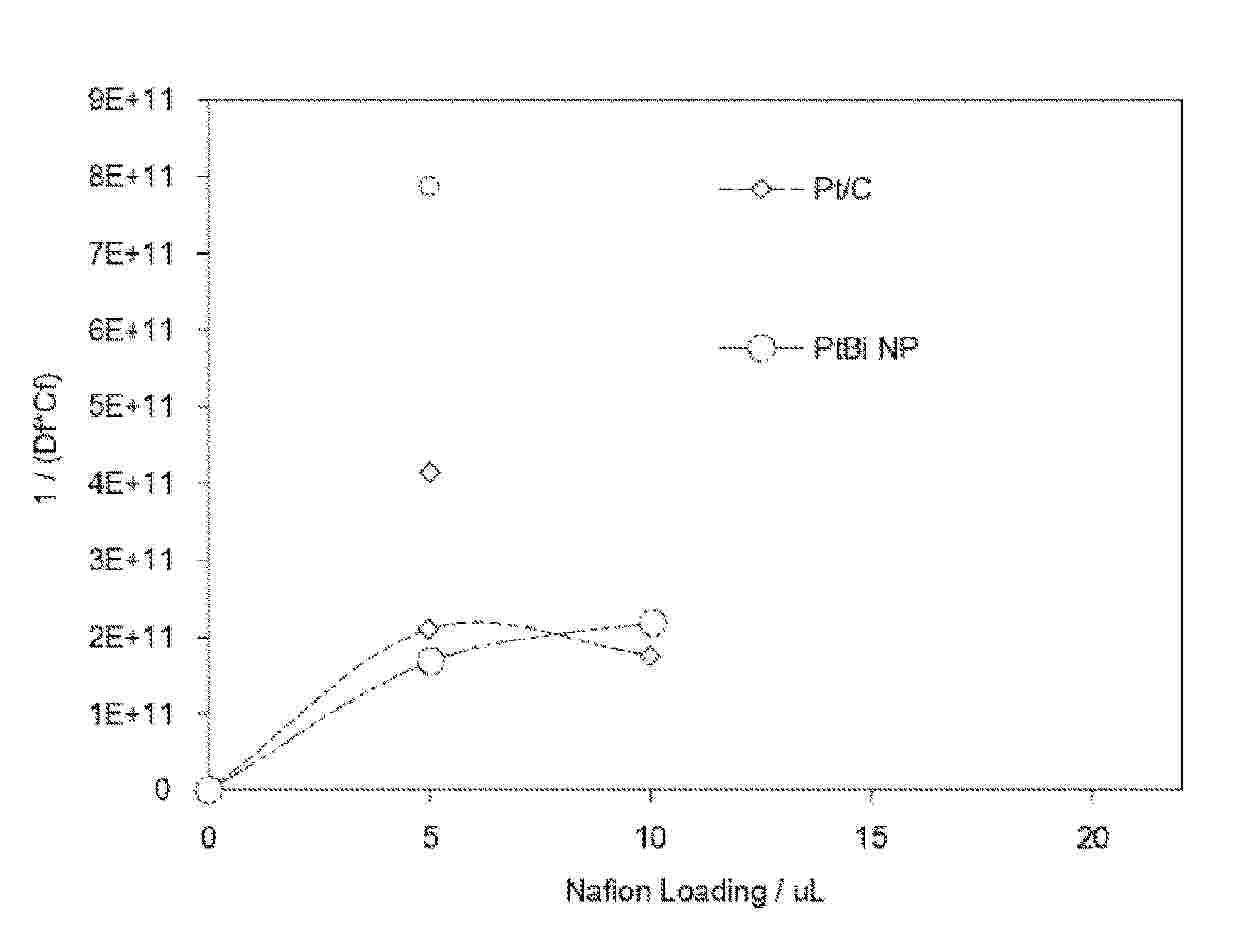
An electrocatalyst ink composition is provided. The ink composition includes a liquid vehicle, particles with at least one electrocatalyst metal, and at least one compound having a phenolic moiety. In various embodiments, the compound comprising a phenolic moiety is resorcinol and the electrocatalyst metal is a platinum-bismuth alloy.
Resumen de: WO2024229230A2
A hybrid electrolyte comprises: (i) a first electrolyte having a first surface and an opposed second surface, wherein the first electrolyte comprises a solid state electrolyte material comprising an oxide, wherein the first surface is an acid-treated surface; and (ii) a second electrolyte comprising a liquid electrolyte, wherein the liquid electrolyte comprises an alkali metal salt and a solvent selected from the group consisting of electron pair donor solvents, and solvent mixtures including at least one electron pair donor solvent and at least one glyme solvent. The oxide can be a doped or undoped LLZO electrolyte material, and the acid can be selected from H3PO4 and HCI.
Resumen de: EP4708413A1
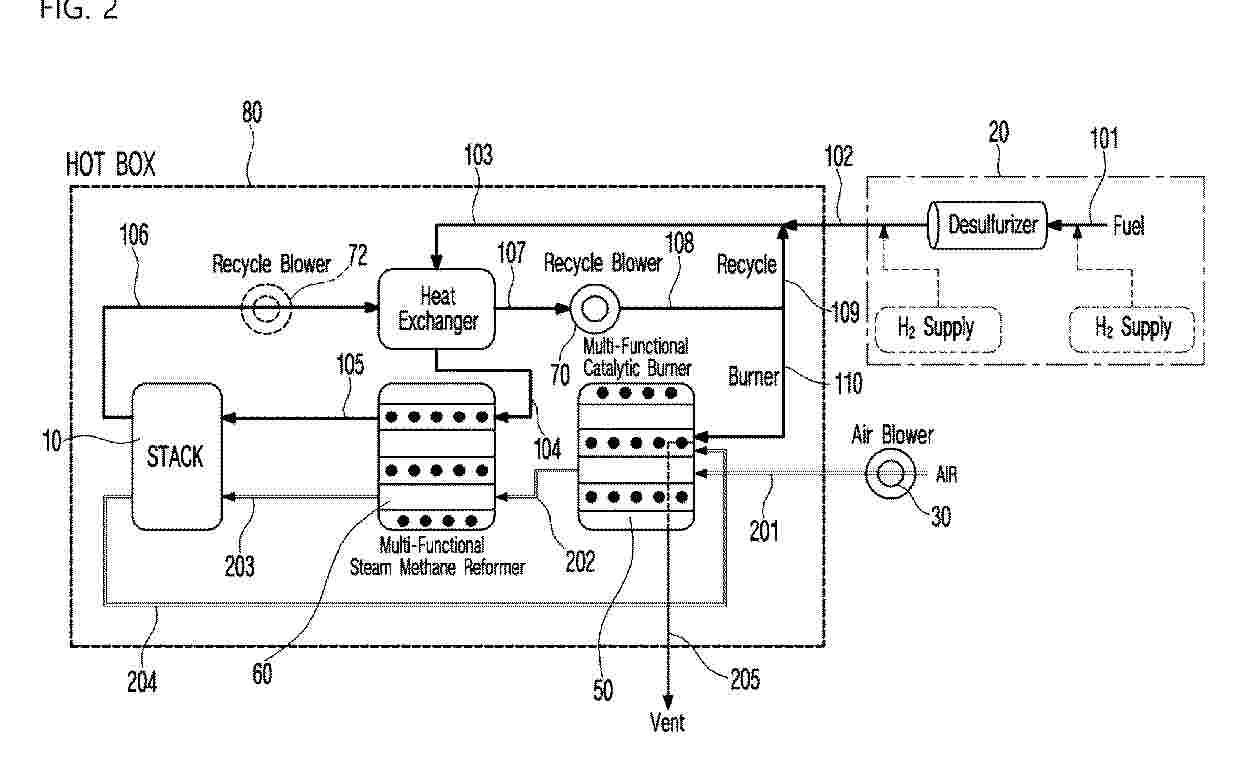
The present invention relates to a solid oxide fuel cell system comprising a catalytic combustor structured as a heat exchanger, and the present invention can maximize heat transfer efficiency by utilizing, as heat sources, all heat originating from a gas flow of a cathode and an anode of a stack, by comprising a multi-functional catalytic combustor structured as a heat exchanger, which utilizes, as heat sources, a stack cathode off-gas discharged from the stack of a fuel cell, and a fuel off-gas of a second exhaust line that diverges after passing through a heat exchanger, in order to increase the temperature of air supplied from an air supply part and supply same to a multi-functional steam reformer.
Resumen de: EP4708409A1
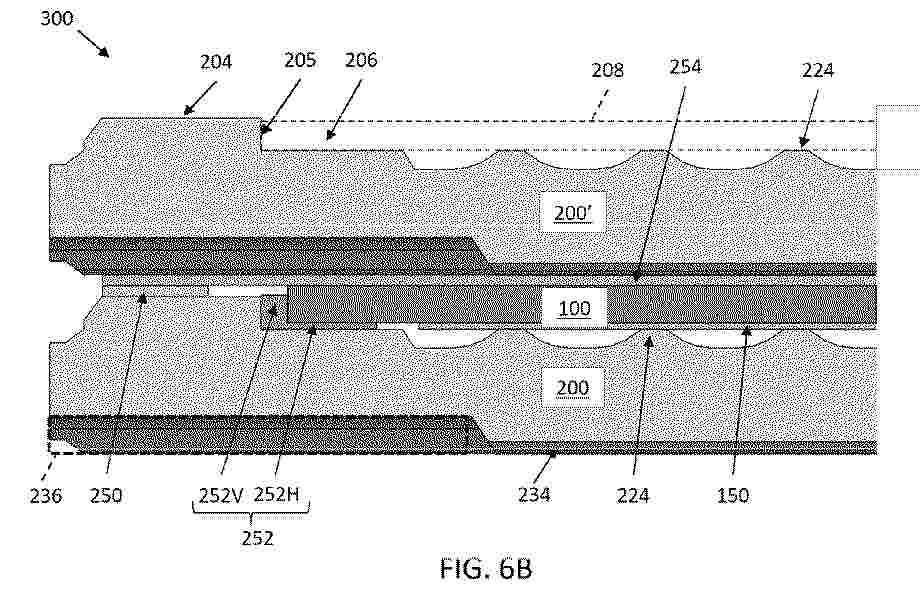
An interconnect for an electrochemical cell stack includes reactant holes that extend through the interconnect, and a reactant side including a reactant field containing reactant channels and reactant ribs that extend between the reactant holes, a peripheral seal surface that surrounds the reactant field and the reactant holes, recess seal surfaces disposed inside of the peripheral seal surface on opposing sides of the reactant field and recessed relative to the peripheral seal surface, and nest sidewalls that connect the recess seal surfaces to the peripheral seal surface. The nest sidewalls extend substantially perpendicular to the peripheral seal surface and to the recess seal surfaces. The nest sidewalls, the recess seal surfaces, and tops of the reactant ribs at least partially define a cell nest configured to receive an electrochemical cell. An air side includes an air field disposed between the reactant holes, and ring seal surfaces disposed around the reactant holes.
Resumen de: EP4708416A1
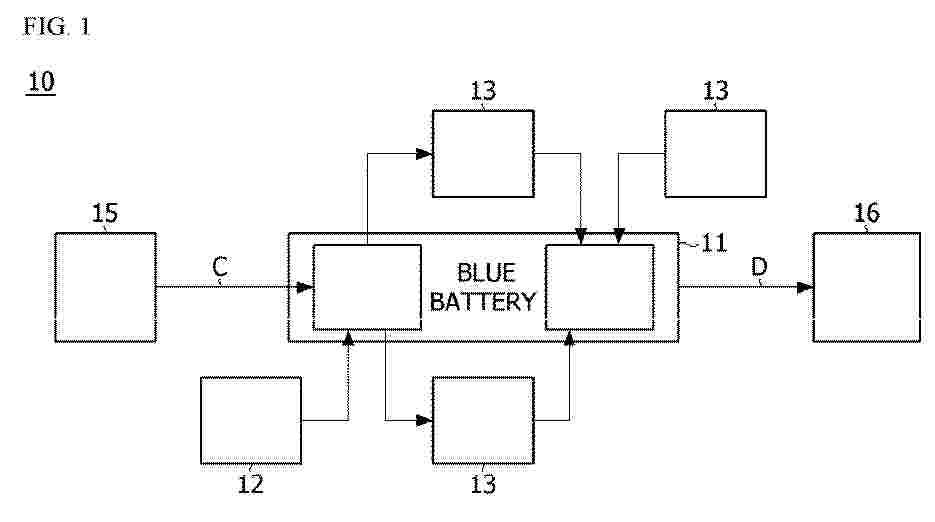
The present invention provides a blue battery for energy storage including a first electrode, a second electrode electrically connected to the first electrode, first and second cation exchange membranes disposed sequentially between the first electrode and the second electrode in a direction from the first electrode to the second electrode, an anion exchange membrane disposed between the first cation exchange membrane and the second cation exchange membrane, a bipolar electrode disposed between the first cation exchange membrane and the anion exchange membrane and including a catalyst layer facing any one of the first cation exchange membrane and the anion exchange membrane, and an ion exchange resin layer facing the other of the first cation exchange membrane and the anion exchange membrane, a first flow path provided between the first cation exchange membrane and the bipolar electrode, a second flow path provided between the bipolar electrode and the anion exchange membrane, and a third flow path provided between the anion exchange membrane and the second cation exchange membrane.
Resumen de: WO2024227860A2
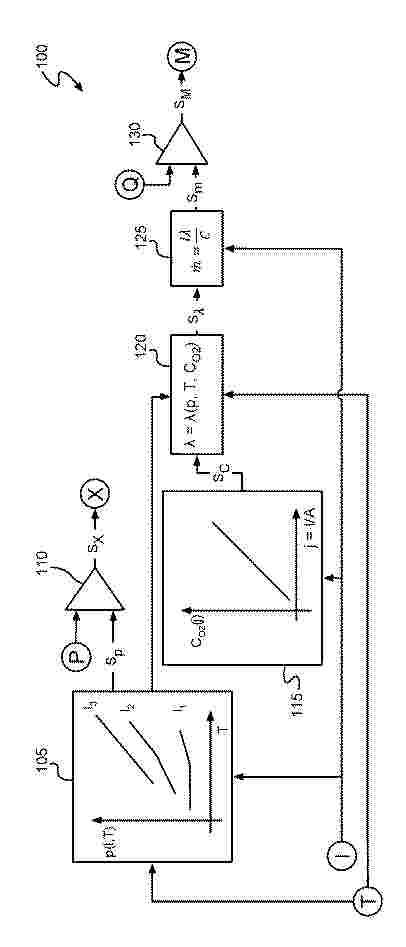
Provided is a method of controlling an operation of a PEM fuel cell system, PEMFCS, comprising a set of one or more PEM fuel cells, PEMFC, a compressor with one or more compressor stages for providing a pressurized gaseous oxidizing agent to a cathode side of the PEMFC, and a controller for controlling an operation of the PEMFCS. The method comprises controlling the PEMFCS, by the controller, so as to cause the compressor to compress and provide the gaseous oxidizing agent to a cathode side of the PEMFC during the operation of the PEMFCS as a function of a target electricity output Oe of the PEMFCS. Specifically, controlling the PEMFCS comprises controlling at least two of the following parameters: a pressure p to which the oxidizing agent is compressed by the compressor, a flow rate r at which the compressed oxidizing agent is provided to cathode side of the PEMFC, and an operating temperature T of the PEMFC, such that an increase of the operating temperature T is accompanied by at least one of a corresponding increase of the pressure p, and a corresponding decrease of a stoichiometric ratio of the consumption of the oxidizing agent in its electrochemical reaction with a fuel in the PEMFC.
Resumen de: WO2024227908A1
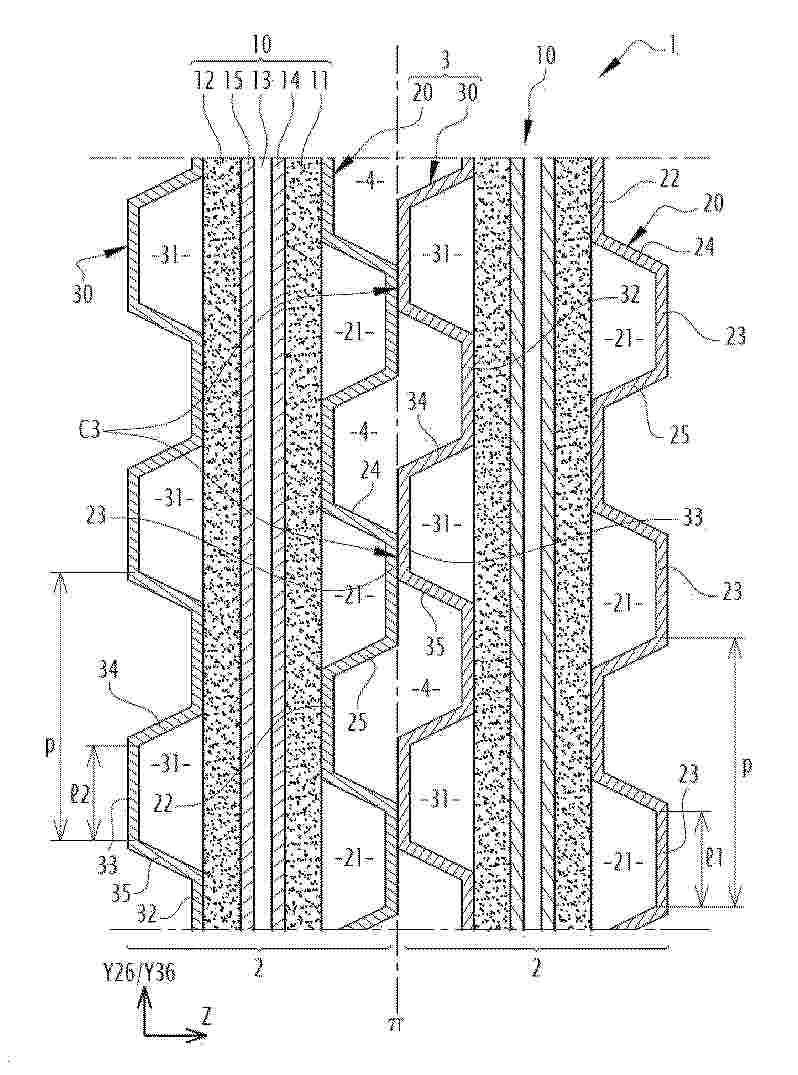
The invention relates to a bipolar plate which has two plates, anode and cathode, which are provided with channels for circulating a reactive fluid. The bottom walls of the channels form identical parallel corrugations (26, 36) which are regularly distributed along a distribution axis (Y26, Y36) and are spaced apart in pairs by a pitch, denoted p. Each of the corrugations defines a mean axis (X26, X36) which is perpendicular to the distribution axis. Each corrugation (26, 36) is delimited by two opposite and parallel longitudinal edges (26A, 26B, 36A, 36B) which are spaced apart by a corrugation width, denoted I1 or l2, and define a neutral fibre (26C, 36C) midway between the two longitudinal edges. Each corrugation (26, 36) includes first and second top portions (26.1, 36.1, 26.2, 36.2) which are arranged on the same first or second side of the mean axis of the corrugation and aligned in a direction parallel to the mean axis. The corrugations have the same offset D along the distribution axis (Y26, Y36). The offset is such that D = p + x where min(l1, l2)/2 < x < (I1 + l2)/2.
Nº publicación: GB2700742A 11/03/2026
Solicitante:
ZEROAVIA LTD [US]
ZeroAvia Ltd
Resumen de: GB2700742A
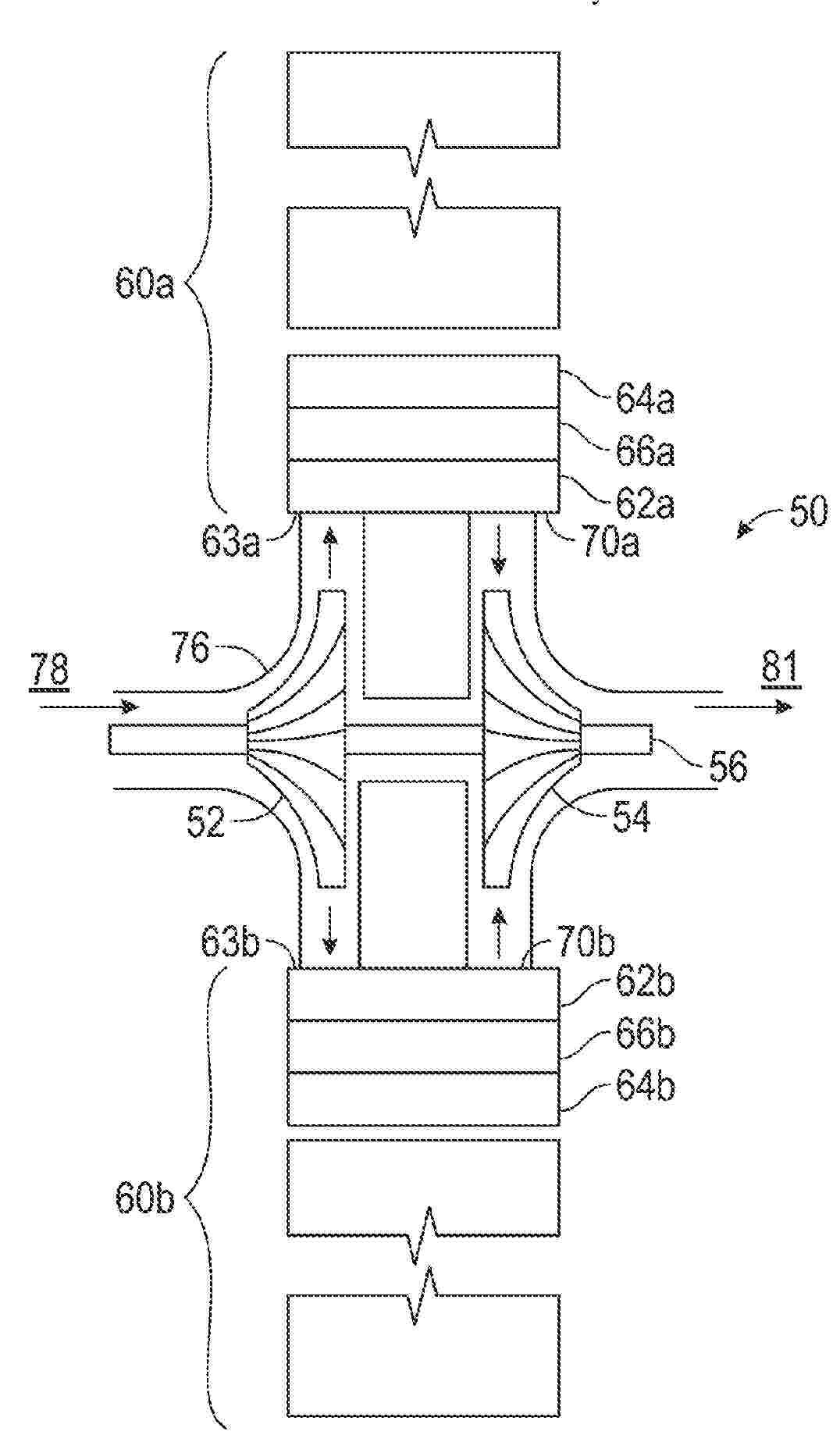
A fuel cell stack 60 comprising a plurality of fuel cells arranged in a stack in a curved pattern. The fuel cells may be spaced from one another, optionally equally spaced. The pattern may be spiral or involute. There may be cooling ducts 76 provided between adjacent stacks, optionally tapered ducts, optionally triangular-shaped. The fuel cells may be hydrogen fuel cells. In a further embodiment, a plurality of fuel cell stacks (Fig. 11, 88) may be arranged in a multi-pointed star pattern (Fig. 11, 89). The star pattern may be flat-sided or curved-sided. An integrated fuel cell electric engine 50 may comprise a compressor 52 and a turbine 54 rotatably mounted on a shaft 56 with one or more of the fuel cell stacks arranged on the outside of the compressor and turbine. The fuel cells may be configured to be cooled by air flow, optionally from the compressor. A vehicle comprising the engine, optionally wherein the vehicle is an aircraft (Fig. 10, 120), optionally wherein the engine is mounted in a fuselage or nacelle of the aircraft. Fig. 6
 BOPI
BOPI
 Sede Electrónica