Resumen de: US20260238177A1
A superconducting circuit may include a transmission line having at least one transmission line inductance, a superconducting resonator, and a coupling capacitance that communicatively couples the superconducting resonator to the transmission line. The transmission line inductance may have a value selected to at least partially compensate for a variation in a characteristic impedance of the transmission line, the variation caused at least in part by the coupling capacitance. The coupling capacitance may be distributed along the length of the transmission line. A superconducting circuit may include a transmission line having at least one transmission line capacitance, a superconducting resonator, and a coupling inductance that communicatively couples the superconducting resonator to the transmission line. The transmission line capacitance may be selected to at least partially compensate for a variation in coupling strength between the superconducting resonator and the transmission line.
Resumen de: AU2025300587A1
In a general aspect, quantum-assisted two-sample test is presented. In some implementations, a hybrid computer system configured to evaluate data points in a dataset includes a quantum computing system and a classical computing system. The classical computing system is configured to cause the quantum computing system to execute a quantum logic circuit to encode the data points from the dataset in the quantum logic circuit which includes at least one layer of single-qubit quantum logic gates and at least one layer of multi-qubit quantum logic gates; obtain measurements of expectation values of quantum states generated by executing the quantum logic circuit on the quantum computing system; determining a quantum density operator associated with the dataset, the quantum density operator being determined based on the measurements; and determining a data characteristic of the dataset based on the quantum density operator.
Resumen de: AU2024414024A1
A quantum information processing device is disclosed. The quantum information processing device comprises a semiconductor device and a single-electron electrometer electrically connected to the semiconductor device. The semiconductor device comprises a plurality of point defects having a plurality of quantum states associated with at least one electron. First transitions are effectible between first ones of the plurality of quantum states by means of electromagnetic signals interacting with the at least one electron. Second transitions occur between second ones of the plurality of states. At least some of the plurality of point defects are arranged in the semiconductor device at distances below 20 nm. The single-electron electrometer is configured to be operated at frequencies of 1 MHz or more.
Resumen de: US20260236641A1
0000 Existing approaches provide limitations to scale Hybrid DFT calculations to large systems and there is no such scalable technique to correct errors during Hybrid DFT computation with tensors. This disclosure relates generally to implementation of Hybrid Density Functional Theory on Quantum Processors with Moller-Plesset Perturbation (MP2) corrected simulation. The system receives a plurality of inputs from a classical computer component to transmit to a quantum computer component. Initially, a density matrix is computed from a core Hamilton. Further, the quantum processor computes a direct (J) matrix, a Hybrid matrix, and a correlation exchange potentials to compute a Fock matrix. Further, the density matrix is iteratively performed for a criteria where difference between the density matrix and an updated density matrix converges to a value below a threshold convergence error. MP2 energy corrections are performed for extracting the plurality of properties associated with the chemical compound.
Resumen de: US20260237468A1
0000 An information processing device calculates an excited state to be calculated based on a predetermined parameter value. The information processing device generates a candidate representing sets of mutually orthogonal states Sx(i) based on the calculated excited state. The information processing device calculates a set of energies for each state Sx(i) in each generated candidate. The information processing device assigns a rank for set of energies of calculated states Sx(i) in each candidate. The information processing device updates each state Sx(i) with one of the candidates based on the assigned rank. The information processing device changes the values of the predetermined parameter Pn so that the rank of the set of the energies of each updated state Sx(i) becomes higher in the coordinate system.
Resumen de: US20260236816A1
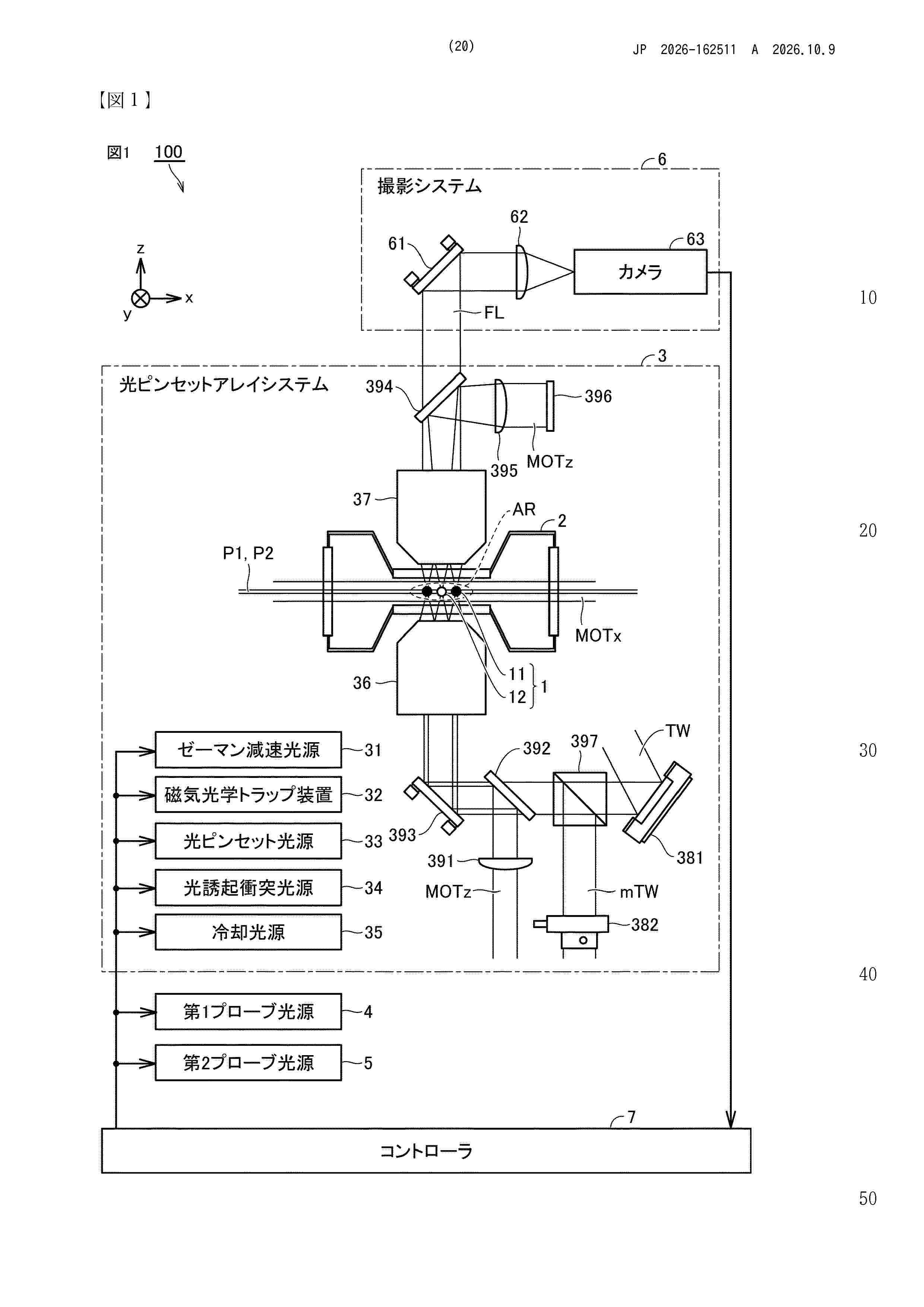
Systems, methods, and computer-readable media of performing state detection of addressing qubits for non-classical computing, may include: (A) obtaining a plurality of qubits in an array of spatially distinct optical trapping sites; and (B) selectively exposing each qubit of a subset of said plurality of qubits to one or more light beams of a plurality of light beams, wherein: (i) each light beam of said plurality light beams comprises two gate operations that are the inverse of each other, and (ii) a target qubit in said subset of said plurality of qubits is exposed to each of said plurality of light beams that are collectively configured to selectively apply a rotation operation to said target qubit.
Resumen de: US20260236811A1
0000 A processing unit causes a quantum computer to execute a quantum circuit including a first-polarity first control gate and a second-polarity second control gate, each controlled by an auxiliary qubit. The first control gate applies a first time-evolution operator corresponding to a Hamiltonian H(λ) to a qubit group corresponding to a quantum state |ψ>. The second control gate applies a second time-evolution operator corresponding to H(λ+δλ) to the qubit group. The processing unit acquires, from the quantum computer, a probability amplitude corresponding to an event that a result of applying the two types of time-evolution operators to the quantum state |ψ> matches |ψ>. The processing unit acquires a cumulative distribution function for an energy level difference between H(λ) and H(λ+δλ) by executing discrete Fourier transform using the probability amplitude, and estimates the difference based on the cumulative distribution function.
Resumen de: US20260236820A1
Hybrid quantum and probabilistic methods for sampling and/or optimization problems may include using a probabilistic processing unit (PPU) to perform classical sampling for part of the problem space and using a quantum processing unit (QPU) to perform quantum sampling for another portion of the problem space. A method may include representing the problem as a graph; partitioning with sparsification the graph into subgraphs; performing classical sampling on a larger subgraph by the PPU; and performing quantum sampling on the smaller subgraph by the QPU. A method may include a non-equilibrium non-local Monte Carlo approach, including obtaining a seed solution; finding backbones or frozen variables in a configuration space; performing classical sampling on the backbones or frozen variables by the PPU, inducing a larger Hamming distance exploration; and providing coordinates from the classical sampling to the QPU and performing quantum sampling based on the coordinates, inducing a smaller Hamming distance exploration.
Resumen de: US20260236683A1
0000 Systems and methods for performing sentiment analysis using natural language processing techniques are provided. A method includes: receiving an input dataset comprising a plurality of natural language sentences and a plurality of sentiment labels; pre-processing the input dataset to convert each natural language sentence into a string diagram representation; converting each string diagram into embedded representations; determining, using a hybrid deep learning model, a predicted sentiment label associated with each embedded representation, wherein each predicted sentiment label is associated with a respective probability that each natural language sentence belongs to a first class; identifying for each predicted sentiment label, a noise level; and optimizing a performance of the hybrid deep learning model by updating one or more parameters of the hybrid deep learning model.
Resumen de: WO2026169778A1
This patent document discloses computer systems, methods and techniques that can be implemented using a quantum processing unit and a classical computing device. Some example embodiments of computer systems and methods can be implemented to provide readout signals from a quantum processing unit to a classical computing device in various applications with quantum computing. An example of such a computer system can include a quantum processing unit comprising a plurality of quantum bit units and one or more pluralities of cryogenic readout circuits; and a classical computing device.
Resumen de: DE102025105174A1
Steuerungssystem (1) zur Steuerung eines Mikrowellen-Ausgabesystems (2) zum Emittieren elektromagnetischer Strahlung zu mindestens zwei Registern (3), die jeweils mindestens ein Ion für eine Quantenberechnung umfassen, mit- eine integrierte Schaltung (5),- einen lokalen Oszillator (6),- mindestens zwei Digital-zu-Analog-Wandlersysteme (7), die jeweils mit der integrierten Schaltung (5) verbunden sind,- mindestens zwei Frequenzmischer (8), die jeweils mit dem lokalen Oszillator (6) verbunden sind, wobei- jedes der mindestens zwei Digital-zu-Analog-Wandlersysteme (7) mit einem der mindestens zwei Frequenzmischer (8) verbunden ist, und- jeder der mindestens zwei Frequenzmischer (8) mit mindestens einem Teil des Mikrowellen-Ausgabesystems (2) verbunden ist, das einem der mindestens zwei Register (3) zugeordnet ist.Weiterhin ist ein Quantencomputersystem (15) vorgesehen.
Resumen de: US20260238656A1
0000 A device may determine a plurality of training data observations corresponding to a plurality of application-layer request messages received at the computing system, the plurality of training data observations including a plurality of fingerprint values determined based on content associated with the plurality of application-layer request messages, a first subset of the plurality of application-layer request messages being classified as malicious, a second subset of the plurality of application-layer request messages being classified as legitimate. A device may determine a classical support vector machine based on a quantum kernel, the quantum kernel being determined based on a quantum feature map and a plurality of quantum states, the quantum feature map embedding the plurality of fingerprint values into a quantum space corresponding to the quantum states. A device may determine a fingerprint value for an application-layer request message received at an application gateway within the computing system.
Resumen de: EP4790601A1
0001 A processing unit acquires, for a plurality of terms included in a Hamiltonian corresponding to a problem to be solved by a variational quantum eigensolver and capable of being simultaneously measured by a quantum computer, first information indicating the variance of each term and the covariance of each pair of terms, upon performing a simultaneous measurement, generates, based on the first information, an optimization problem that minimizes a total sum of the variance of each term and the covariance of each pair based on the constraint that the amount of a change with respect to an average value of the sum of the terms is equal to or less than a predetermined value, determines a plurality of first terms to be simultaneously measured by the quantum computer by solving the optimization problem, and computes the number of samples of the simultaneous measurement based on the minimized total sum.
Resumen de: GB2634325A
A quantum information system comprises a quantum information element 10 and a control line. The quantum information element comprises a first Josephson element J1 and a second Josephson element J2, with each Josephson element comprising a Josephson junction provided between two superconducting islands wherein one of the superconducting islands 16 is common to both the first and second Josephson elements. The superconducting islands of the first Josephson element are coupled to the superconducting islands of the second Josephson element such that the quantum information element comprises a plurality of states. The states comprise a first state, a second state, and a third state, wherein there is a single-excitation transition between the third state and the first state and wherein there is a single-excitation transition between the third state and the second state. The control line is configured to encode into the quantum information element one of two states of a computational subspace: the first state of the computational subspace corresponding to the first state and the second state of the computational subspace corresponding to the second state. The arrangement may reduce bit flip errors and can be used for continuous error detection.
Resumen de: WO2023132865A2
Dynamically reconfigurable architectures for quantum information and simulation are provided. A plurality of neutral atoms is provided. Each neutral atom is disposed in a corresponding optical trap. Each of the plurality of neutral atoms is prepared in a mF = 0 clock state. A pair of neutral atoms of the plurality of neutral atoms is entangled by directing a laser pulse thereto. The laser pulse is configured to transition the pair of neutral atoms through a Rydberg state. The optical trap corresponding to at least one neutral atom of the pair is adiabatically moved, thereby moving one atom of the pair relative to the other atom of the pair without destroying entanglement of the pair.
Resumen de: EP4790598A1
An information processing apparatus acquires error data indicating an error of a first quantum gate. The information processing apparatus generates, using an approximation function that linearly approximates an influence of an additional quantum gate, which is to be added to the first quantum gate, on an operation of the first quantum gate, a linear equation which includes a variable corresponding to the additional quantum gate and indicates a relationship in which the error is canceled by the additional quantum gate. The information processing apparatus determines a second quantum gate corresponding to the additional quantum gate by solving the linear equation for the variable. The information processing apparatus determines a second quantum gate corresponding to the additional quantum gate by solving the linear equation for the variables.
Resumen de: EP4790602A1
An information processing apparatus performs, a plurality of times, an update process of updating a value of a first parameter, which is a variable included in a cost function applied to a variational quantum circuit used for variational quantum eigenvalue computation. The information processing apparatus determines a value of a second parameter representing a weight for an amount of change in the value of the first parameter in each update process, by adding a constant term and a variable term expressed using a ratio between the values of the cost function calculated through the variational quantum eigenvalue computation using the values of the first parameter obtained in the k-th and (k-1)-th update processes. The information processing apparatus performs the (k+1)-th update process using the amount of change weighted by the determined value of the second parameter.
Resumen de: EP4790599A1
An analog computing system having a qubit which is provided with inductors positioned near to the qubit's Josephson junctions and inductors positioned far from the qubit's Josephson junctions. The near inductors exhibit capacitance-reducing behavior and the far inductors exhibit capacitance-increasing behavior as their respective inductances are increased. Near and far inductors can be tuned to homogenize the capacitance of the qubit across a range of programmable states based on predicted and target capacitance for the qubit. The inductors may be tuned to homogenize both capacitance and inductance.
Resumen de: GB2703842A
A photonic chip 200 for an ion trap system comprising: a conductive window structure 206 configured to transmit electromagnetic radiation within a first wavelength range further comprising: aluminium doped zinc oxide (AZO); a photonics layer 204 configured to: i) permit the propagation of electromagnetic radiation through the photonic chip, such as light delivered from a laser source 208; and ii) emit electromagnetic radiation from the photonic chip via the conductive window structure and/or receive electromagnetic radiation via the conductive window structure. The ion trap may trap 40Ca+ ions or 137Ba+ ions and may be for quantum information processing. The photonic layer may comprise a grating coupler and a thin-film stack comprising one or more conductive electrodes configured to provide electrical control of an electromagnetic field. The photonic chip may be fabricated using an electron beam lithography process. (Figure 2)
Resumen de: EP4790597A1
It is provided a method for measuring on a quantum computing device an expectation value of an observable in a given quantum state. The method comprises (a) obtaining an efficient tensor network representation T of the observable in the Pauli basis; (b) extracting from the observable a sum of one or more directly measurable operators, each directly measurable operator being: i) such that after applying a local qubit rotation at each qubit site, said directly measurable operator is diagonal in a Z basis, and ii) represented by an efficient tensor network; (c) for each directly measurable operator, applying said local qubit rotations on the qubits of the quantum device and measuring said qubits in a computational basis to compute expectation values corresponding to each of said directly measurable operators; (d) combining the expectation values of said directly measurable operators to compute an approximation of the expectation value of the observable.
Resumen de: WO2026054753A2
Systems, devices, and methods for performing hierarchical multiplexing while encoding a logical qubit or a logical block. A plurality of respective layer one copies are produced of each brick of a plurality of bricks of a target fusion network. A respective first quality metric is determined for each layer one copy of each brick of the plurality of bricks. Based at least in part on the first quality metrics, a first layer one copy of the respective layer one copies is selected for each brick of the plurality of bricks. The first layer one copies are fused together to produce an aggregate brick. This process is hierarchically iterated for one or more layers of sub-bricks of the plurality of bricks.
Resumen de: WO2025264200A2
Non-Abelian anyons are created, braided, and fused using the physical qubits of a QCCD-based quantum processor. A controller controls operation of a confinement apparatus to cause a plurality of physical qubits to be confined by the confinement apparatus. At least some of the plurality of physical qubits are logically organized onto a lattice and have been prepared to provide a non-Abelian topological order ground state. The lattice is formed of a plurality of sublattices. The controller causes performance of an anyon creation gate to cause creation of a first pair of non-Abelian anyons on a sublattice of the plurality of sublattices; causes a path traversal gate sequence to be performed to cause at least a first anyon of the first pair of anyons to traverse a braiding path to form a closed loop on the sublattice; and determines a fusion channel formed by fusing the first pair of anyons.
Resumen de: CN121444010A
Systems and methods for generating entangled photons are presented. The systems and methods generally utilize dopant molecules contained in a host material within a microcavity. The dopant molecules are generally associated with a ground state triplet (GST) electron manifold. When the dopant molecules are subjected to light, the electron state of the dopant molecules is excited to an excited triplet (EST) electron manifold. The electronic state then decays via a transition path that includes a zero phonon line (ZPL) electron transition. In the presence of the microcavity, the decay rate of electron transition along the ZPL is greatly enhanced. Thus, when the dopant molecules decay from the EST electron manifold to the GST electron manifold they emit photons having a nearly pure optical state (e.g., nearly pure wavelength and optical polarization). Thus, the optical state of the emitted photons correlates with the electronic state of the dopant molecules.
Resumen de: WO2025090259A2
Photonic circuits can generate entangled "seed" states of two or more photonic qubits, such as Bell states, 3-GHZ states, 4-GHZ states, and 4-Line states. A set of input waveguides to receive photons is coupled to via a network of linear optical components to a set of output waveguides including a first subset of output waveguides and a second subset of output waveguides. The network of linear optical components can implement a unitary transform operation that probabilistically produces either a success output state or a failure output state. Photon detectors coupled to the second subset of output waveguides can provide photon counts to a classical decision logic circuit that determines whether the output state is the success output state or the failure output state. The unitary transform can be selected and output waveguides can be assigned to the subsets in a manner that provides robustness against errors in the circuit.
Nº publicación: EP4789222A2 12/08/2026
Solicitante:
QUANTINUUM LLC [US]
Quantinuum LLC
Resumen de: WO2025090260A2
A quantum object confinement apparatus is provided comprising one or more electrode sequences and a voltage control circuit for providing analog control signals to at least a first symmetric pair of control electrodes of one of the electrode sequences. The voltage control circuit (i) selectively closes one of a first plurality of switches to complete an electrical connection between the voltage control circuit and a first symmetric control electrode and (ii) simultaneously selectively closes one of a second plurality of switches to complete an electrical connection between the voltage control circuit and a second symmetric control electrode. The voltage control circuit applies a same voltage to an input of the one of the first plurality of switches and to an input of the one of the second plurality of switches prior to selectively closing and as the switches close.