Si deseas distinguir tus productos, servicios o ambos de los de otra empresa, es posible que necesites una marca o nombre comercial. Descubre qué son, en qué consiste su procedimiento de registro y qué implica.

Información sobre los plazos de presentación de solicitudes de transformación de marcas de la Unión Europea en marca nacional española. Más información


Si tienes un nuevo dispositivo, producto o procedimiento que resuelva un problema técnico o tenga una ventaja práctica, existen distintas formas de protegerlo en España y en otros países. Descubre cómo hacerlo.

¿Tu innovación reside en la estética, la ornamentación o la apariencia de tu producto? Protégela mediante un diseño industrial. Descubre qué derechos confiere el registro y cómo realizar la tramitación.

Las indicaciones geográficas protegen el nombre de un producto originario de una zona geográfica, a la cual le debe una determinada calidad, reputación u otra característica. Descubre qué son, en qué consiste su procedimiento de registro y qué beneficios conceden.

Las patentes publicadas en todo el mundo son una valiosa fuente de información científica, técnica y comercial.

Si eres emprendedor/a o una empresa y quieres potenciar y mejorar la rentabilidad de tu negocio protegiendo de forma adecuada los activos intangibles de tu organización, en este espacio encontrarás lo necesario.


 1009
resultados
1009
resultados
 Última actualización
25/10/2026 [07:03:00]
Última actualización
25/10/2026 [07:03:00]


 Resultados 975 a 1000 de 1009

Resumen de: DE102025107067A1
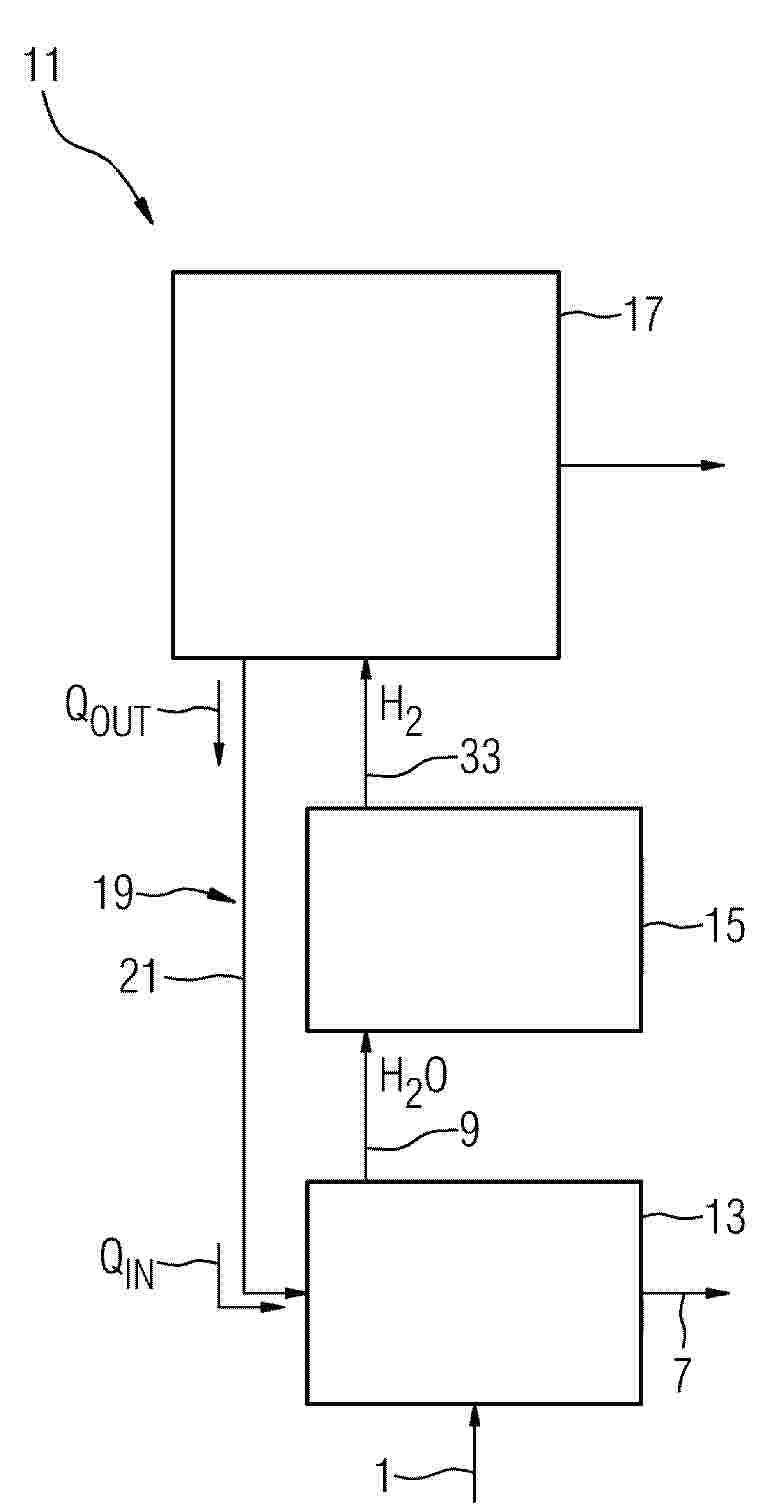
Die Erfindung betrifft ein Verfahren zur Aufbereitung von Rohwasser (1) für die Nutzung als Edukt-Wasser in einem Elektrolyseprozess, bei dem salzbeladenes Rohwasser (1) bereitgestellt und eine thermische Entsalzung des Rohwassers (1) durchgeführt wird, wobei Wärme (QIN) dem Rohwasser (1) zugeführt und dieses verdampft wird, wobei salzfreies Wasser (H2O) abgezogen wird, das als Edukt-Wasser (9) bereitgestellt und einem Elektrolyseprozess zugeführt wird, bei dem Wasserstoff (H2) als Produktgas erzeugt wird, wobei der erzeugte Wasserstoff (H2) verladen wird, indem der Wasserstoff (H2) einem exothermen Verladeprozess unterzogen wird, aus dem Wärme (QOUT) freigesetzt wird, wobei freigesetzte Wärme (QOUT) übertragen und als Heizwärme (QIN) dem Rohwasser (1) zugeführt und zur Verdampfung genutzt wird.Die Erfindung betrifft weiterhin ein Wasseraufbereitungssystem (11) zur Durchführung des Verfahrens.

Resumen de: US20260250854A1
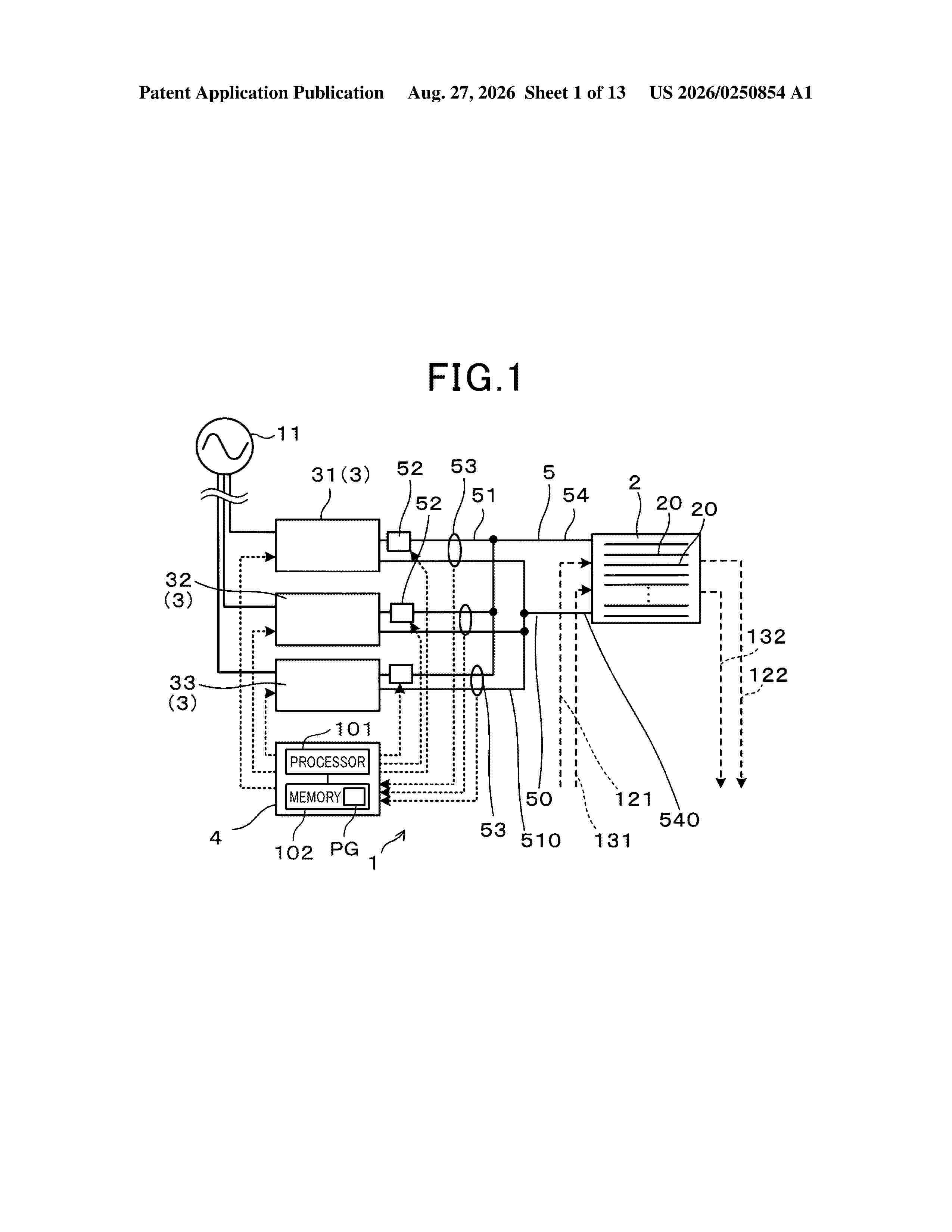
0000 A hydrogen production system of the present disclosure includes an electrolytic device, a plurality of electrical power conversion devices that convert three-phase AC power to DC power and supply the DC power to the electrolytic device, and a control device that controls the electrical power conversion devices. The electrolytic device is connected with the plurality of electrical power conversion devices connected in parallel with each other. The control device is configured to correct, when electrical power supply from some of the plurality of electrical power conversion devices to the electrolytic device is stopped, at least one of voltage and current of the electrical power conversion device that is continuing electrical power supply to the electrolytic device so that a later hydrogen production amount of the electrolytic device approaches a predetermined target amount.
Resumen de: US20260250853A1
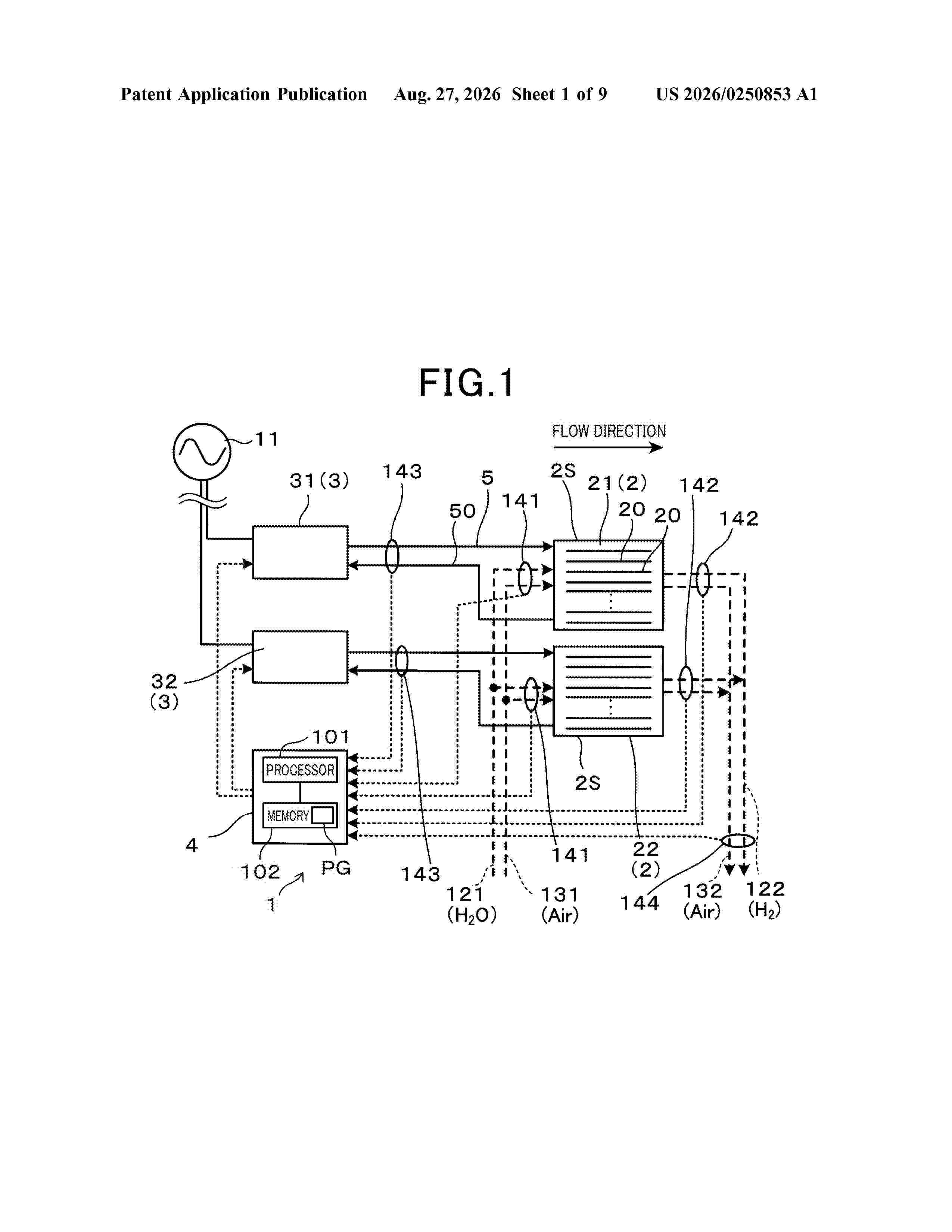
0000 A hydrogen production system of the present disclosure includes a plurality of electrolyzers which produce hydrogen by electrolyzing a raw material, a plurality of power converters which convert three-phase AC power into DC power and supply the DC power to the plurality of electrolyzers, and a control device which controls the plurality of power converters. Each electrolyzer is connected to a different one of the power converters. The control device is configured to individually control a current or a voltage supplied from the plurality of power converters to each electrolyzer by individually controlling the plurality of power converters, and to control the current or the voltage supplied from the power converter to a measured electrolyzer based on a detection value detected by at least one detection unit of an inlet gas state detection unit, an outlet gas state detection unit, and a power supply physical quantity detection unit.
Resumen de: WO2026177750A2
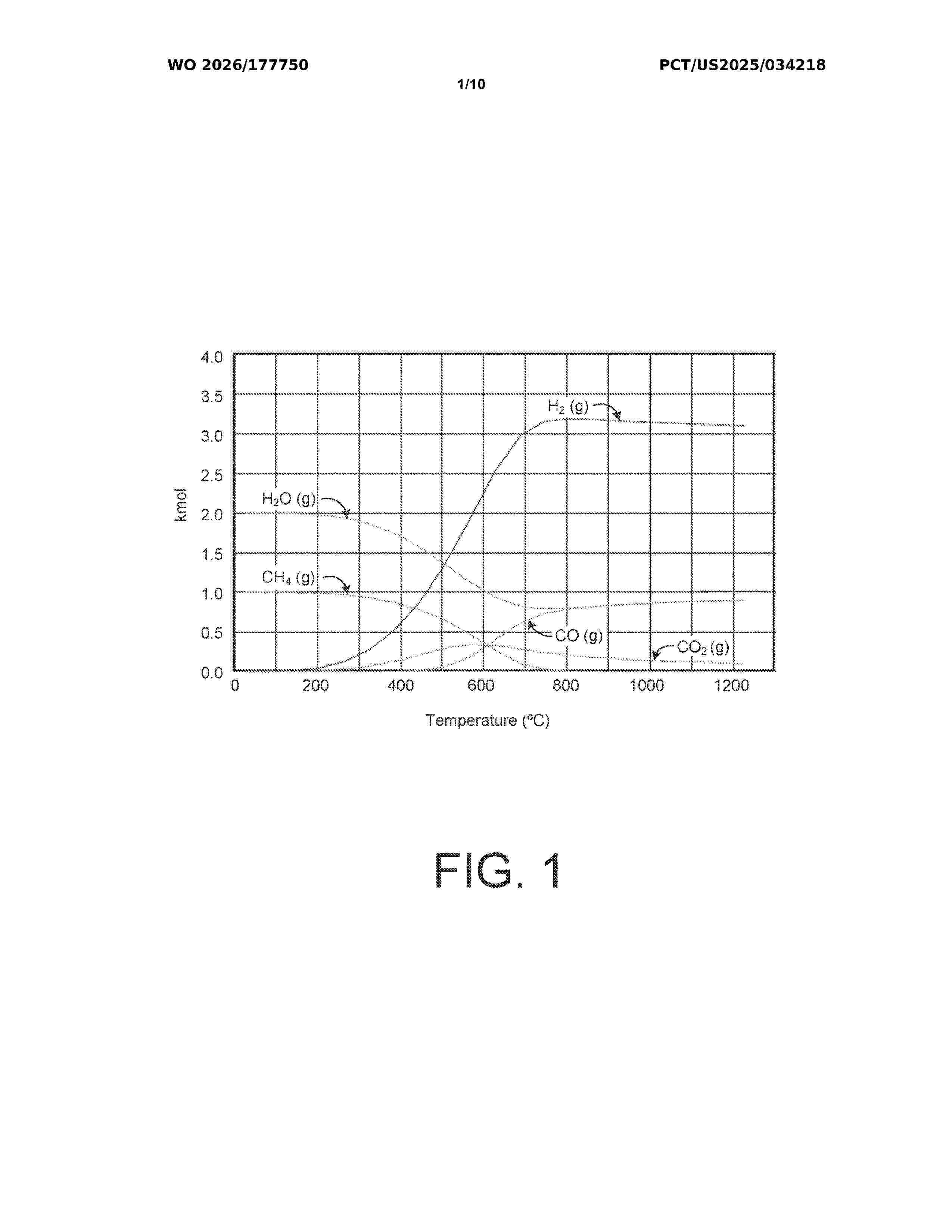
An integrated energy system (IES) including a power plant is discussed herein. In some examples, the IES may include a power plant configured to generate steam, a Low-Temperature Methane Steam Reforming plant configured to receive at least a portion of the steam from the power plant to react with Methane within the Low-Temperature Methane Steam Reforming plant to produce Hydrogen, first Carbon Monoxide, and Carbon Dioxide, a first separation unit configured to separate the Hydrogen, the first Carbon Monoxide, and the Carbon Dioxide, a Solid Oxide Electrolysis Stack configured to receive at least a portion of the Carbon Dioxide and to produce second Carbon Monoxide and Oxygen, a second separation unit configured to separate the Carbon Dioxide from the second Carbon Monoxide, and a methanol synthesis reactor configured to receive at least a portion of the Hydrogen and at least a portion of the second Carbon Monoxide to produce Methanol.
Resumen de: WO2026176213A1
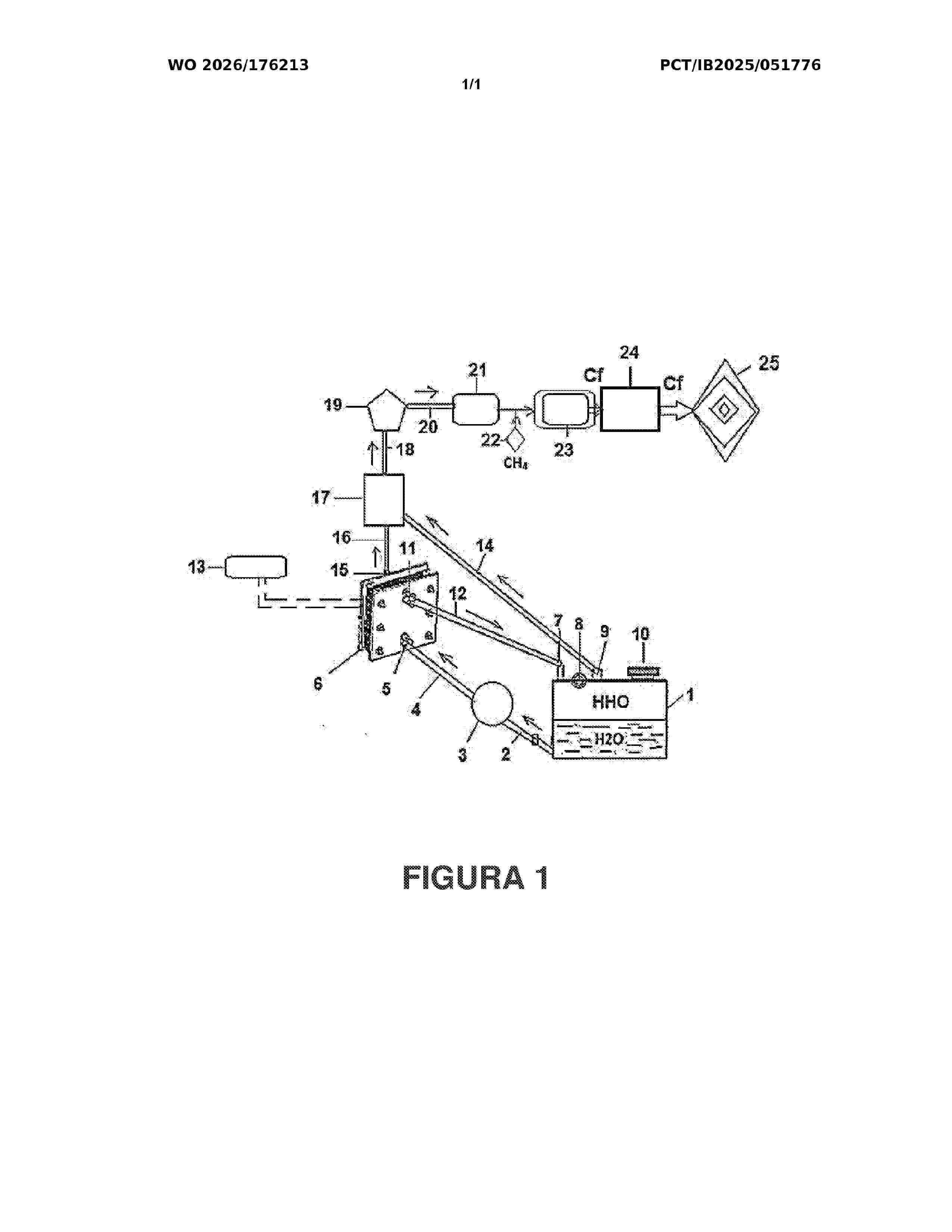
The present invention relates to a system for generating energy by means of hydrogen gas (HHO) for domestic and industrial use, wherein the system is used as an energy source in different applications, such as heating, cooking, boilers and industrial motors or similar. The system comprises a set of units and devices that includes a multipolar cell and several interconnected components, such as pressure valves, a pressurised pump and a gas mixer, which allow HHO to be produced, controlled, and blended with other fuels, optimising energy efficiency and reducing carbon emissions.
Resumen de: WO2026175484A1
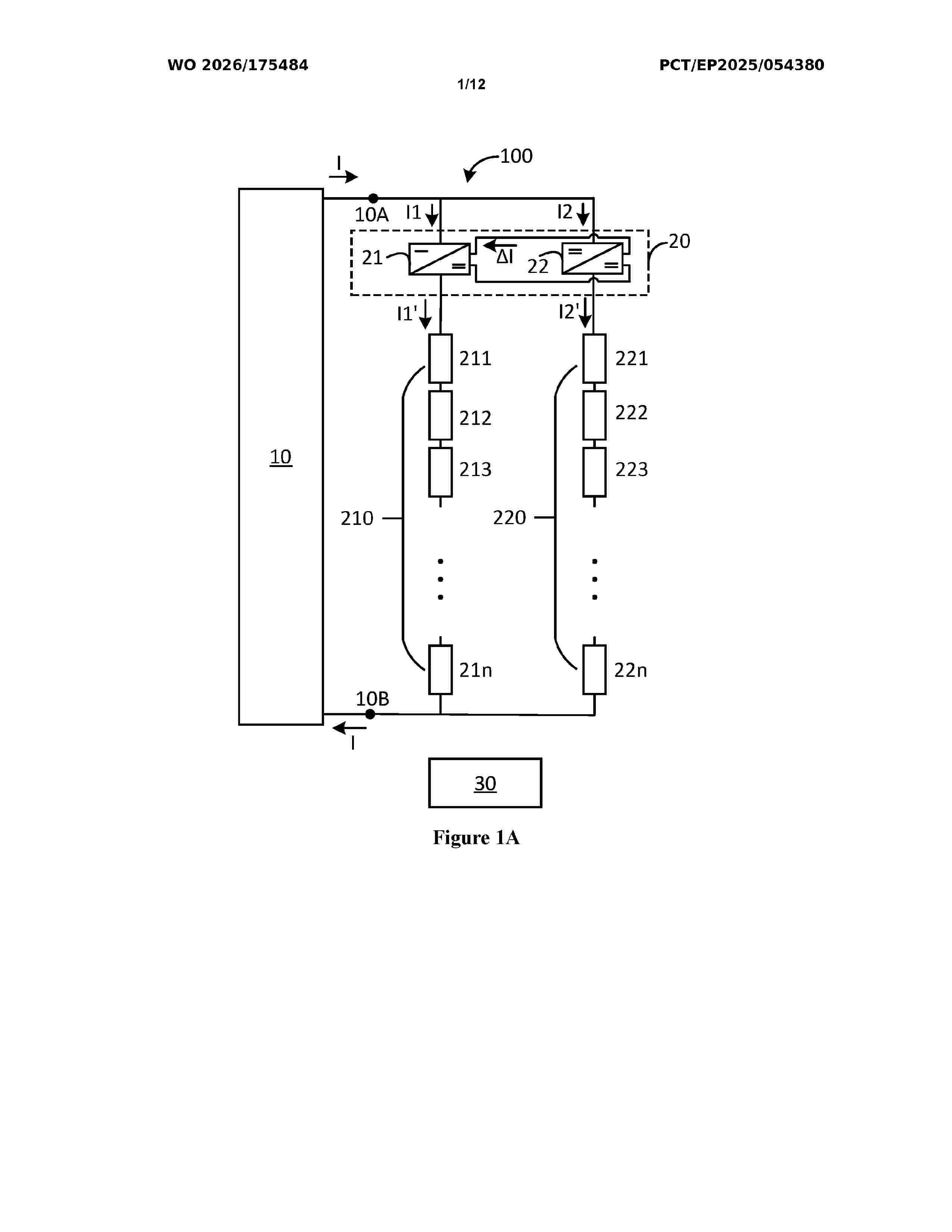
A converter system (100) for powering a plurality of hydrogen electrolyzers is provided. The plurality of hydrogen electrolyzers are electrically coupled together to form at least two electrolyzer strings (210, 220). The converter system (100) comprises: a main power supply unit (10) comprising a main converter that provides bulk power to the at least two electrolyzer strings (210, 220) such that a main current flows through each of the at least two electrolyzer strings; an auxiliary power supply unit (20) comprising at least one DC/DC converter, which is electrically coupled with one electrolyzer string from the at least two electrolyzer strings to inject or extract an adjustable current to or from the one electrolyzer string; and a control system (30) configured to control at least one of the main power supply unit (10) and the auxiliary power supply unit (20) for operating the converter system (100).
Resumen de: WO2026176299A1
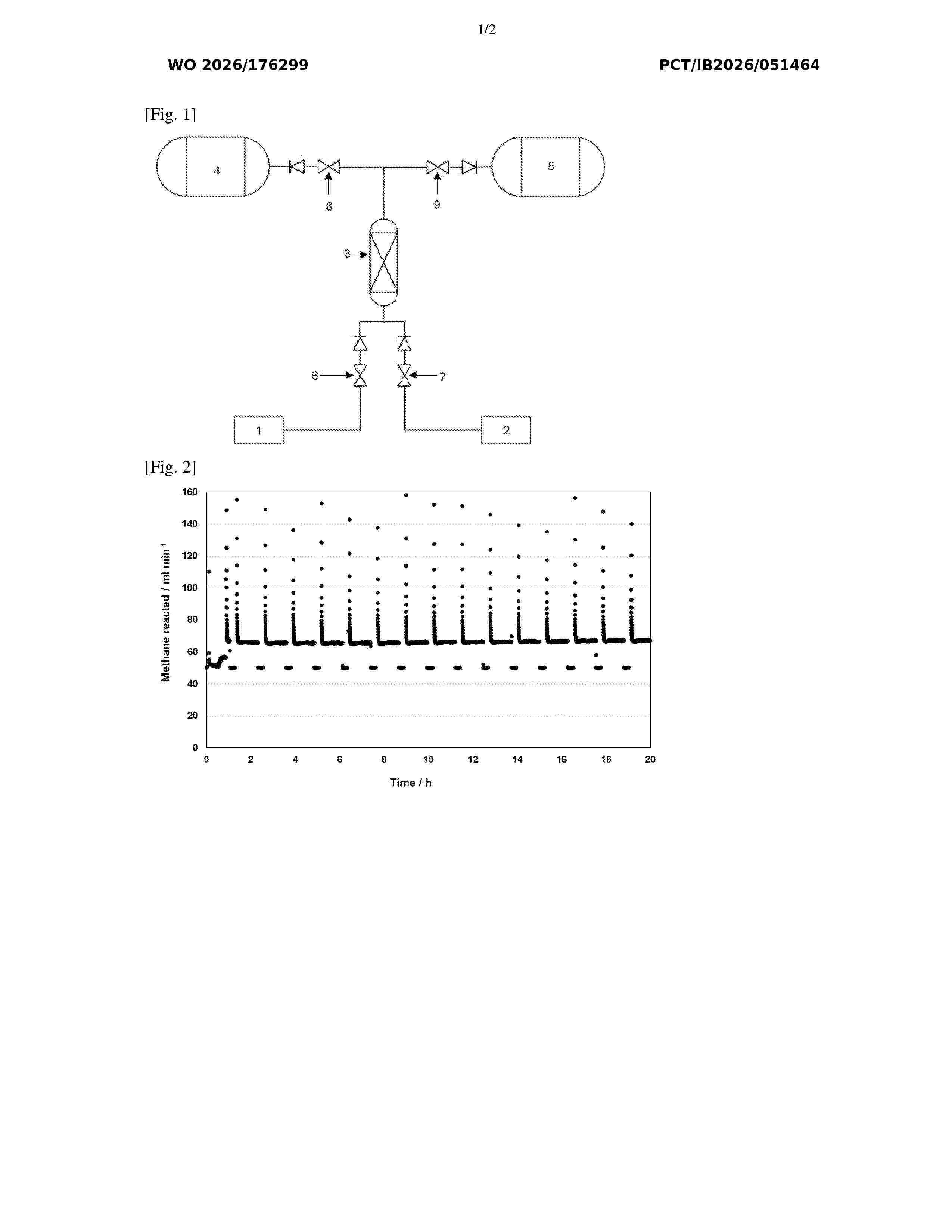
The present application relates to an advanced process for the decoupled production of hydrogen and carbon monoxide from hydrocarbons and carbon dioxide. This process combines the catalytic decomposition of hydrocarbons with the gasification of a solid carbon intermediate to separately produce and store hydrogen and carbon monoxide. From an industrial perspective, this process allows for an easy and highly flexible subsequent mixture of the two products that is critical for downstream processes.
Resumen de: WO2026175483A1
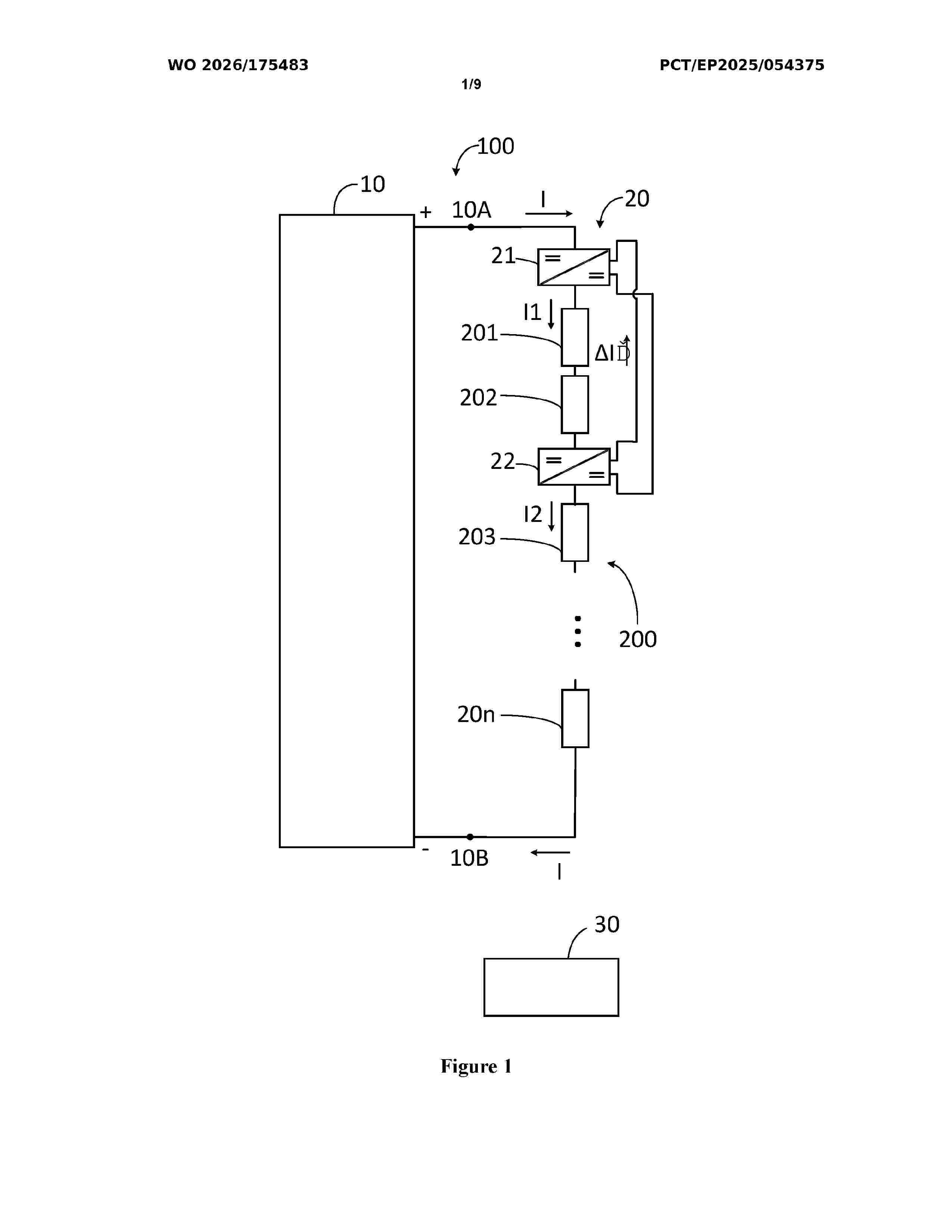
The present disclosure provides a converter system (100) for powering a plurality of hydrogen electrolyzers that are electrically coupled together to form at least one electrolyzer string (200). The converter system (100) includes a main power supply unit (10) configured to provide bulk power to the at least one electrolyzer string (200) such that a main current flows through the at least one electrolyzer string (200); an auxiliary power supply unit (20) comprising at least one DC/DC converter (21), which is electrically coupled with the at least one electrolyzer string (200) to inject or extract an adjustable current to or from the at least one electrolyzer string (200); and a control system (30) configured to control at least one of the main power supply unit (10) and the auxiliary power supply unit (20) for operating the converter system (100).
Resumen de: WO2026176844A1
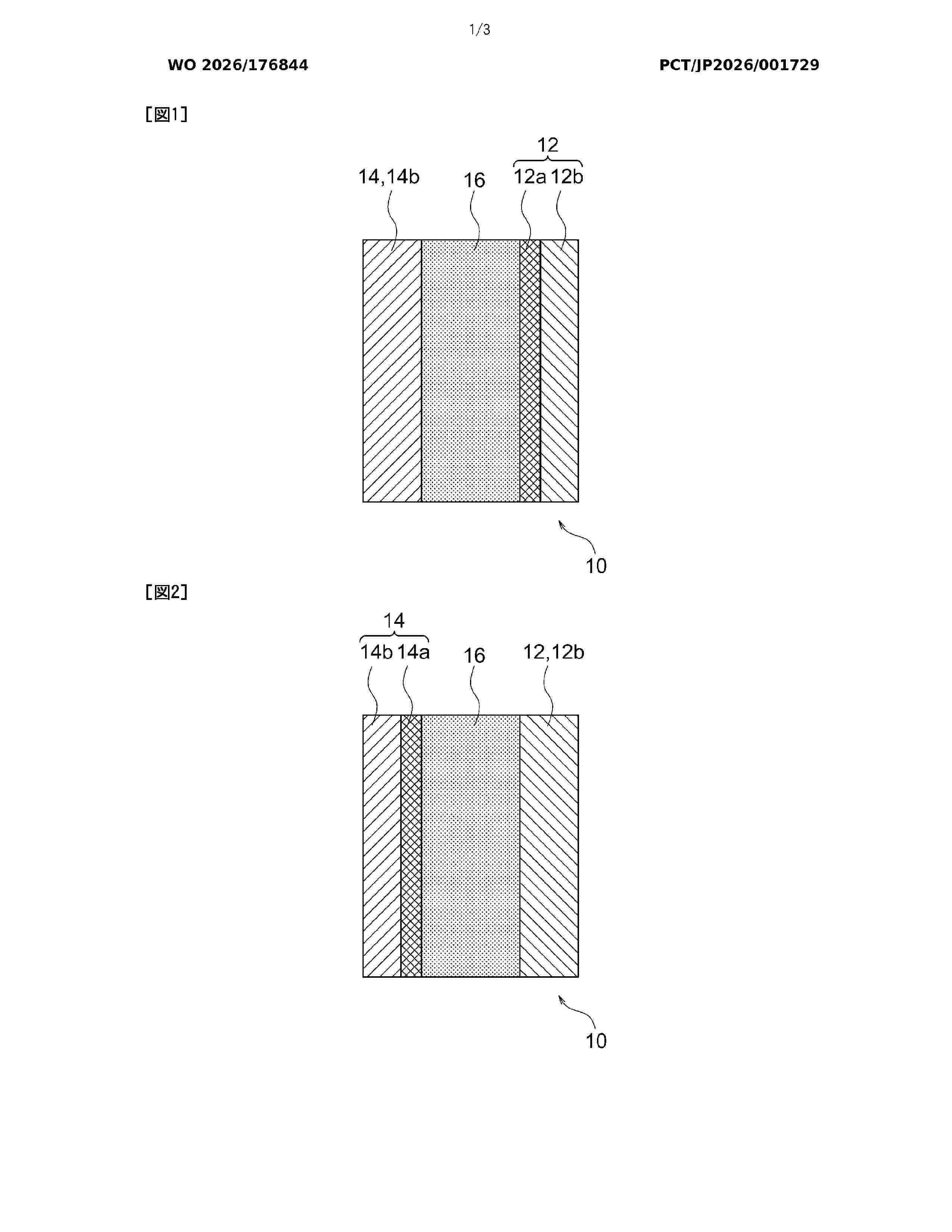
Provided is an electrode laminate for an alkaline water electrolysis cell in which a short circuit due to breakage of a diaphragm is unlikely to occur while having a zero gap structure. The electrode laminate for an alkaline water electrolysis cell comprises: an anode that serves as an oxygen generation electrode; a cathode that serves as a hydrogen generation electrode; and a diaphragm that is interposed between the anode and the cathode and has hydroxide ion conductivity. The electrode laminate has a zero gap structure in which the anode, the diaphragm, and the cathode are laminated so as to be in contact with each other. The anode includes an anode stress relaxation layer, which is deformable by stress, on a surface that is in contact with the diaphragm, and/or the cathode includes a cathode stress relaxation layer, which is deformable by stress, on a surface that is in contact with the diaphragm.
Resumen de: US20260250126A1
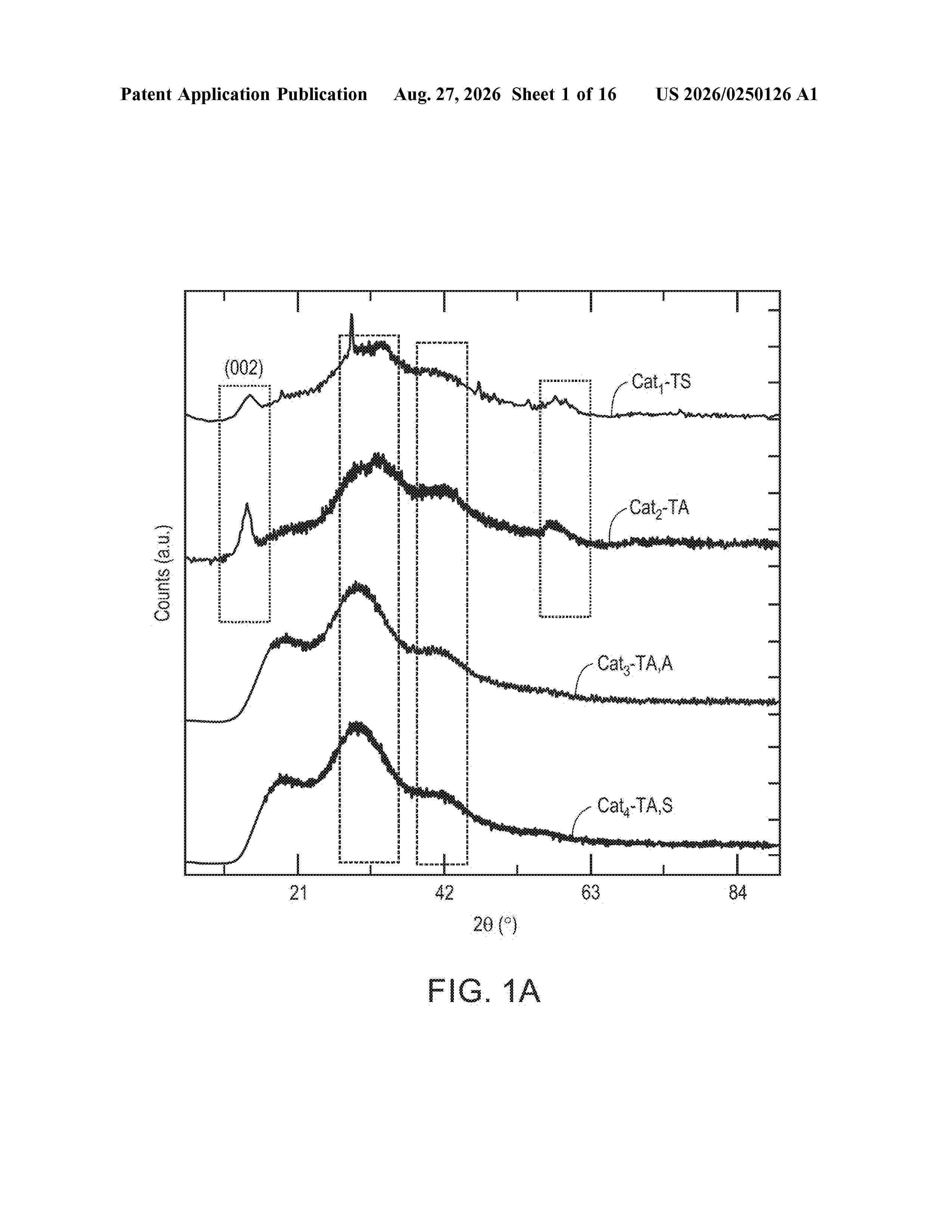
A method for converting hydrogen sulfide (H2S) to hydrogen (H2) and sulfur(S) includes contact a H2S-containing feed gas stream with a molybdenum disulfide (MoS2) catalyst at a temperature of about 500 to about 1000° C., thereby converting at least a portion of the H2S to H2 and S and producing a spent catalyst in-situ and a residue gas stream leaving the reactor. A method for preparing the MoS2 catalyst in the form of a flower-like nanosheet microsphere. A method for preparing the MoS2 catalyst in the form of a nanosheet.
Resumen de: WO2026177000A1
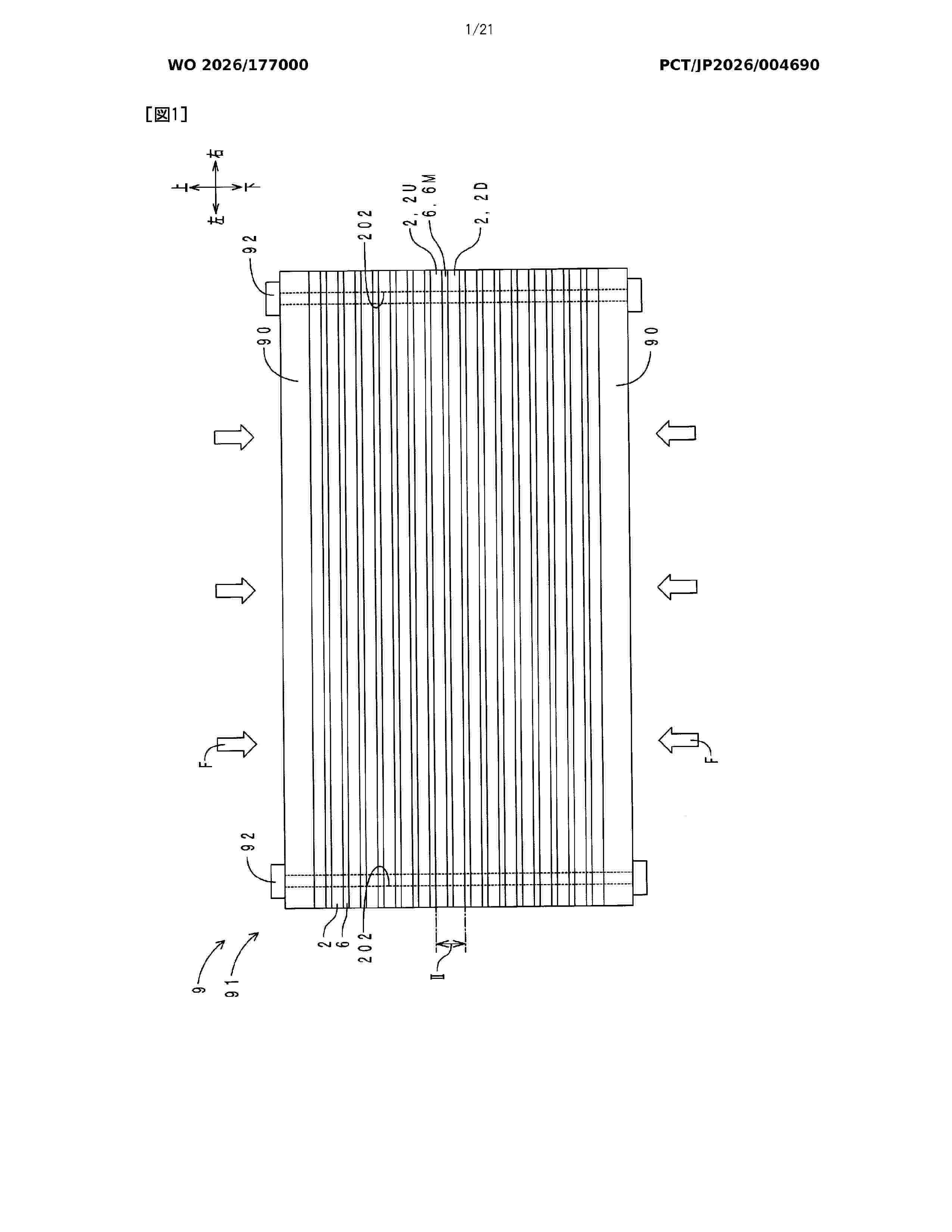
The present invention addresses the problem of providing a bipolar plate with a double-sided gasket, which has high productivity. This bipolar plate (2) comprises a bipolar plate main body (20) and a gasket (5). A front-side gasket (5U) of the gasket (5) is provided with a front-side first seal part (52U) and a front-side second seal part (53U). A rear-side gasket (5D) of the gasket (5) is provided with a rear-side first seal part (52D) and a rear-side second seal part (53D). On the front surface (20U) side of the bipolar plate main body (20), the front-side first seal part (52U) surrounds first manifolds (20La, 20Rb) and a front-side flow path area (21U), and the front-side second seal part (53U) surrounds second manifolds (20Lb, 20Ra). On the rear surface (20D) side of the bipolar plate main body (20), the rear-side first seal part (52D) surrounds the first manifolds (20La, 20Rb), and the rear-side second seal part (53D) surrounds the second manifolds (20Lb, 20Ra) and a rear-side flow path area (21D).
Resumen de: WO2026175476A1
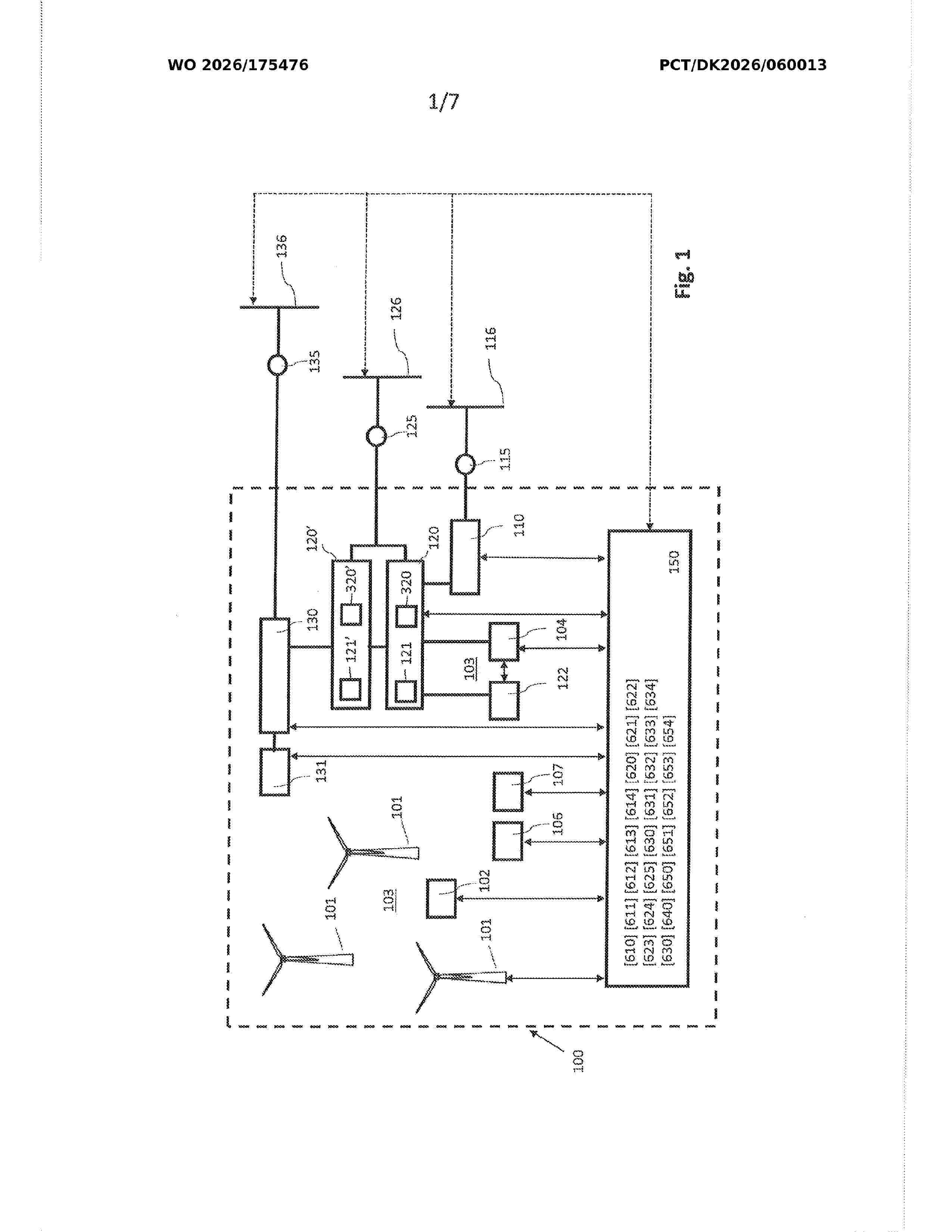
A method (200) for handling a waste heat generated by at least one component of a wind turbine generator is presented. The method (200) comprises: - determining (210) that an inflow of thermal energy to at least one electrolyzer (121) is needed to control the at least one electrolyzer (121) to operate in a specific electrolyzer state; and - transferring (220) a turbine thermal energy TEturbine associated with at least a part of the waste heat from the wind turbine generator (101) to the at least one electrolyzer (121), by transferring the turbine thermal energy TEturbine from a turbine temperature controlling arrangement (310) to at least one electrolyzer temperature controlling arrangement (320) of the at least one electrolyzer (121) via a connection (322, 330, 340) between the turbine temperature controlling arrangement (310) and the at least one electrolyzer temperature controlling arrangement (320), respectively.
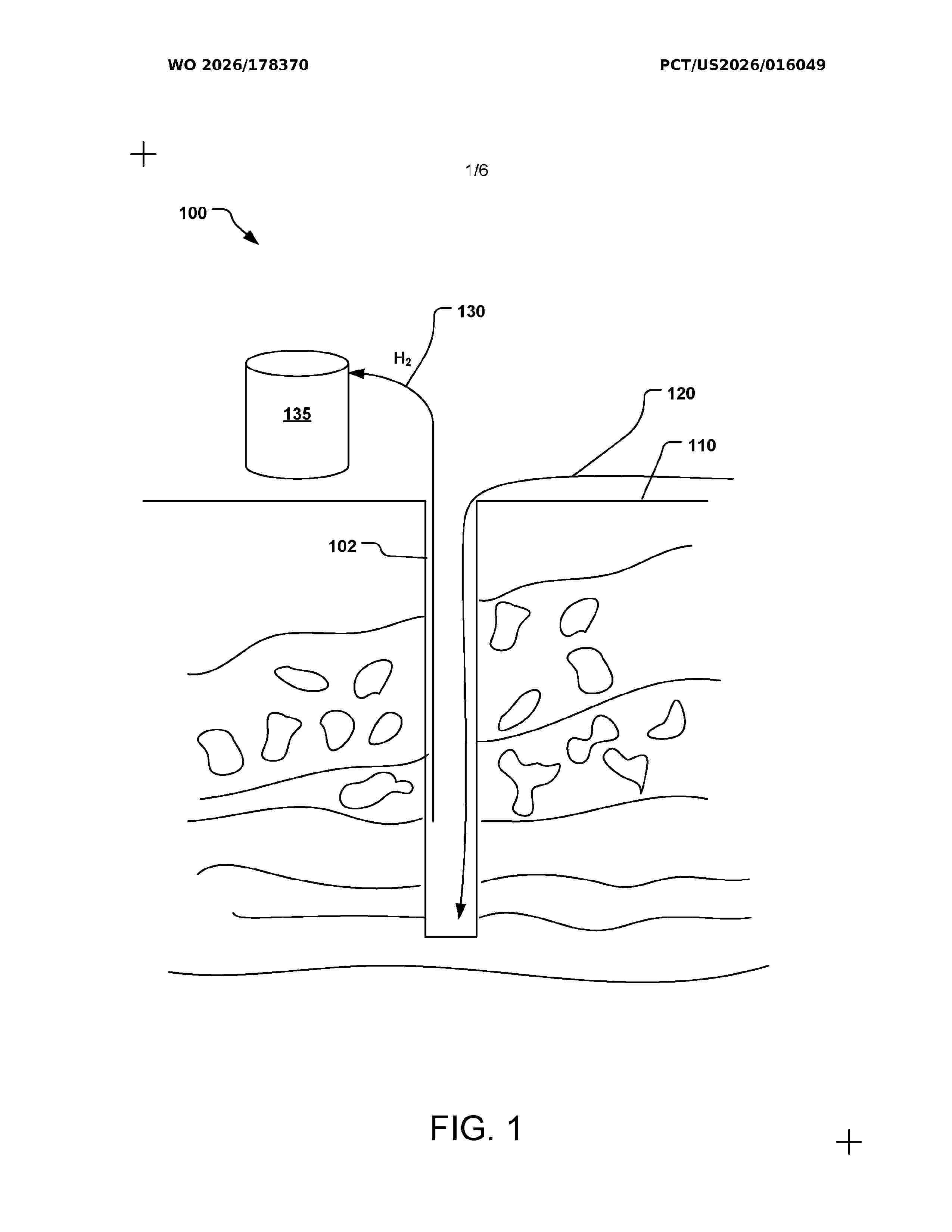
Resumen de: WO2026178370A1
Methods for stimulating hydrogen production from Fe(II)-bearing rocks and minerals under non-hydrothermal conditions (e.g., ≤200oC) by both increasing the rate and extent of hydrogen production and reducing the consumptive loss of hydrogen by abiotic or biotic reactions. The methods utilize a fluid (e.g., liquid) having low levels of oxidants such as oxygen, nitrates, sulfates and carbon dioxide (CO2), low levels of nutrients such as phosphate, a highly basic pH, and elevated Ca2+ or ammonium activity. In some embodiments of the methods, the fluid is free of any or all of oxidants, nitrates, sulfates, CO2, as well as the nutrient phosphate. By use of the terms "free of" and "essentially free of," what is intended is a level of no more than 1 ppm per oxidant.
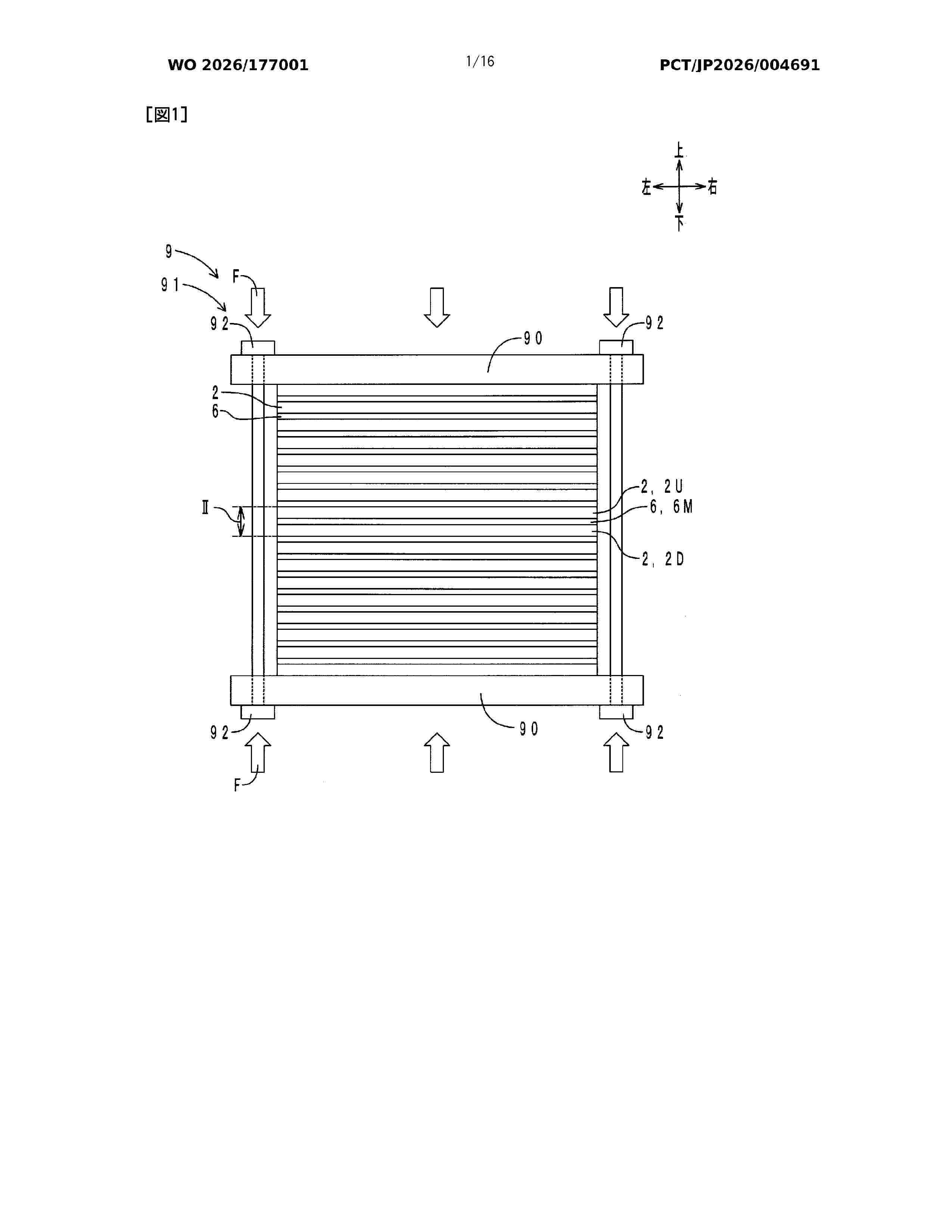
Resumen de: WO2026177001A1
The present invention addresses the problem of providing a bipolar plate with double-sided gaskets that is capable of reducing shunt current. A bipolar plate (2) comprises a bipolar plate main body (20) and gaskets (5). Of the gaskets (5), a front-side gasket (5U) is provided with a front-side base layer (50U), and a rear-side gasket (5D) is provided with a rear-side base layer (50D). When viewed from the front-back direction, the front-side base layer (50U) is disposed on the ring inner side of a front-side first seal part (52U) and a front-side second seal part (53U) over the entire surface of a portion excluding first manifolds (20La, 20Rb), second manifolds (20Lb, 20Ra), and a front-side flow path area (21U). When viewed from the front-back direction, the back-side base layer (50D) is disposed on the ring inner side of a back-side first seal part (52D) and a back-side second seal part (53D) over the entire surface of a portion excluding the first manifolds (20La, 20Rb), the second manifolds (20Lb, 20Ra), and a back-side flow path area (21D).
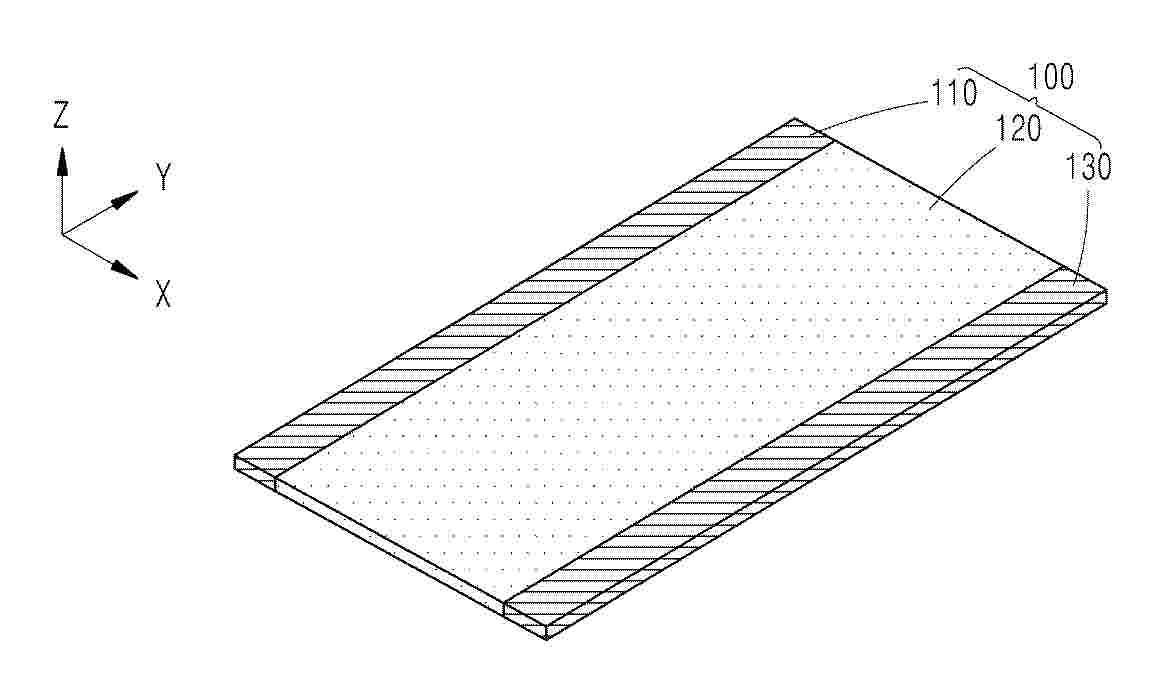
Resumen de: KR20260129632A
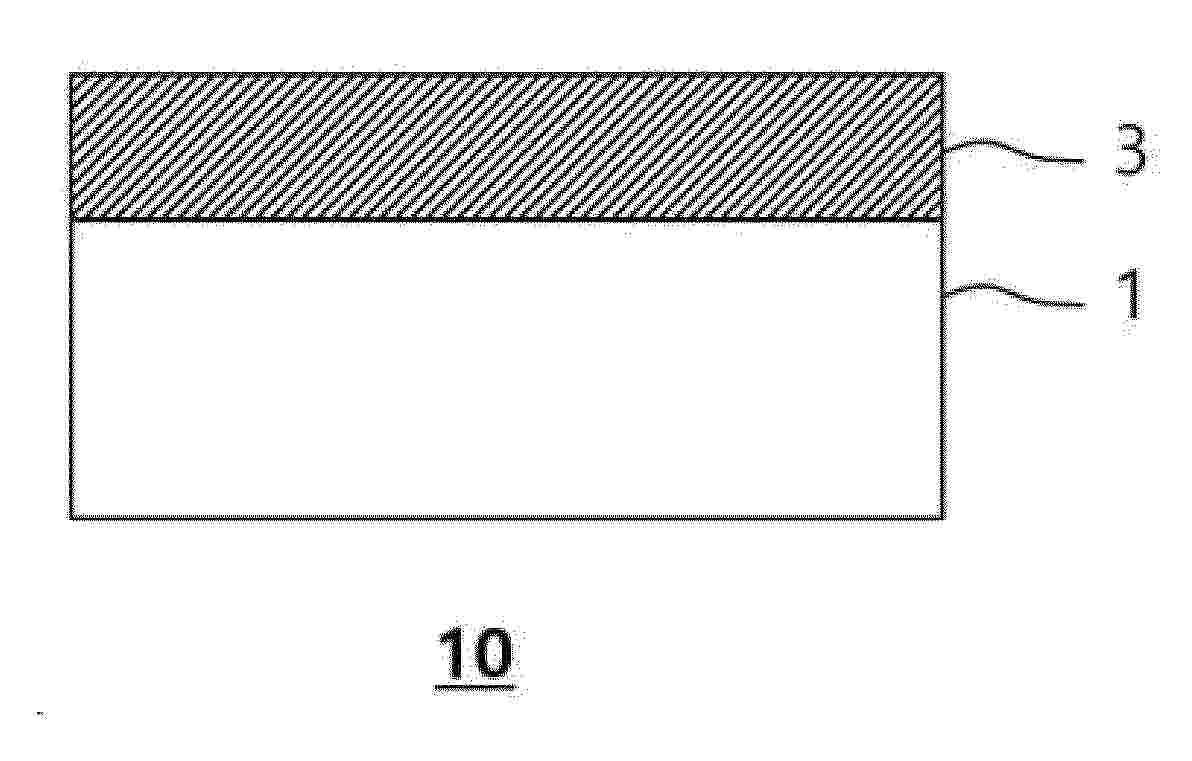
본 개시는 다공성 수송층, 이를 포함하는 수전해 셀 및 다공성 수송층의 제조방법에 관한 것이다. 본 개시의 일 측면에 따르면, 폭 방향을 기준으로, 일측으로부터 타측 방향으로 순차적으로 배치된 제1영역, 제2영역 및 제3영역을 포함하는 다공성 기재를 포함하며, 상기 제1영역 및 제3영역은 제1금속을 포함하고, 상기 제2영역은 상기 제1금속과 다른 제2금속을 포함하는 다공성 수송층을 제공한다.
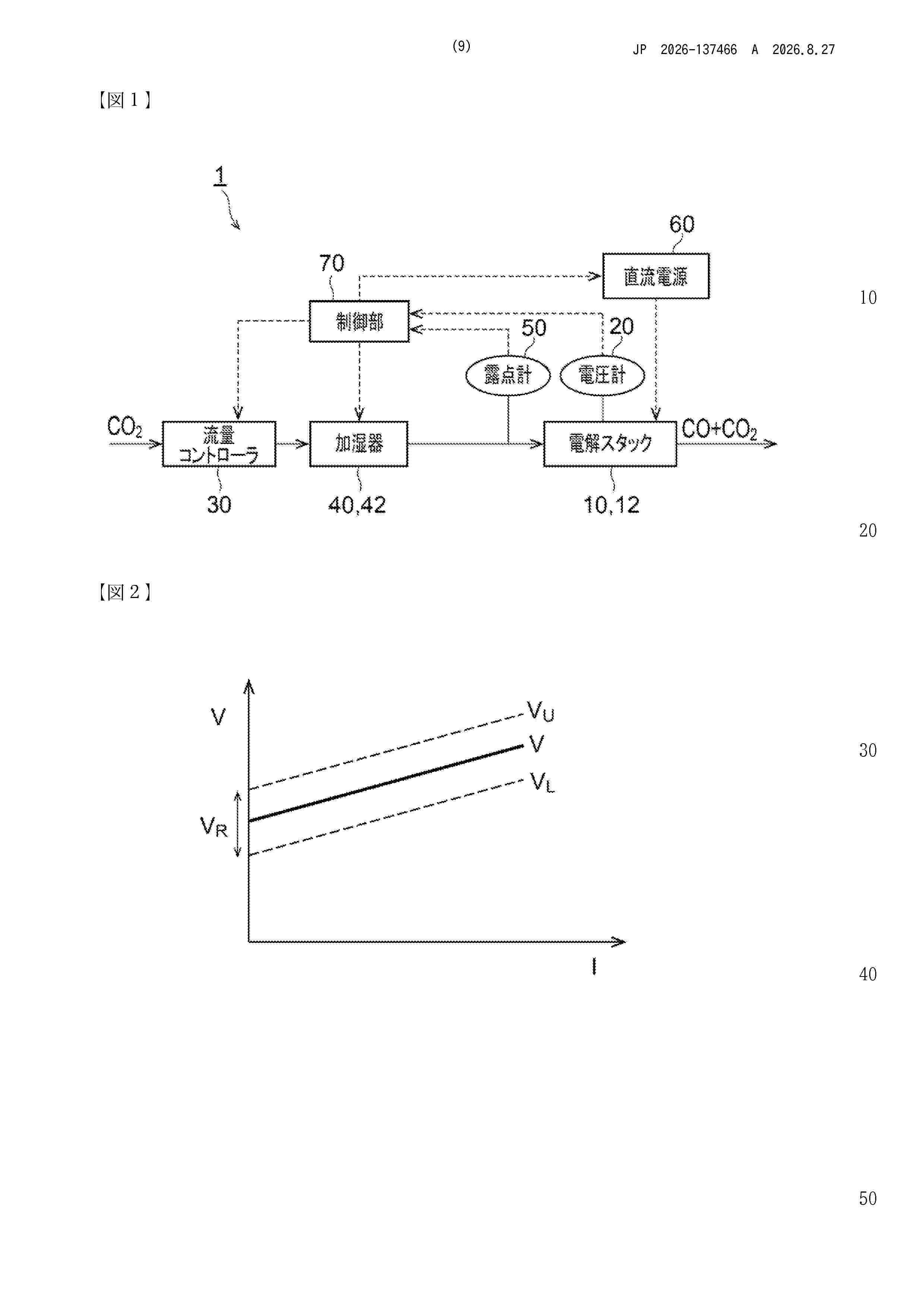
Resumen de: JP2026137466A
【課題】電気化学反応を継続しつつ、電気化学セルの破損を抑制する。【解決手段】実施の形態によるガス電解システムは、複数の電気化学セルが積層されて構成された電解スタックと、電気化学セルのセル電圧を計測する電圧計と、電解スタックに供給する供給ガスの流量を調整可能な流量コントローラと、流量コントローラを制御する制御部と、を備える。制御部は、セル電圧に基づいて、供給ガスの流量を増大させるように、流量コントローラを制御する。【選択図】図1
Resumen de: JP2026137245A
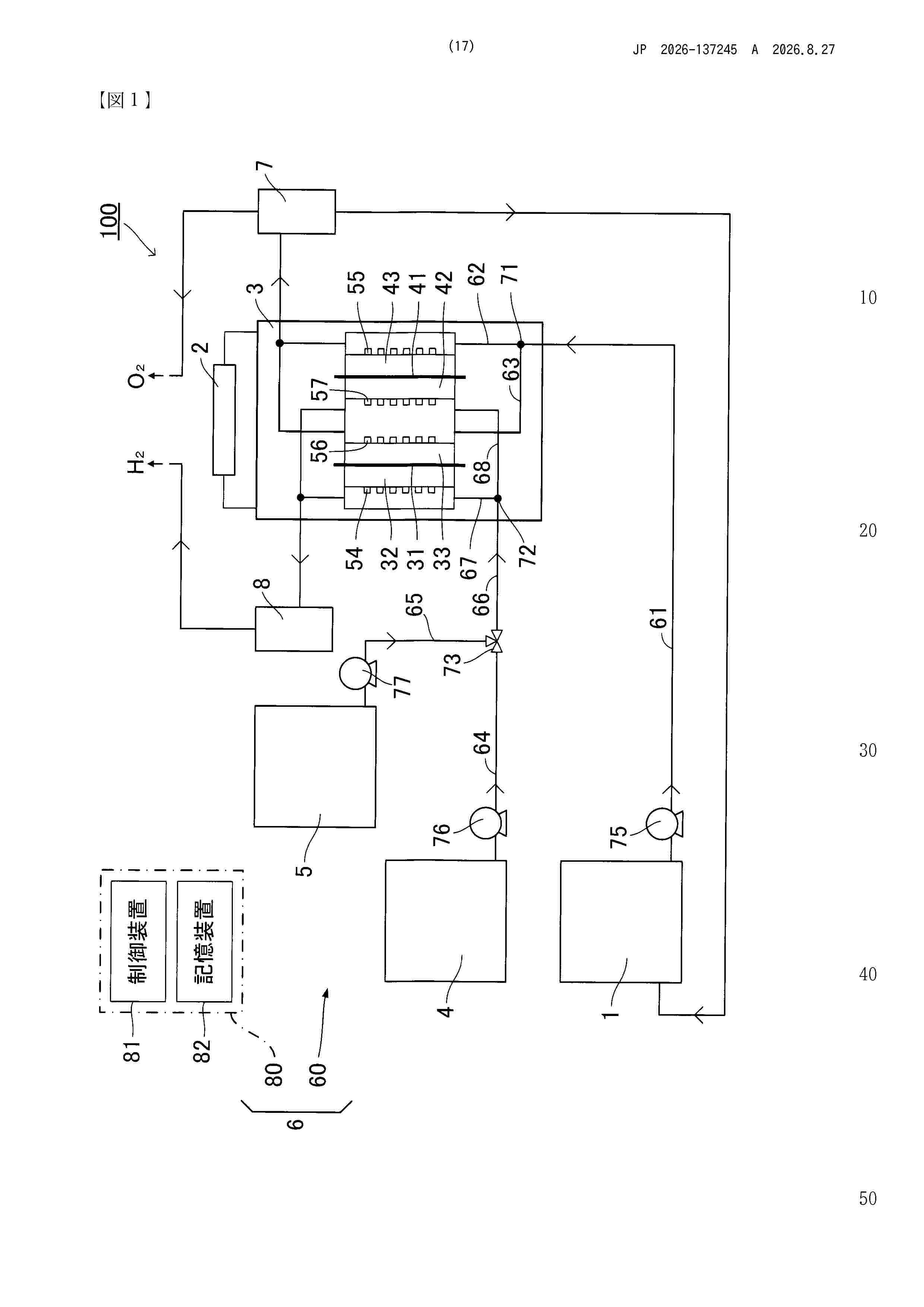
0001 【課題】水電解停止後に水電解スタック内に残留するガスを除去し水電解再開後に純度が高い水素ガスを生成する。 【解決手段】水電解システムは水電解スタックと供給システムとを具備し、水電解スタックはアノード部とカソード部との間に電解質膜が位置する複数の膜電極接合体が積層され、第1膜電極接合体のアノード部と第2膜電極接合体のカソード部とは互いに対向するように隣り合い、第1膜電極接合体のアノード部との対向面に第3流路、カソード部との対向面に第1流路、第2膜電極接合体のアノード部との対向面に第2流路、カソード部との対向面に第4流路がそれぞれ形成され、供給システムは水電解において第2流路および第3流路に反応液を供給し、水電解停止後の洗浄工程において第1流路および第4流路に第1洗浄液を第2流路および第3流路に第2洗浄液を供給し、水電解停止から再開までの準備工程において第1流路および第4流路に気体を供給する。 【選択図】図1
Resumen de: KR20260129438A
본 발명은 내구성이 향상된 금속 분리판으로, 크롬(Cr)의 함량을 한정된 Ni-Cr계 합금이 코팅된 금속 분리판이다. 본 발명에 따른 금속 분리판은 전기전도성, 내식성 및 내구성이 우수하여 연료전지 스택 또는 수전해 스택의 분리판에 적용할 수 있다.
Resumen de: AU2025240729A1
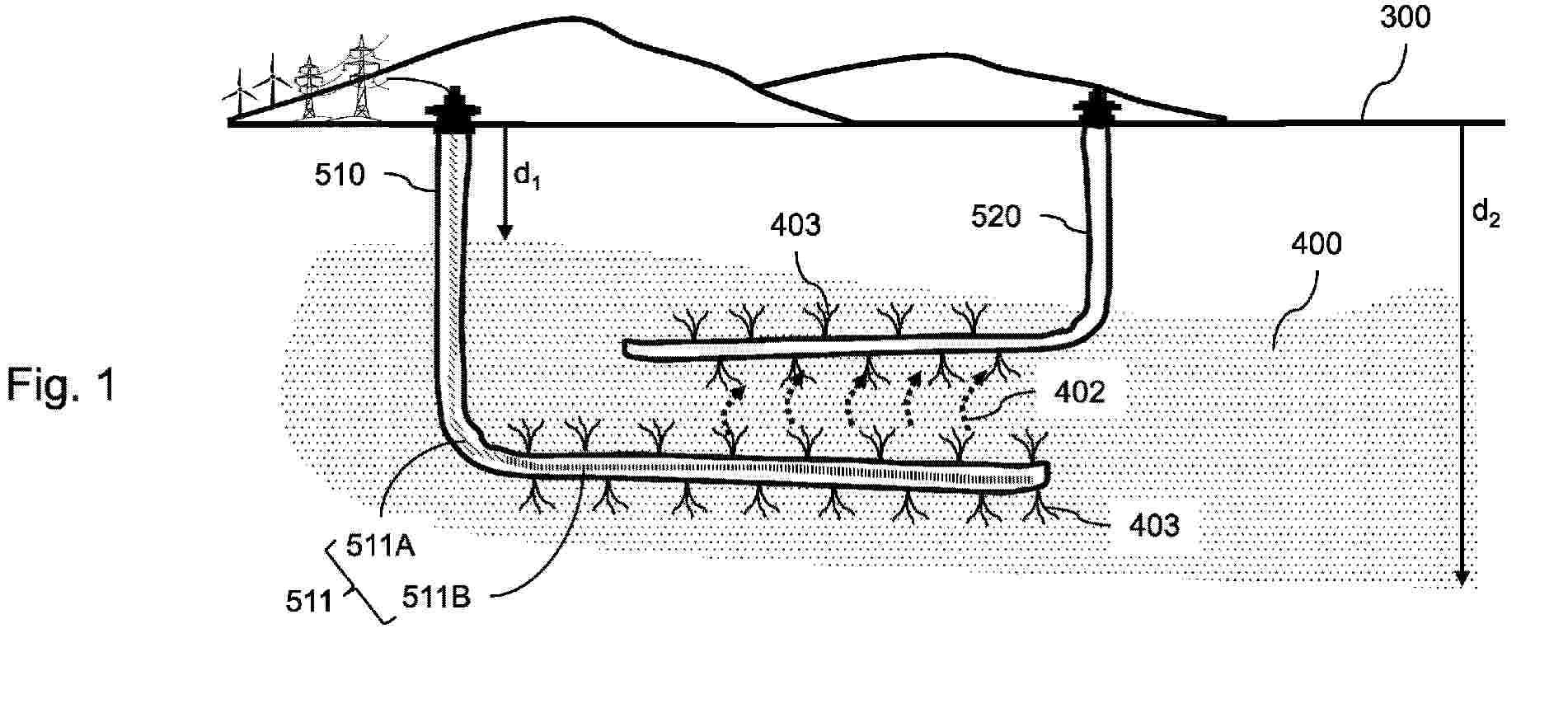
This invention provides a method for generating hydrogen. The comprises using a heater cable (511), provided inside a wellbore (510) in a mafic or ultramafic rock formation (400), to heat the rock formation (400) to a temperature of about 200 to 600 degrees Celsius.
Resumen de: JP2026136645A
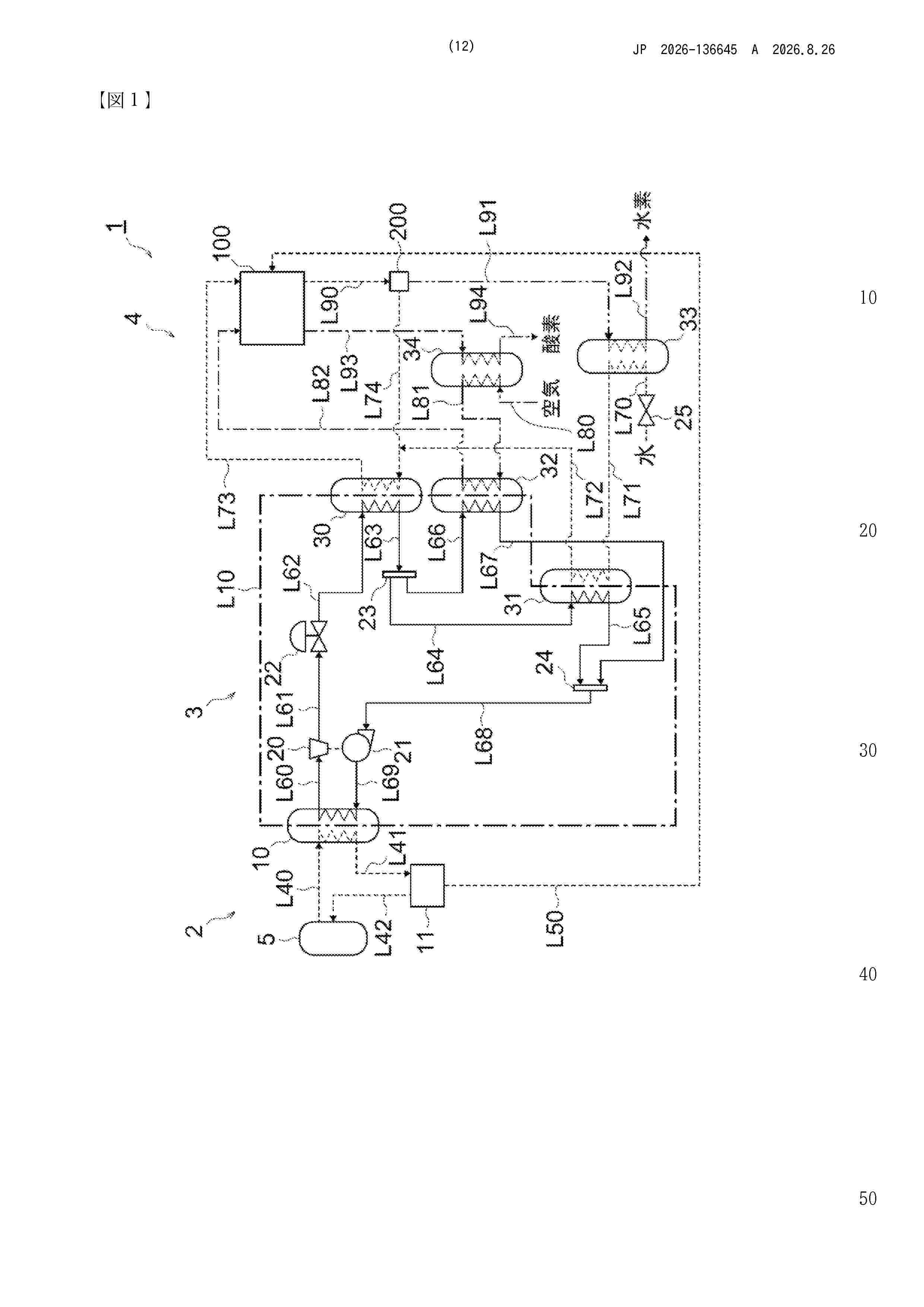
【課題】1次ヘリウムガスと第2熱媒体との熱交換率を維持しつつ、高温水蒸気電解装置に供給される水蒸気と第2熱媒体と熱交換する熱交換器伝熱管のクリープ破壊を抑制する。【解決手段】本実施形態によれば、水素製造システムは、第1循環系と、第2循環系と、中間熱交換器と、減圧部と、高温水蒸気電解装置と、第1熱交換器と、を備える。第1循環系は、700℃以上の1次ヘリウムガスが循環する第1循環経路を有する。第2循環系は、第2熱媒体が循環する第2循環経路を有する。中間熱交換器は、1循環系の1次ヘリウムガスと、第2循環系の第2熱媒体との熱を熱交換する。減圧部は、第2循環系の第2熱媒の圧力を下げる。高温水蒸気電解装置は、水素と酸素とを製造する。第1熱交換器は、減圧部で減圧された第2熱媒と高温水蒸気電解装置のスタックに供給される少なくとも水蒸気との熱を熱交換器伝熱管により熱交換する。【選択図】図1
Resumen de: WO2025036406A1
An SOEC module and an SOEC water electrolysis hydrogen production device based on a multi-stack-core module. Said device comprises a steam generator, a mixer, an air heater and a plurality of SOEC modules; each SOEC module comprises a heat preservation shell provided with a hot air module inlet, a hydrogen-containing mixed steam module inlet, an oxygen-rich air module outlet and a product crude hydrogen module outlet, and a plurality of electrolytic cell stack cores arranged in the heat preservation shell; and each electrolytic cell stack core comprises a hot air single-stack inlet, a hydrogen-containing mixed steam single-stack inlet, an oxygen-rich air single-stack outlet and a product crude hydrogen single-stack outlet.
Resumen de: WO2025082675A1
The invention relates to a hydrogen-production plant comprising at least a first production line, comprising at least a first electrolysis device with a plurality of first electrolysis modules and comprising a first compressor device with a plurality of first compressor modules, and comprising a controller, comprising at least a schedule-creating module and a control module, wherein the schedule-creating module is designed for creating an activation schedule at least for the first electrolysis modules and for the first compressor modules on the basis of respective performance characteristics of the respective first electrolysis modules, respective performance characteristics of the respective first compressor modules and at least one predetermined optimization criterion, and wherein the control module is designed for activating the first compressor modules and the first electrolysis modules on the basis of the activation schedule created.
Resumen de: WO2025082916A1
The invention relates to a unit (200) for producing hydrogen that comprises: - a stack (102) of solid oxide cells, - an air circuit (110), and a fuel circuit (120) passing through the stack (102); characterised in that the unit (200) is equipped with a stopping system comprising: - an inlet (202) and an outlet (204) for neutral gas, for circulating a predetermined neutral gas in the stack; - an inlet (206) and an outlet (208) for safety gas, for circulating a safety gas in the stack (102); and - a control module (210) for switching the stack (102) from the production configuration to the stopped configuration. The invention also relates to a method for controlling such a unit.
Resumen de: EP4541945A1
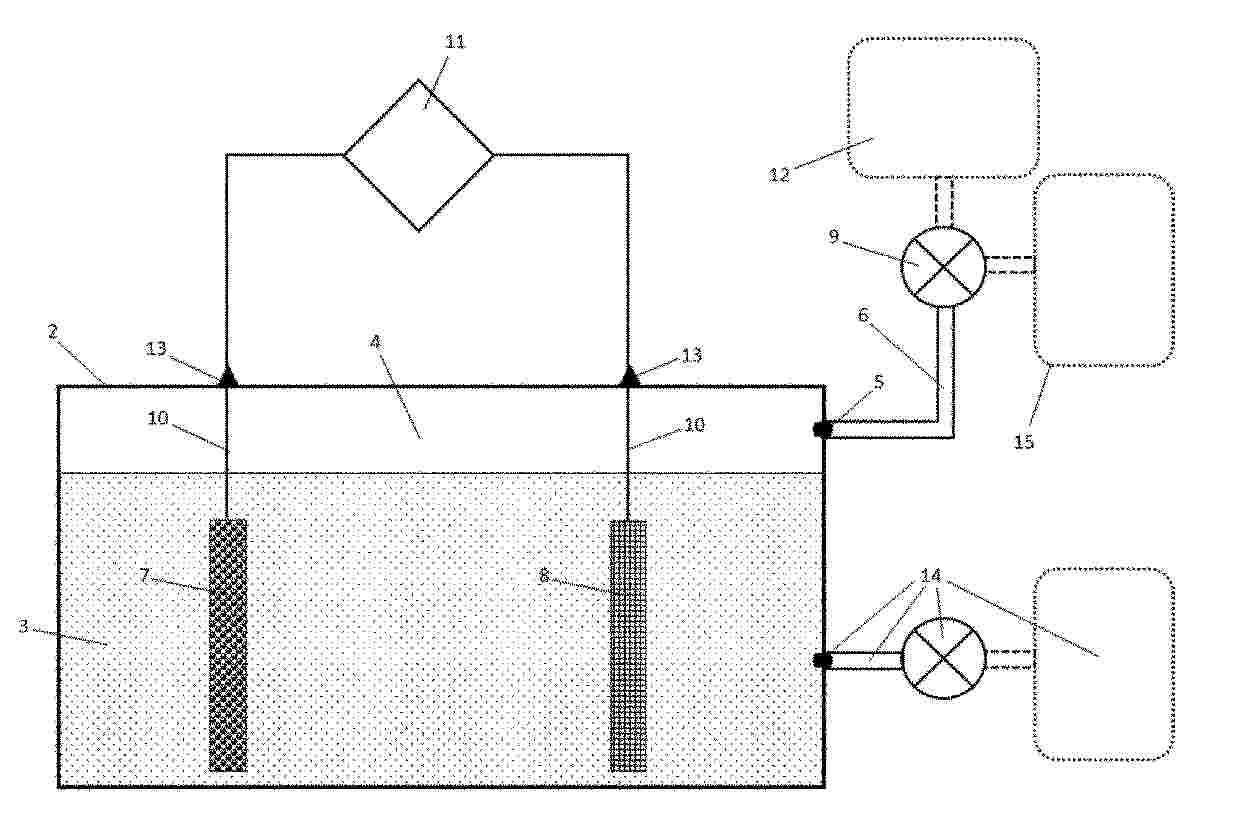
The invention relates to Device for electrochemical reversible dihydrogen storage (1), said device comprising: a sealed chamber (2) intended to receive an electrolytic media (3) and gaseous dihydrogen (4), connection means (5) suitable for connecting the seal chamber to a gas circuit (6) and at least one first electrode (7), and at least one second electrode (8), arranged within the sealed chamber. The at least one second electrode is suitable to oxidize dissolved gaseous dihydrogen, in the electrolytic media, and form protons and to reduce protons and form gaseous dihydrogen according to formula 1: H2 ↔ 2H+ + 2e-, formula 1. The at least one first electrode comprises at least one redox couple My/Mx, insoluble in the electrolytic media, said at least one redox couple being arranged to exhibit at least two oxidation states and being suitable to be reduced from an oxidized state My to a reduced state Mx, and conversely, according to formula 2: My + pe- ↔ Mx, formula 2, wherein x and y are oxidation number. An absolute potential difference |ΔE| between a redox potential of the couple H+/H2, for a predetermined electrolytic media and a predetermined pressure range of gaseous dihydrogen, and a redox potential of the at least one couple My/Mx is lower than or equal to 0.6 V.
Nº publicación: EP4794830A2 26/08/2026
Solicitante:
ITM POWER TRADING LTD [GB]
ITM Power (Trading) Limited
Resumen de: GB2634782A
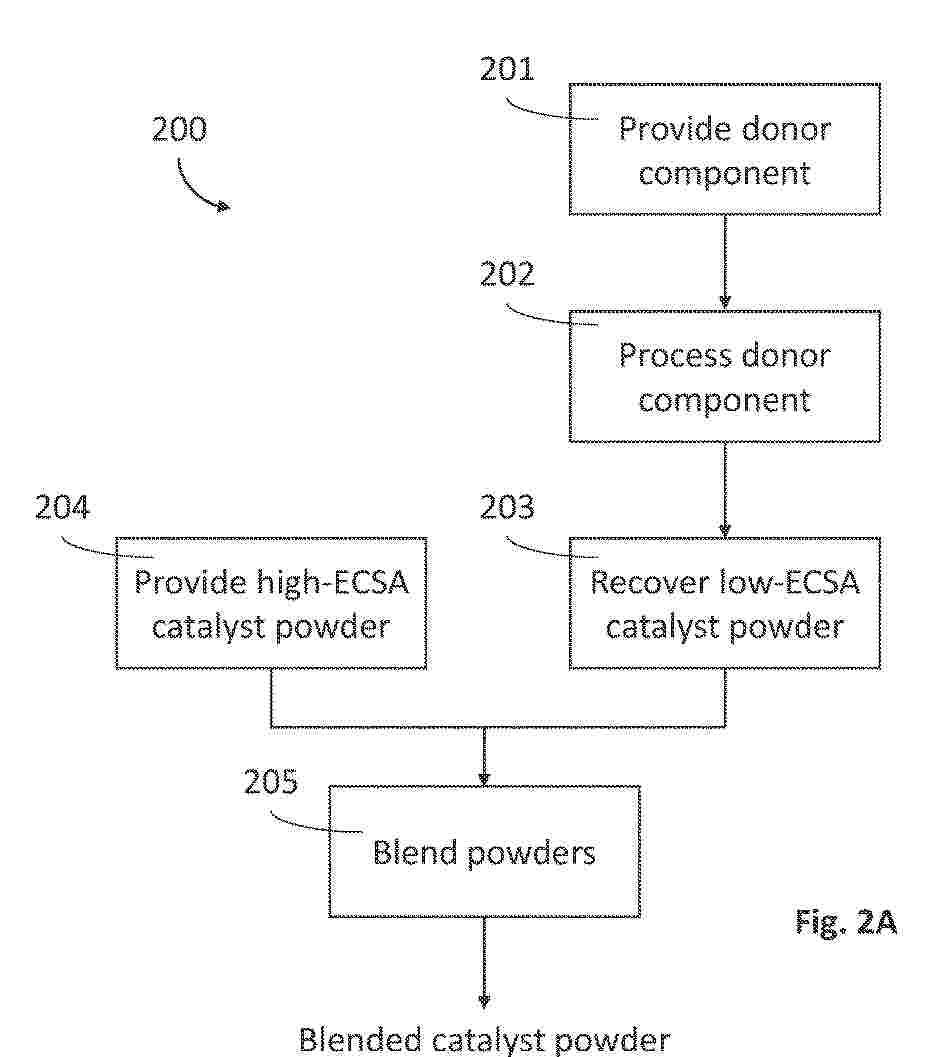
A method for manufacturing a catalyst coating 200 for a recipient component of a PEM electrolyser and a blended catalyst. The method comprising the steps of: processing a pre-used catalyst-coated donor component 202, to recover a quantity of a catalyst 203; converting the catalyst recovered from the donor component into a powder, thus producing a low-ECSA (electrochemical active surface area) recycled catalyst powder; and blending the recycled catalyst powder 203 with a quantity of high-ECSA unrecycled catalyst powder 204 to form a blended catalyst powder 205. ECSA represents a value for the active surface area of the catalyst and is related to the BET (Brunauer-Emmett-Teller) value.
 BOPI
BOPI
 Sede Electrónica