Si deseas distinguir tus productos, servicios o ambos de los de otra empresa, es posible que necesites una marca o nombre comercial. Descubre qué son, en qué consiste su procedimiento de registro y qué implica.

Información sobre los plazos de presentación de solicitudes de transformación de marcas de la Unión Europea en marca nacional española. Más información


Si tienes un nuevo dispositivo, producto o procedimiento que resuelva un problema técnico o tenga una ventaja práctica, existen distintas formas de protegerlo en España y en otros países. Descubre cómo hacerlo.

¿Tu innovación reside en la estética, la ornamentación o la apariencia de tu producto? Protégela mediante un diseño industrial. Descubre qué derechos confiere el registro y cómo realizar la tramitación.

Las indicaciones geográficas protegen el nombre de un producto originario de una zona geográfica, a la cual le debe una determinada calidad, reputación u otra característica. Descubre qué son, en qué consiste su procedimiento de registro y qué beneficios conceden.

Las patentes publicadas en todo el mundo son una valiosa fuente de información científica, técnica y comercial.

Si eres emprendedor/a o una empresa y quieres potenciar y mejorar la rentabilidad de tu negocio protegiendo de forma adecuada los activos intangibles de tu organización, en este espacio encontrarás lo necesario.


 1060
resultados
1060
resultados
 Última actualización
24/10/2026 [07:27:00]
Última actualización
24/10/2026 [07:27:00]


 Resultados 150 a 175 de 1060

Resumen de: WO2025114700A1
A process for preparing an oxygen evolution reaction (OER) catalyst comprises an oxygenated iridium component supported on a particulate solid support, which process comprising the steps of: (i) forming an aqueous mixture comprising a particulate solid support and a solution of a halide-free metal iridate; (ii) reducing the pH of the aqueous mixture to ≤ 5.0 to precipitate an oxygenated iridium component onto the particulate solid support; and (iii) isolating the product of step (ii).

Resumen de: WO2025114716A1
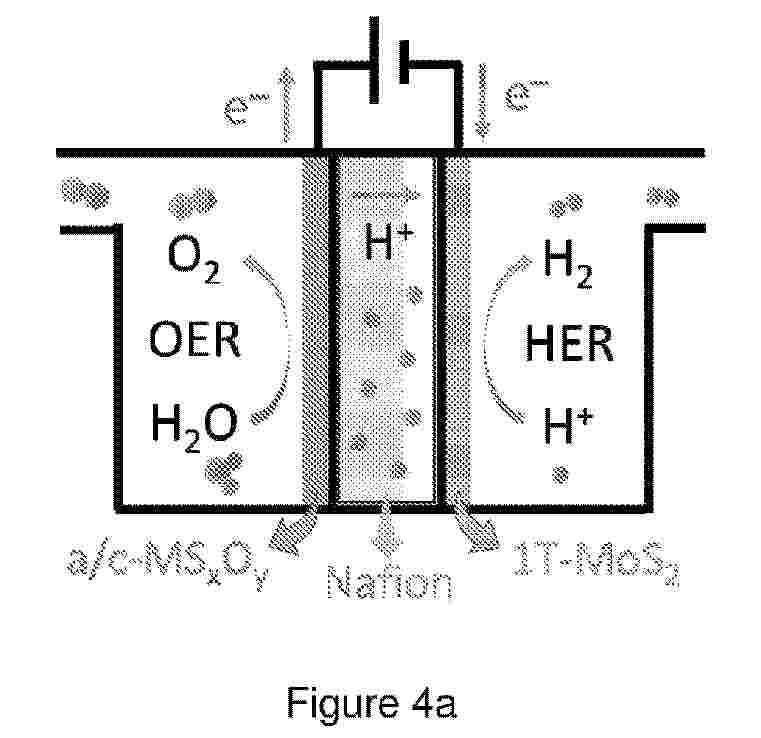
A water-electrolyser anode for a proton exchange membrane (PEM) water electrolyser comprises: a transition metal oxychalcogenide catalyst having the formula ABxOy, wherein A is a transition metal and B is a chalcogenide, and wherein 0 < x < 2 and 0 < y < 2. Also provided are a proton exchange membrane (PEM) water electrolyser, a method of water electrolysis, use of a transition metal oxychalcogenide as a catalyst in an oxygen evolution reaction under acidic conditions, and a method of manufacturing an anode for an electrolyser.
Resumen de: EP4563523A1
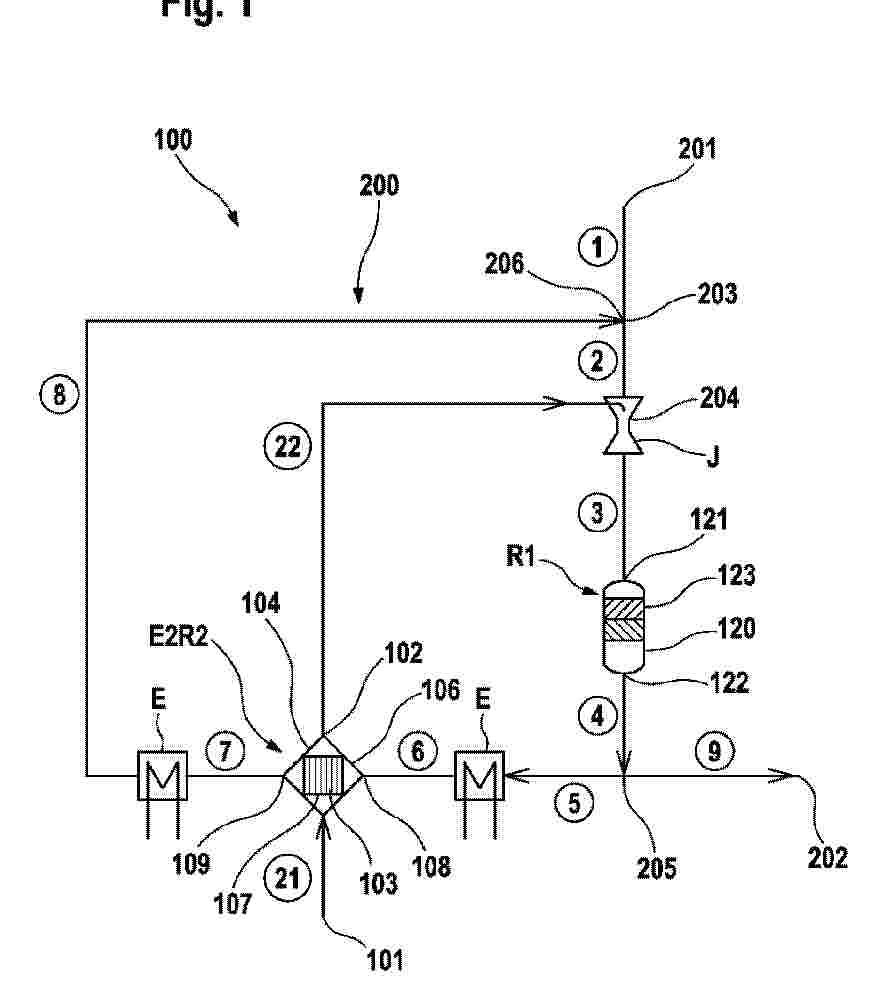
The invention relates to a process (100) for the production of hydrogen from ammonia comprising the following steps:- providing a water feed stream to a water electrolyzer (101);- performing a water electrolysis (102) of the water feed stream in the electrolyzer, producing an oxygen product stream and an electrolysis hydrogen stream;- providing an ammonia feed stream to an ammonia cracking reactor (103);- providing an oxidant stream (105) and performing a combustion reaction (106) with said oxidant stream, thereby generating heat;- in the ammonia cracking reactor, performing an endothermic reaction of ammonia cracking (104) of the ammonia feed stream with said generated heat;characterized in that the oxidant stream comprises at least a portion of the oxygen product stream produced by the water electrolysis of the water feed stream.
Resumen de: WO2025114049A1
The present invention relates to a gaseous fuel composition comprising O2, N2, H2O, NH3, H2 and optionally further atmospheric components the molar content of H2 is denoted a, the molar content of NH3 is denoted b, the molar content of O2 is denoted c, the molar content of N2 is denoted d, and the molar content of H2O is denoted e, and (a + 1.5b – 2c) / (a + 2b + c + d + e) is in the range of 0 to 0.01, and a constitutes at least 3 mol% of the gaseous fuel composition. The gaseous fuel composition can be produced in a process of the invention and combusted in another process of the invention. The invention further includes a process set-up and a process of combustion of NH3. In the invention, NH3 is 15 combusted to form a flue gas stream virtually free of NOx.
Resumen de: WO2025114080A1
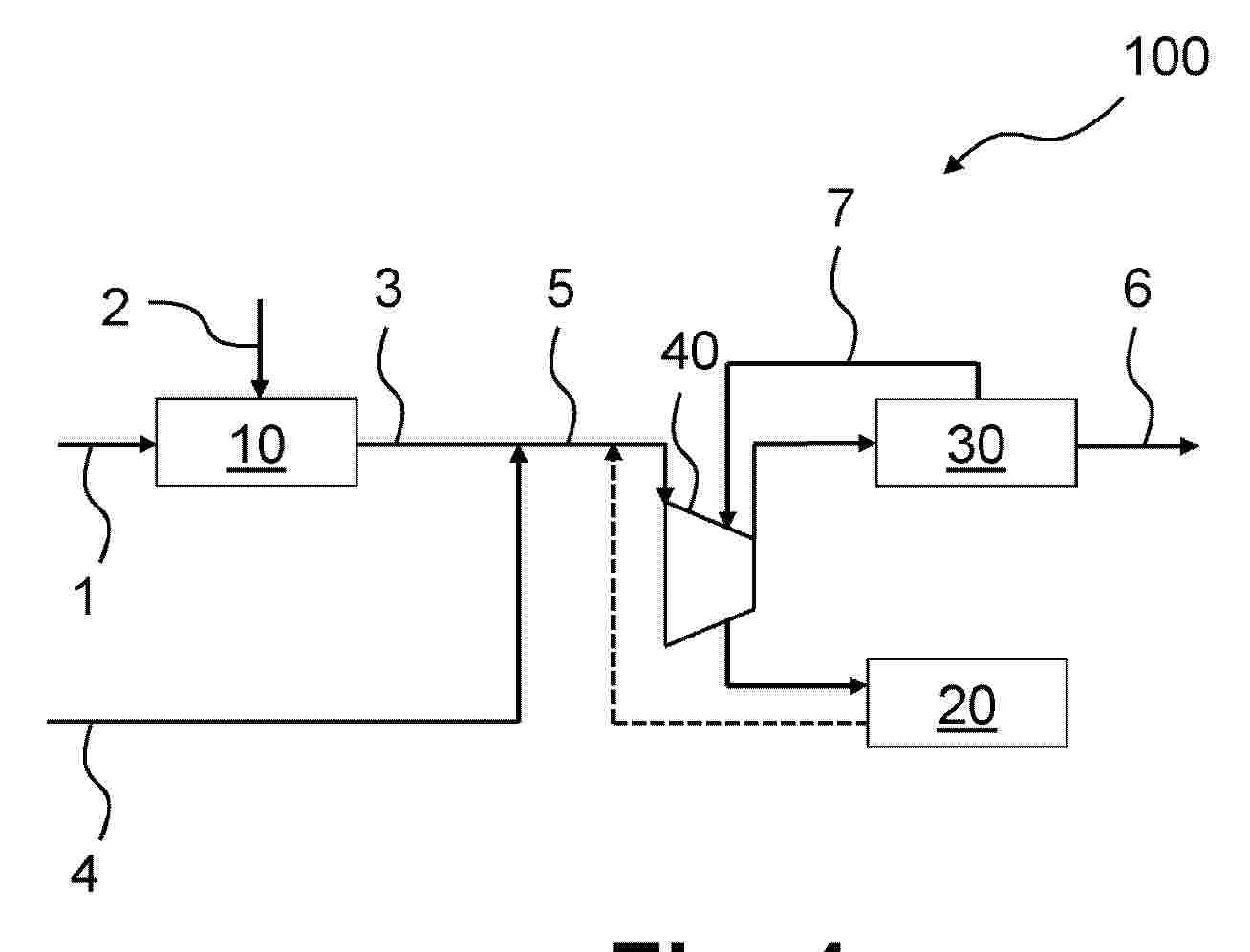
The invention relates to a process (100) for producing a synthesis product (6), in which gaseous hydrogen (3) is provided by electrolysis (10) of water (1) and is subjected to a reaction (30) with one or more gaseous reactants (4) to form the synthesis product (6), wherein during a first process mode, the hydrogen (3) and the one or more reactants (4) are mixed to obtain a gaseous reaction mixture (5) and the gaseous reaction mixture (5), or a part thereof, is stored under pressure in a storage unit (20), and wherein during a second process mode the gaseous reaction mixture (5), or a part thereof, stored under pressure in the first process mode is taken from the storage unit (20) and fed to the reaction (30) to form the synthesis product (6). The invention also relates to a corresponding plant.
Resumen de: WO2025113761A1
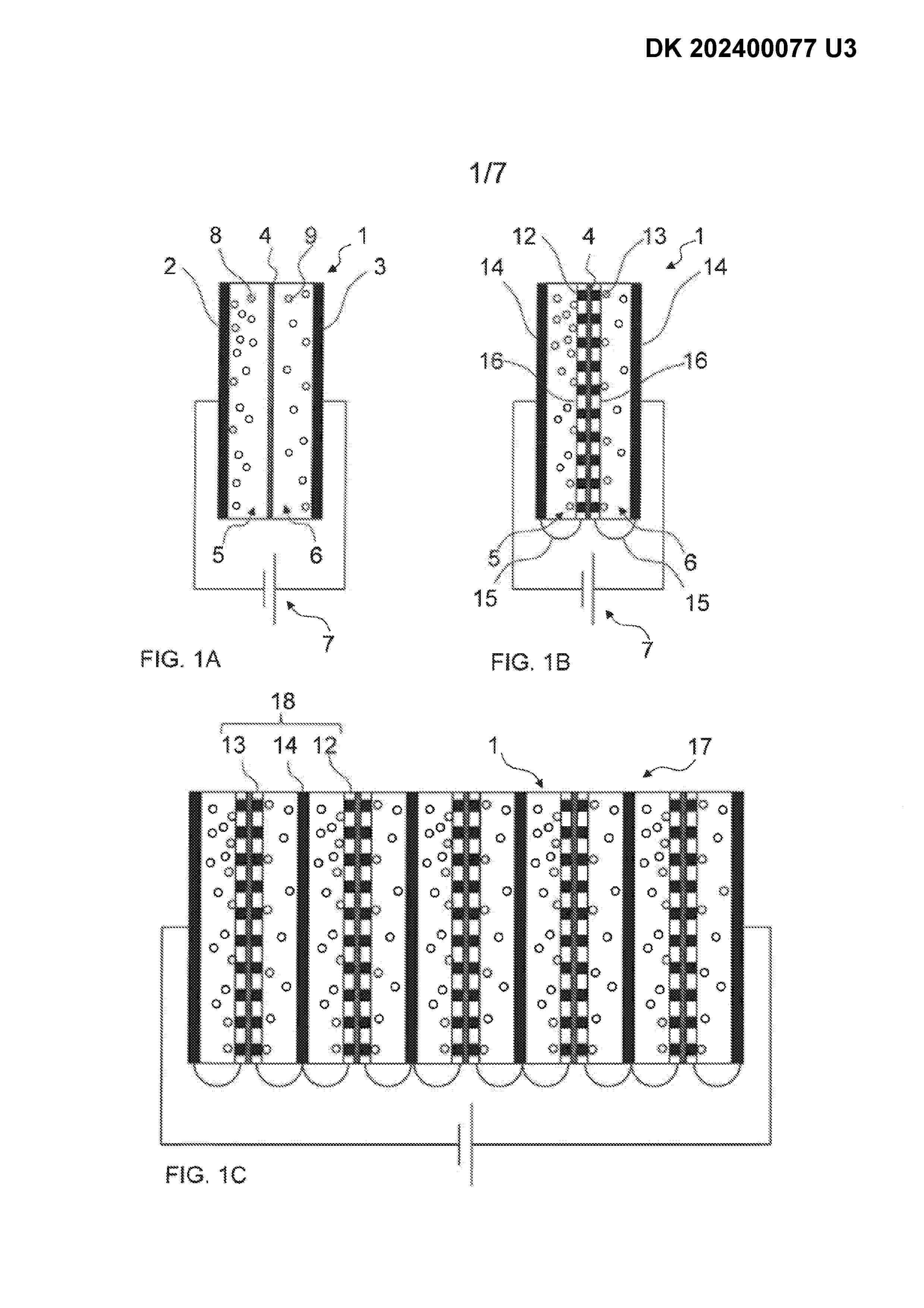
An electrolyzer stack (17) wherein each of the electrode compartments (5, 6) is delimited by the ion-transporting separator (15) and a bipolar plate (14) as well as a gasket (25) that is surrounding the electrode compartments (5, 6). An electrolyte manifold (27) extends along the stack (17) and through an opening (20) in each of the bipolar plates (14). The electrolyte manifold (27) is formed by multiple serially connected flow restrictors (28), of which one flow restrictor (28) is provided per cell (1) and inserted between neighbouring gaskets (25) and comprises a flow canal (30) having a canal inlet (30 A) and a canal outlet (30B), wherein the canal inlet (30 A) is provided in the throughput opening and fluid-flow connected to the electrolyte manifold (27) and the canal outlet (30B) is fluid-flow connected to one of the cells (1) for supply of electrolyte from the electrolyte manifold (27) to the respective cell (1). The canal is narrow and long for reducing shunt currents and for providing a pressure drop larger, for example at least 10 times higher, than a pressure drop along the electrolyte manifold (27).
Resumen de: EP4818112A1
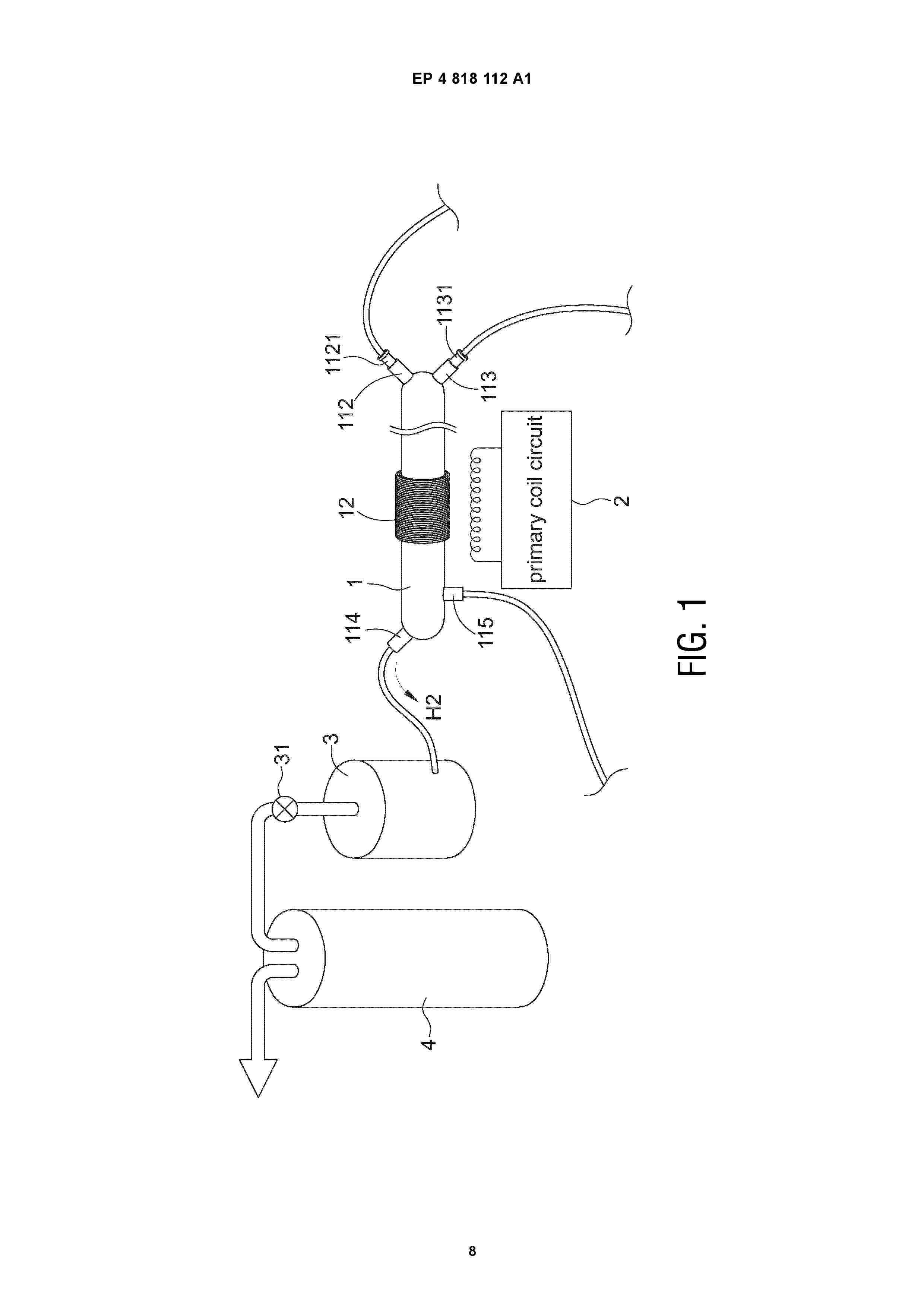
0001 A hydrogen generation apparatus includes a hydrogen generator, a primary coil circuit, a hydrogen compressor, and a hydrogen storage cylinder. The hydrogen generator includes a hydrogen generator body, a secondary coil, and an eddy current generating unit. The hydrogen generator body has a chamber, and is configured with a first inlet for introducing a first substance, a second inlet for introducing a second substance, an outlet and an exhaust port. The secondary coil is wound around the hydrogen generator body. The eddy current generating unit is disposed in the chamber corresponding to the secondary coil. The primary coil circuit is coupled to the secondary coil to induce the secondary coil to generate a high-voltage alternating current, thereby causing the eddy current generating unit to generate an eddy current and produce high temperature. A thermal cracking reaction is induced by the high temperature to generate hydrogen gas.
Resumen de: WO2026127464A1
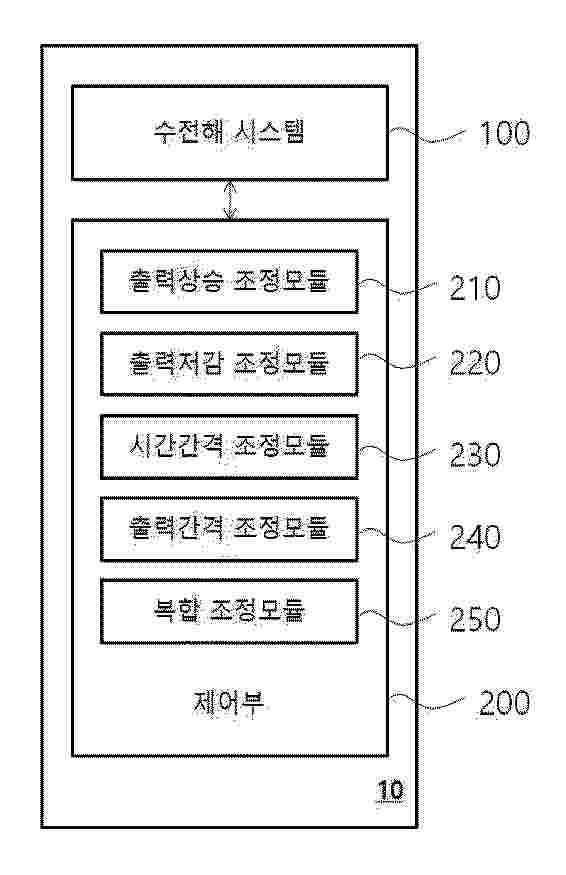
The present invention relates to a water electrolysis operation control system linked to power produced from solar energy, and, to a water electrolysis operation control system linked to solar-generated power for maximizing hydrogen production relative to renewable energy generation. The present invention comprises: a water electrolysis system (100) that is supplied with power from a solar power system and produces hydrogen; and a control unit (200) that controls an output of the water electrolysis system, wherein the control unit adjusts the output of the water electrolysis system according to the variability of the amount of solar power generation, by controlling the output of the water electrolysis system, controlling regular time intervals, controlling regular output intervals, and combining the control of the regular time intervals and the control of the regular output intervals, thus having the effect of reducing ESS capacity and increasing hydrogen production efficiency by means of a water electrolysis operation method that actively responds to the variability of renewable energy.
Resumen de: GB2705198A
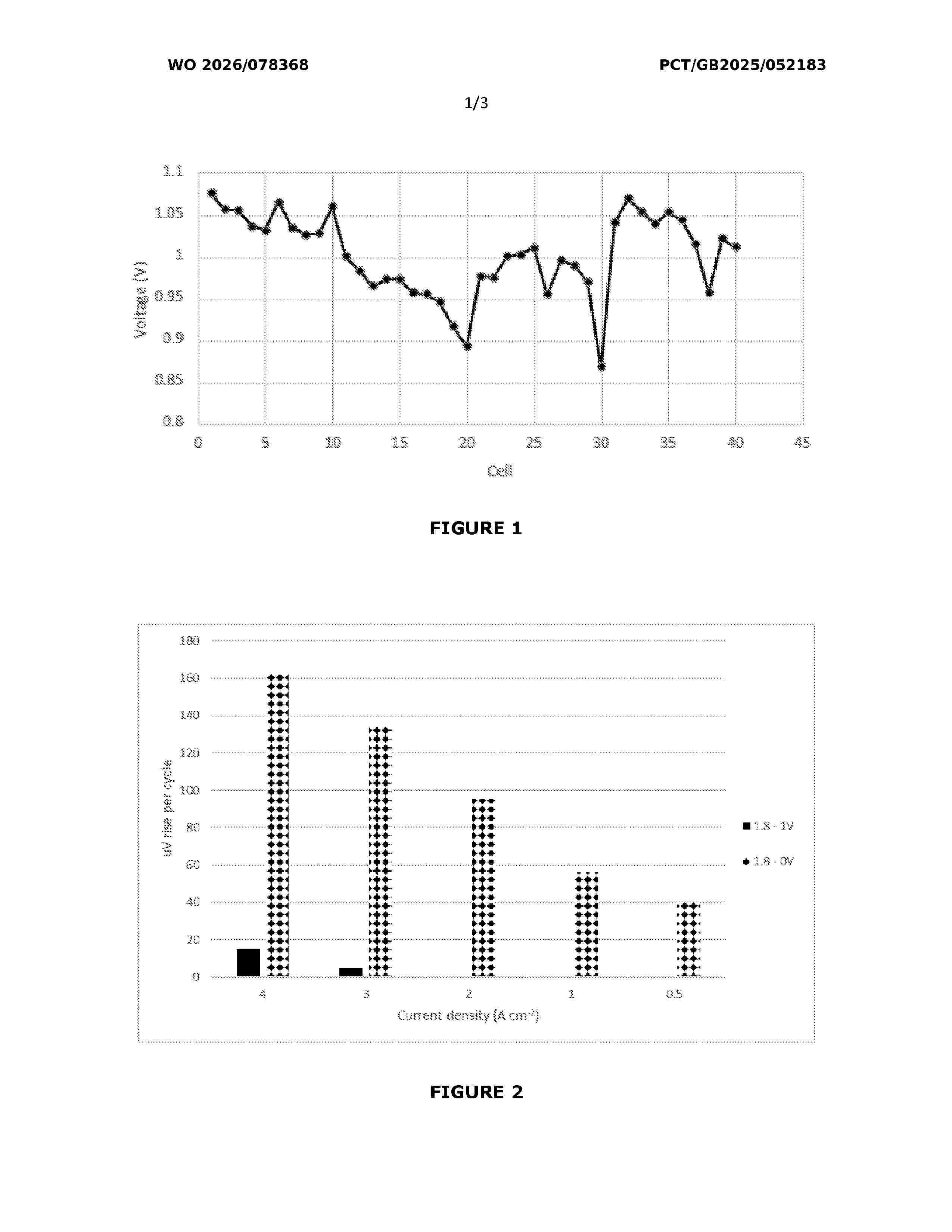
An electrolyser and a method for operating the electrolyser for producing hydrogen is described, The electrolyser and associated method mitigate performance degradation commonly resulting during shutdown periods. The electrolyser comprises a stack of electrolysis cells, a primary power supply and a secondary power supply. During periods Of operation the electrolyser is adapted to produce hydrogen when an electrical voltage from the primary power supply is applied to the stack, and during periods of non-operation, the secondary power supply is configured to apply an electrical voltage to the stack sufficient to inhibit degradation of the stack. The secondary power supply may be a battery or a capacitor configured to supply a voltage from 0.8-1.8V Figure 3
Resumen de: EP4818367A1
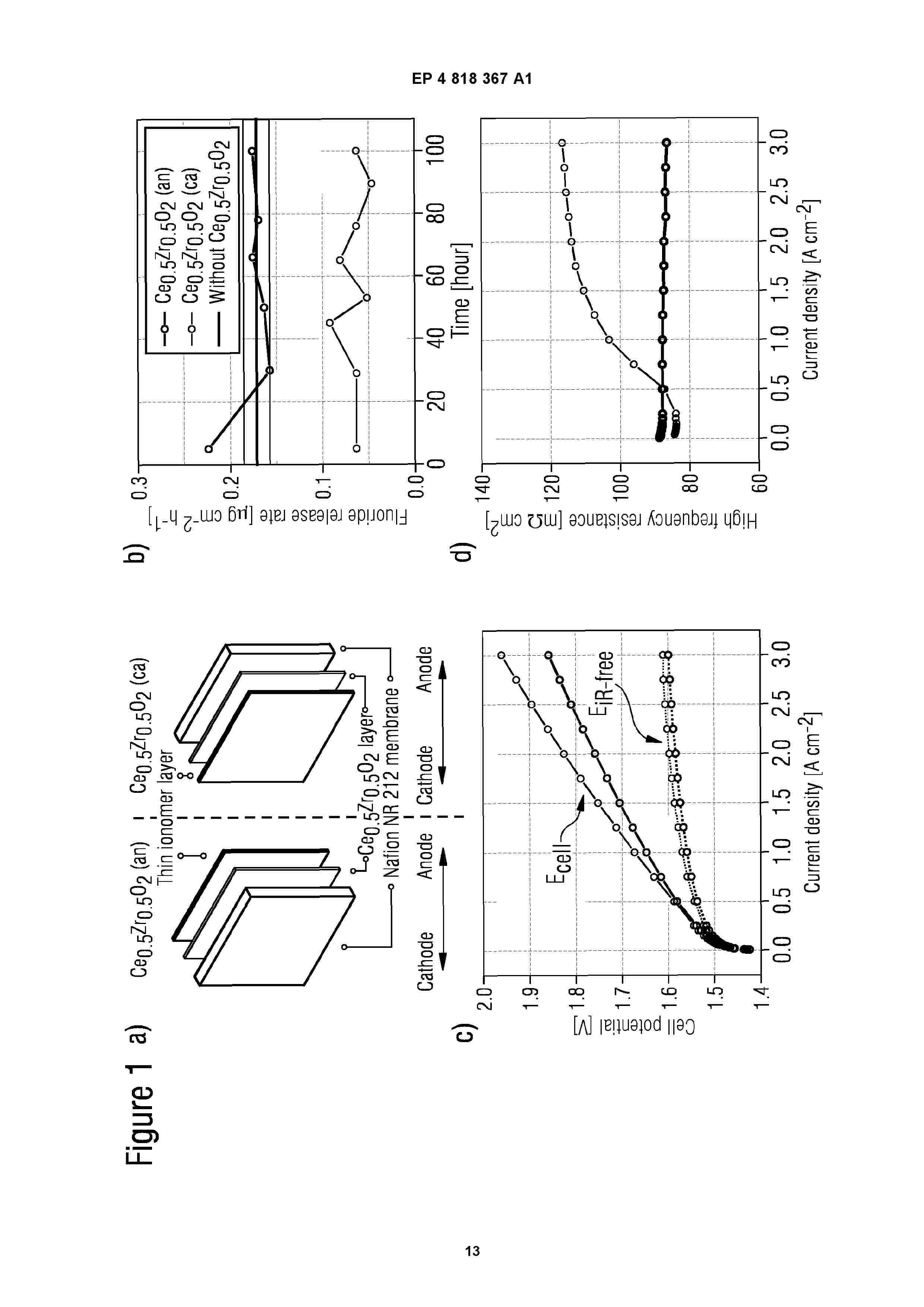
The development of more cost-effective and efficient proton exchange membrane (PEM) water electrolysis cells requires the use of thinner membranes with extended lifetimes and reduced gas crossover. The inventive approach to address these challenges involves the incorporation of radical scavengers to mitigate radical-induced ionomer degradation, along with gas recombination catalysts to promote the conversion of crossover hydrogen and oxygen to water inside the PEM. Each of the two catalyst types has its distinct chemical reaction characteristics, to which the design of the composite membrane is tailored through rational considerations. In various embodiments of the present invention, the positioning effects of Ce0.5Zr0.5O2 and Pt interlayers in composite membranes for their respective roles in radical scavenging and gas recombination were investigated. Results reveal that placing a radical scavenger interlayer near the cathode notably reduces the ionomer degradation rate, compared to its placement near the anode, evidenced by a 61% ± 7% reduction in fluoride release rate. This is likely due to reactive oxygen species in the cell being predominantly generated at the cathode, which is closer to the radical scavenger interlayer in the former case. The Ce content in cerium-zirconium oxide was further optimized using an ex-situ Fenton test, with Ce0.25Zr0.75O2 demonstrating the highest radical scavenging activity.
Resumen de: EP4818960A1
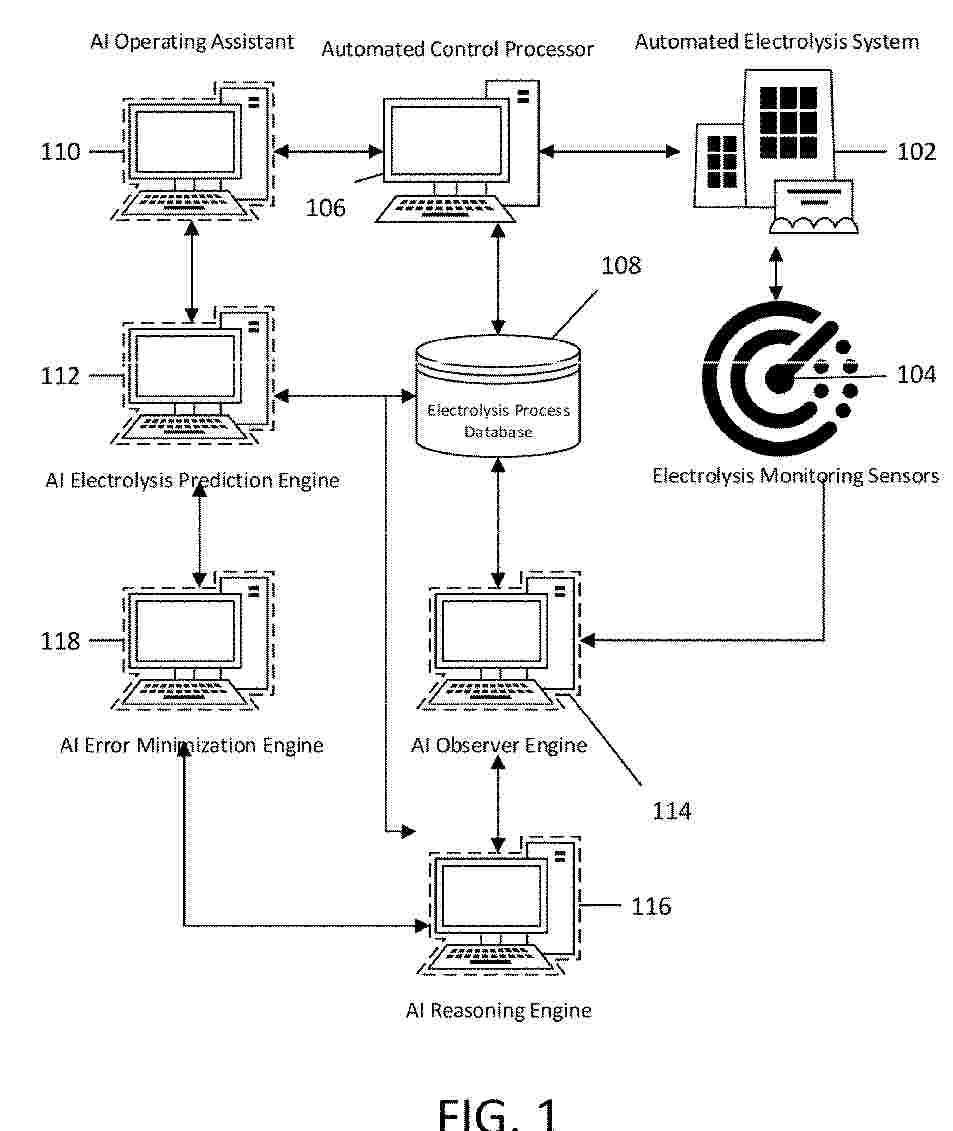
0001 A green hydrogen production system uses an AI operator assistant. Electrolysis sensors collect operating conditions of an automated electrolysis system (102). An artificial intelligence (AI) electrolysis prediction engine (112) uses the operating conditions to model electrolysis. The AI electrolysis prediction engine (112) models electrolysis using a both first principles model (304) and machine learning models of one or more degradation factors, such as electrolyzer degradation or electro-osmatic drag. The AI electrolysis prediction engine (112) hybridizes the models to generate initial set point scenarios for the electrolysis process. An AI operator assistant receives process characteristics from the operator, which are used to select a set point scenario. An automation control processor (106) then controls electrolysis in accordance with the selected settings. An AI observer engine (114), an AI reasoning engine (116), and an AI error minimization engine (118) perform different aspects of a process to observe the process, determine deviations, and predict further optimization.
Resumen de: EP4818127A1
The present invention relates to an electrochemical system and method for water treatment and regeneration, with the simultaneous recovery of valuable by-products, particularly hydrogen. The system is designed to efficiently remove organic matter from wastewater streams while enabling the production and recovery of hydrogen and optionally other useful compounds.
Resumen de: EP4818365A1
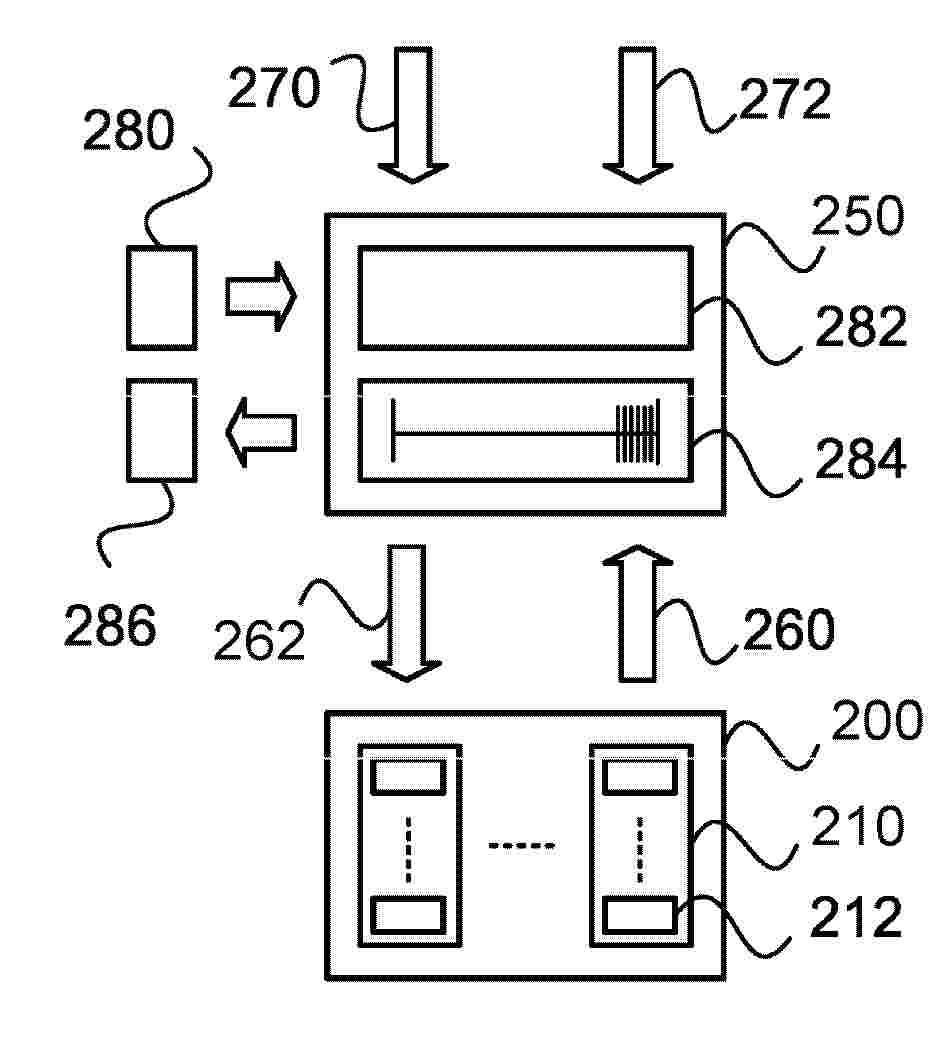
0001 The invention relates to a method for operating an electrolysis plant (200) for producing hydrogen from water, wherein the electrolysis plant comprises electrolysis cells, the method comprising: Providing current operating parameter values (260) of plant operating parameters; Providing performance information (280), wherein the performance information comprises information about a performance of at least one component of the electrolysis plant; Determining, based on the performance information (280), a remaining service life (282) of the at least one component of the electrolysis plant; Determining operating setpoints (262) for the stack assemblies, based on: the current operating parameter values (260), the remaining service life of the at least one component of the electrolysis plant, and operating limits (284) of the stack assemblies or parts thereof, which exceed given respective operating limits; and Providing the operating setpoints (262) for operating the electrolysis plant.
Resumen de: EP4818385A1
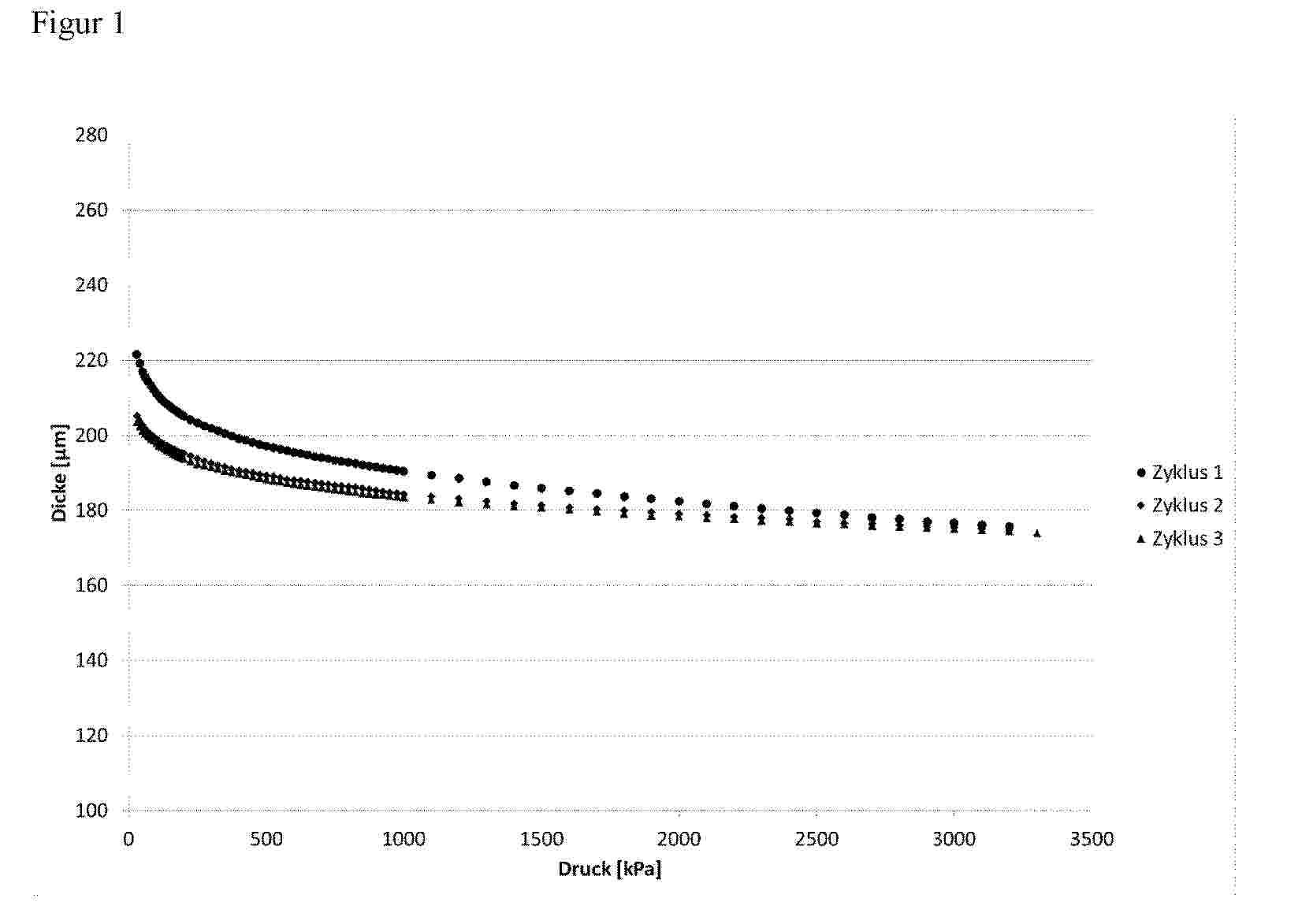
0001 Die vorliegende Erfindung betrifft ein Verfahren zur Herstellung eines leitfähigen Vliesstoffs bzw. einer Gasdiffusionsschicht für einen Elektrolyseur mit einer geringen plastischen Verformbarkeit und guten elastischen Eigenschaften sowie einen mit dem Verfahren erhältlichen leitfähigen Vliesstoff.
Resumen de: GB2705217A
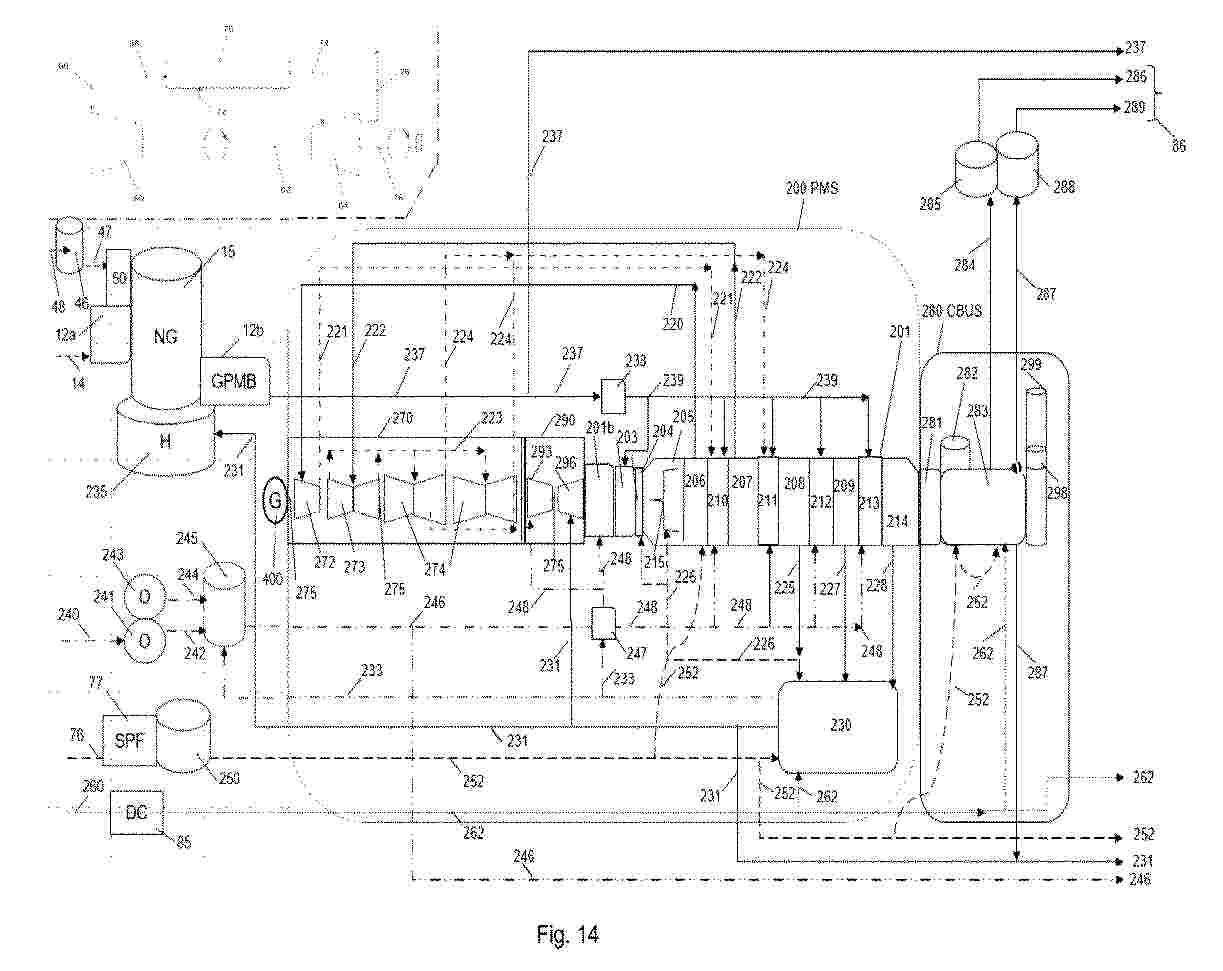
A process for climate-positive operation of a power generation system. A hydrogen H and natural gas HG fuel and compressed oxygen O are provided to a combustion chamber 303 to generate and provide a high temperature and high-pressure gas flow to drive a shaft 275 by expansion of the exhaust gas. A flow of expanded exhaust gas is provided to a heat recovery steam generator 201 to generate steam to drive a steam turbine 270. A flow of steam is provided from the heat recovery steam generator to a first electrolyzer 230 to produce hydrogen and oxygen gases. A flow of exhaust gas is provided from the heat recovery steam generator to a membrane separation system 281 for separation of residual gases, such as sulphur-dioxide, nitrogen-oxides and particulates, and a flow of carbon-dioxide gas and water vapor is provided from the membrane separation system to a second electrolyzer 701 to produce hydrogen gas, oxygen gas and magnesium carbonate. A flow is provided from the second electrolyzer to a gas monitoring system 298. Figure 10
Resumen de: JP2026157283A
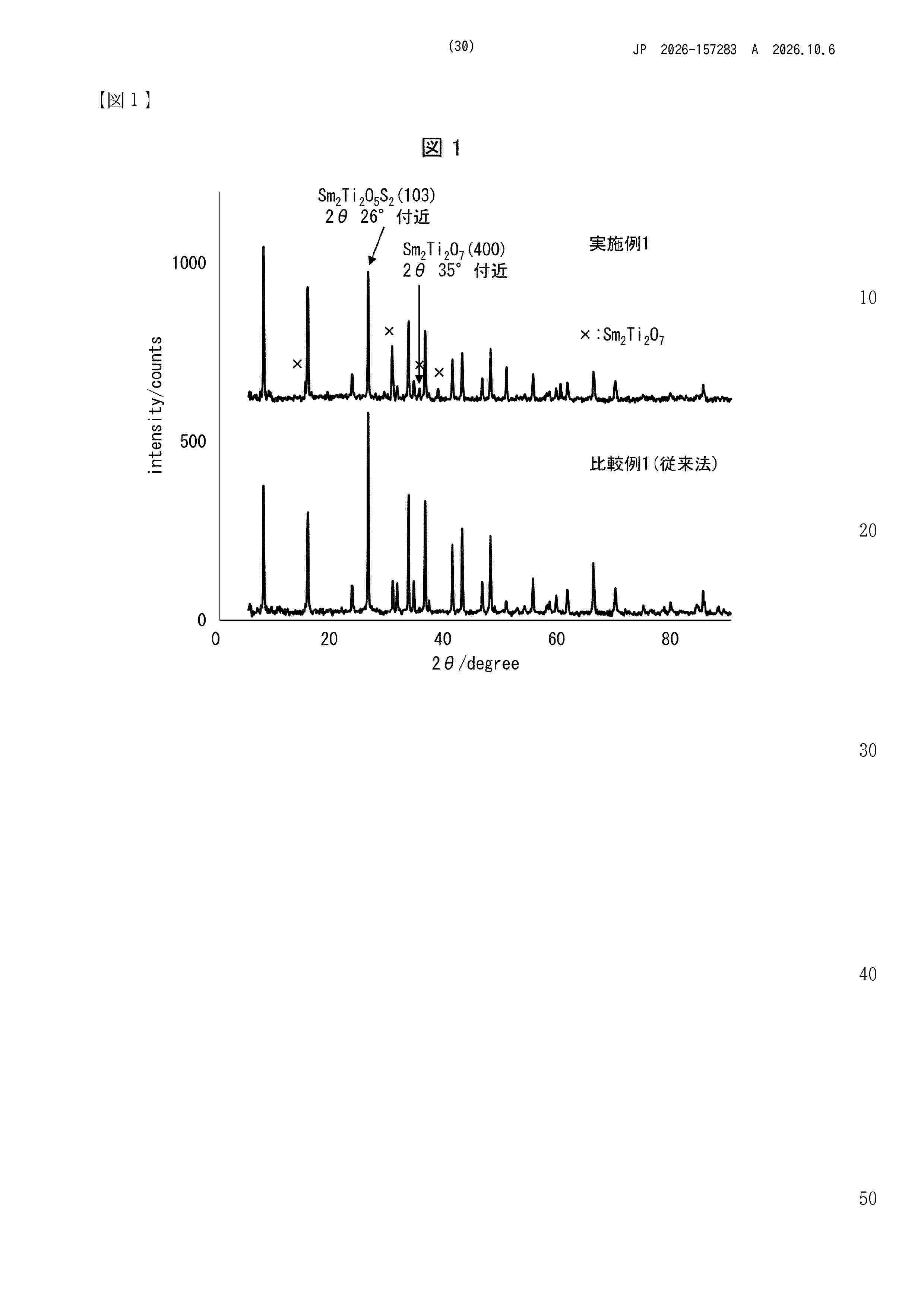
【課題】非腐食性フラックスを用いてMTOS光触媒粒子を合成する技術を提供する。【解決手段】本開示の一態様に係る光半導体粒子の製造方法は、下記の一般式(I)で示される組成の光半導体粒子の製造方法であって、MaTibOcSd…(I)前記光半導体粒子の原料とフラックス成分との混合物を焼成する工程を含み、前記フラックス成分が、以下の(a)~(d)からなる群から選択される少なくとも1種である:(a)Pb酸化物、Bi酸化物、B酸化物、V酸化物及びMo酸化物からなる群から選択される少なくとも1種の酸化物;(b)ホウ酸塩無水物及びメタバナジン酸塩の少なくとも一方;(c)Li酸化物、Na酸化物、K酸化物及びBa酸化物からなる群から選択される少なくとも1種の酸化物と、前記(a)の酸化物との混合物;及び(d)Li酸化物、Na酸化物及びK酸化物からなる群から選択される少なくとも1種の酸化物と、W酸化物との混合物。【選択図】なし
Resumen de: JP2026156303A
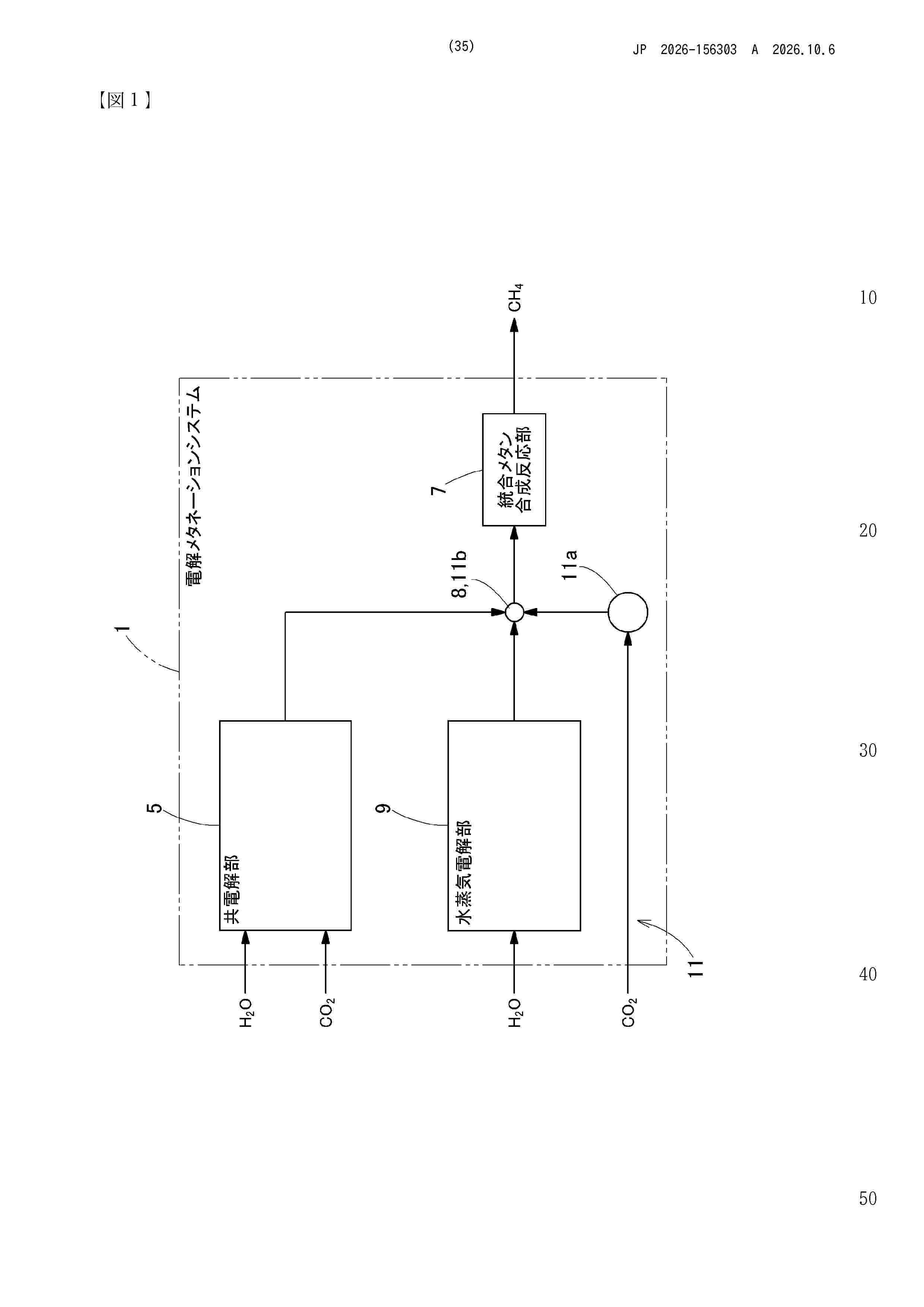
0001 【課題】プロセス出口のメタン純度を高く保ち、熱量の安定化やスケールアップを可能にする電解メタネーションシステムの提供。 【解決手段】水蒸気及び二酸化炭素を電気分解して水素、一酸化炭素、水蒸気及び二酸化炭素を含むガスを生成する共電解部5と、水蒸気を電気分解して水素と水蒸気を含むガスを生成する水蒸気電解部9と、共電解部5のカソード極に供給する水蒸気及び二酸化炭素の各流量、水蒸気電解部9のカソード極に供給する水蒸気の流量を制御する流量制御手段と、共電解部5及び水蒸気電解部9の後段に水を分離する水分離部と、目的ガス合流部8と、目的ガス合流部8により集約されたガスをメタン化触媒に通じてメタネーションを行う統合メタン合成反応部7と、を備える電解メタネーションシステム1であって、水蒸気電解部9のカソード極の出口から統合メタン合成反応部7の出口までの経路に二酸化炭素を注入する二酸化炭素注入部11を有する。 【選択図】図1
Resumen de: JP2026157077A
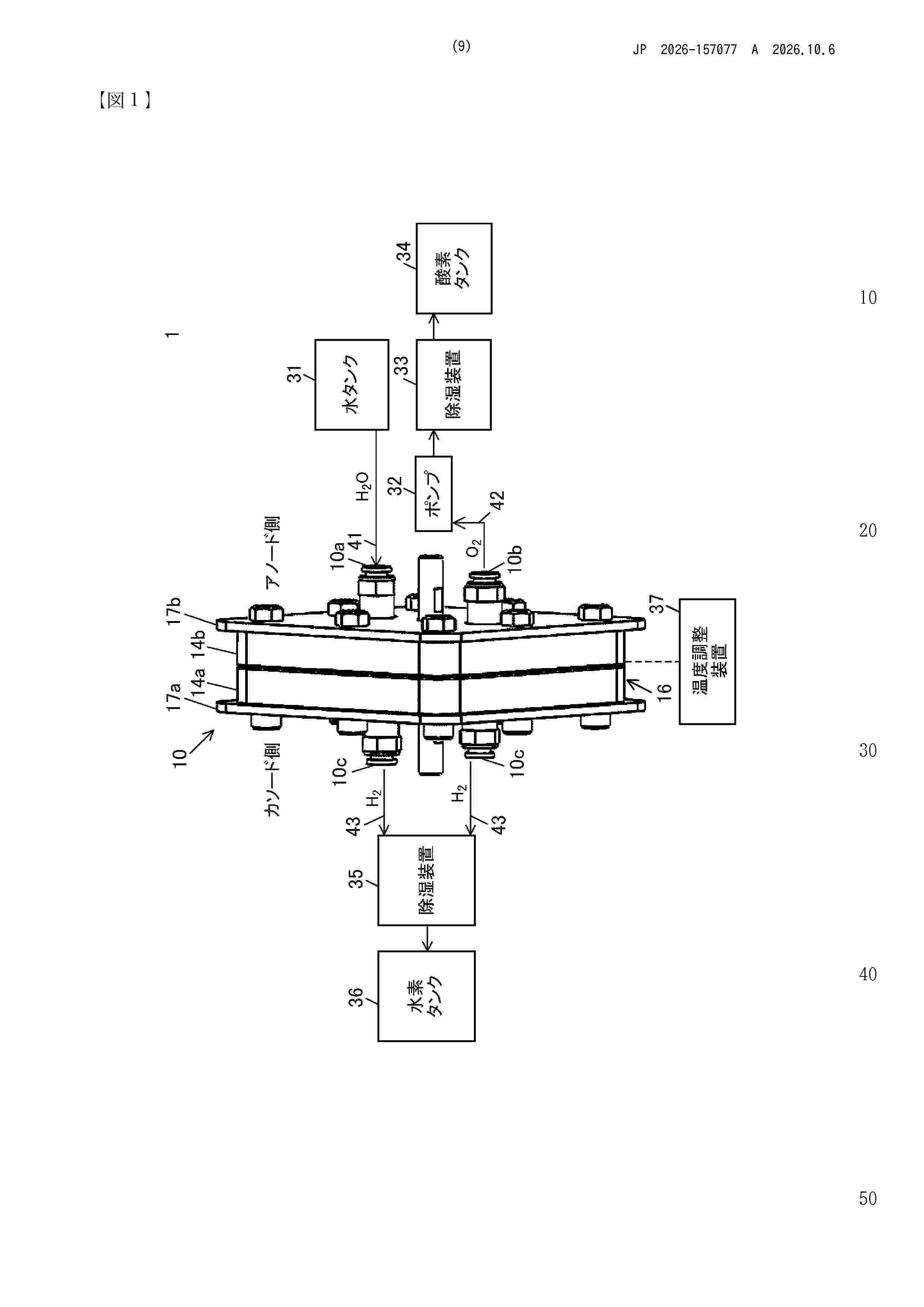
0001 【課題】水の使用量やエネルギー消費を抑え、装置構成を簡素化すること。 【解決手段】水電解装置1は、水電解セル10の酸素排出口10b側にポンプ32を設け、ポンプ32により酸素を吸引することで、水電解セル10内に水が供給される。 【選択図】図1
Resumen de: JP2026156302A
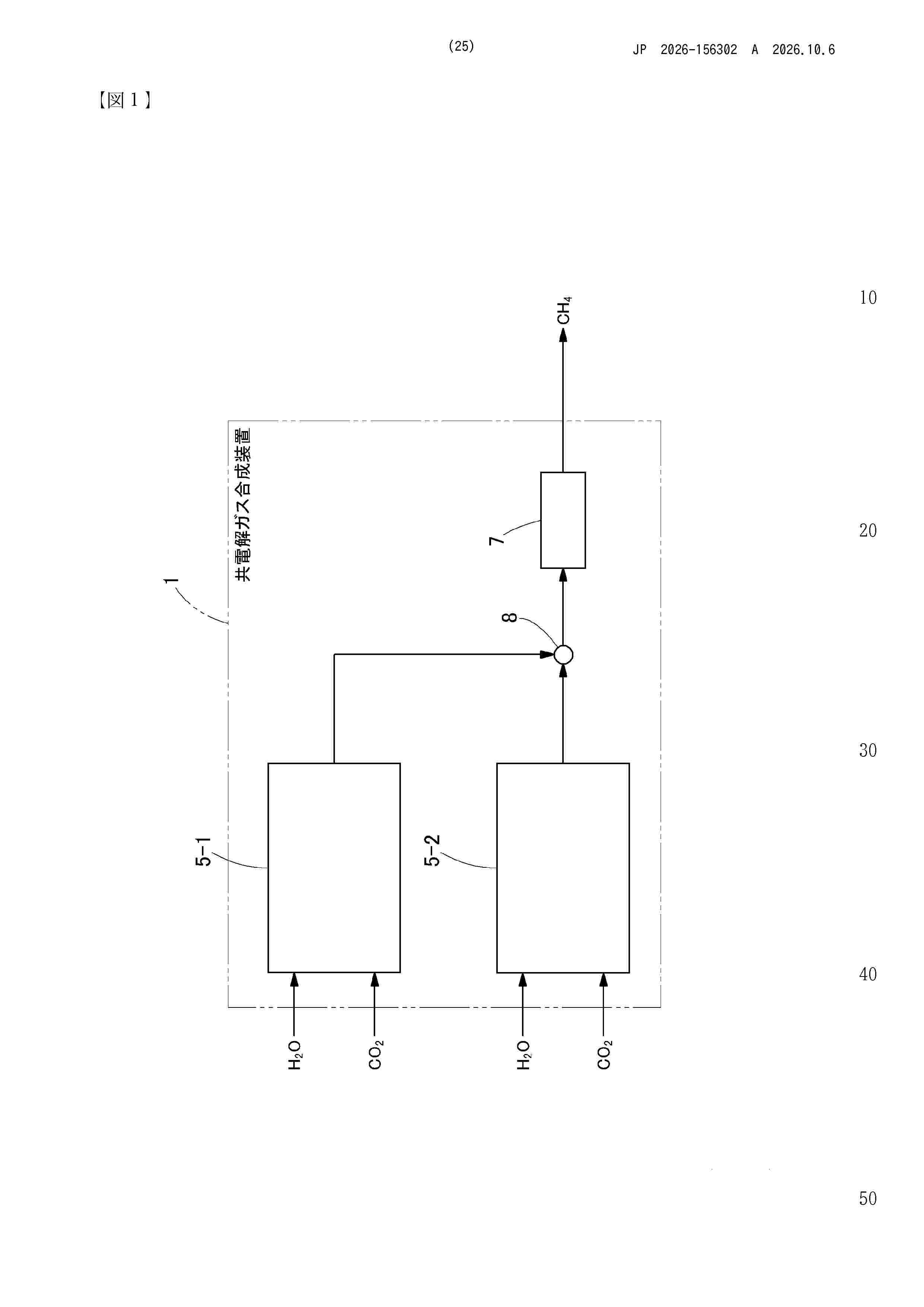
0001 【課題】プロセス出口の生成ガスのメタン純度を高く保ち、熱量の安定化やスケールアップを可能にする共電解ガス合成装置の提供。 【解決手段】水蒸気と二酸化炭素を電気分解し合成ガスを生成する2以上の共電解部5-1、5-2と目的ガス合流部8と統合ガス合成反応部7と制御手段とを備える共電解ガス合成装置1であって、各共電解部5-1、5-2はカソード極に供給する水蒸気と二酸化炭素の流量を制御する流量制御手段と、水蒸気と二酸化炭素の合計流量に対する電気分解により生成される水素と一酸化炭素の合計流量の比率を電解利用率(α)として算出する電解利用率検知手段と水分離部と切替弁とを有し、制御手段は、電解利用率(α)に基づき各共電解部5-1、5-2に供給する水蒸気と二酸化炭素の流量比、流量のうち少なくとも1つを決定し、切替弁は合成ガスをベント排気ラインに通過する状態と目的ガス合流部8に通流する状態との切替が可能である。 【選択図】図1
Resumen de: JP2026154519A
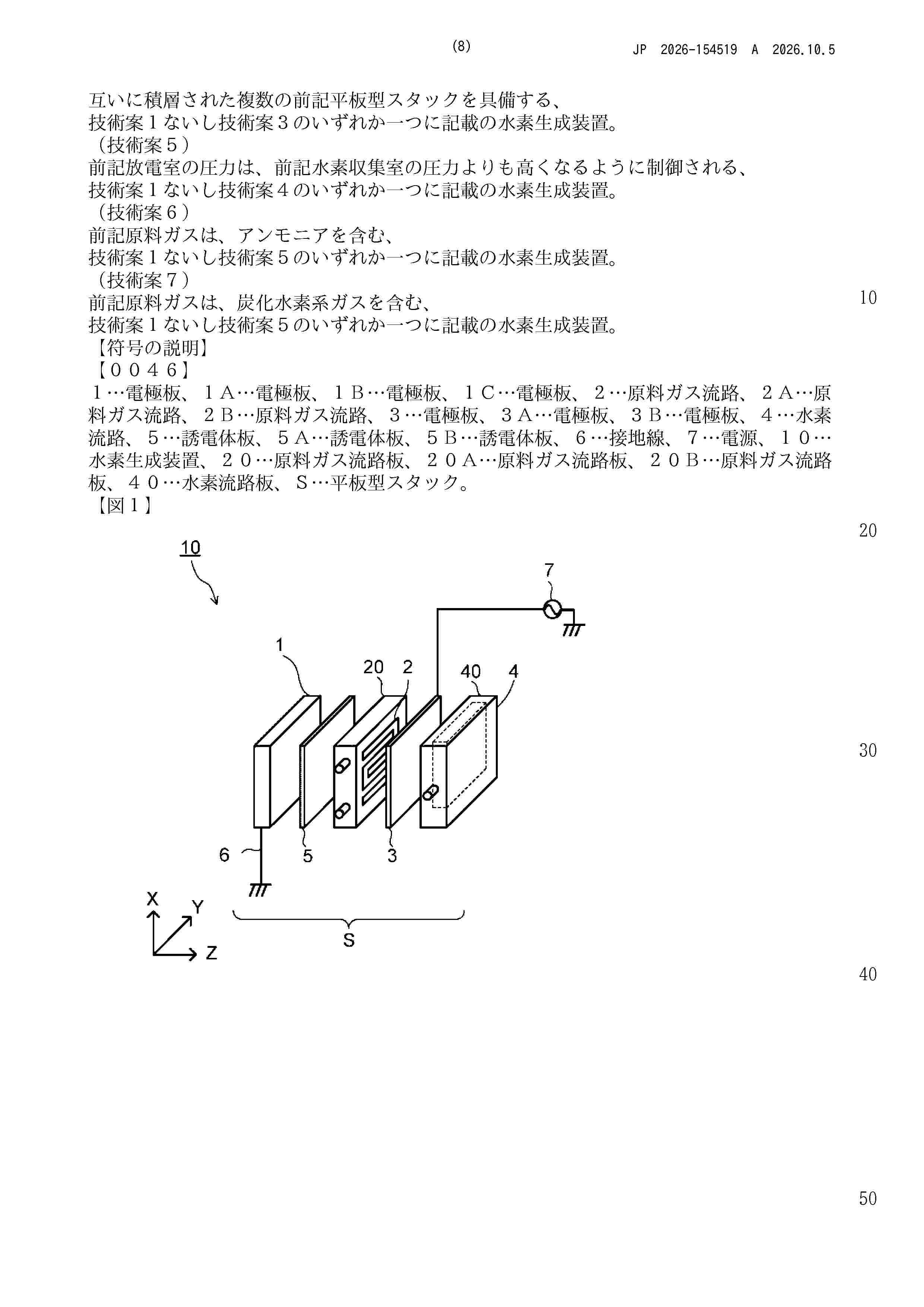
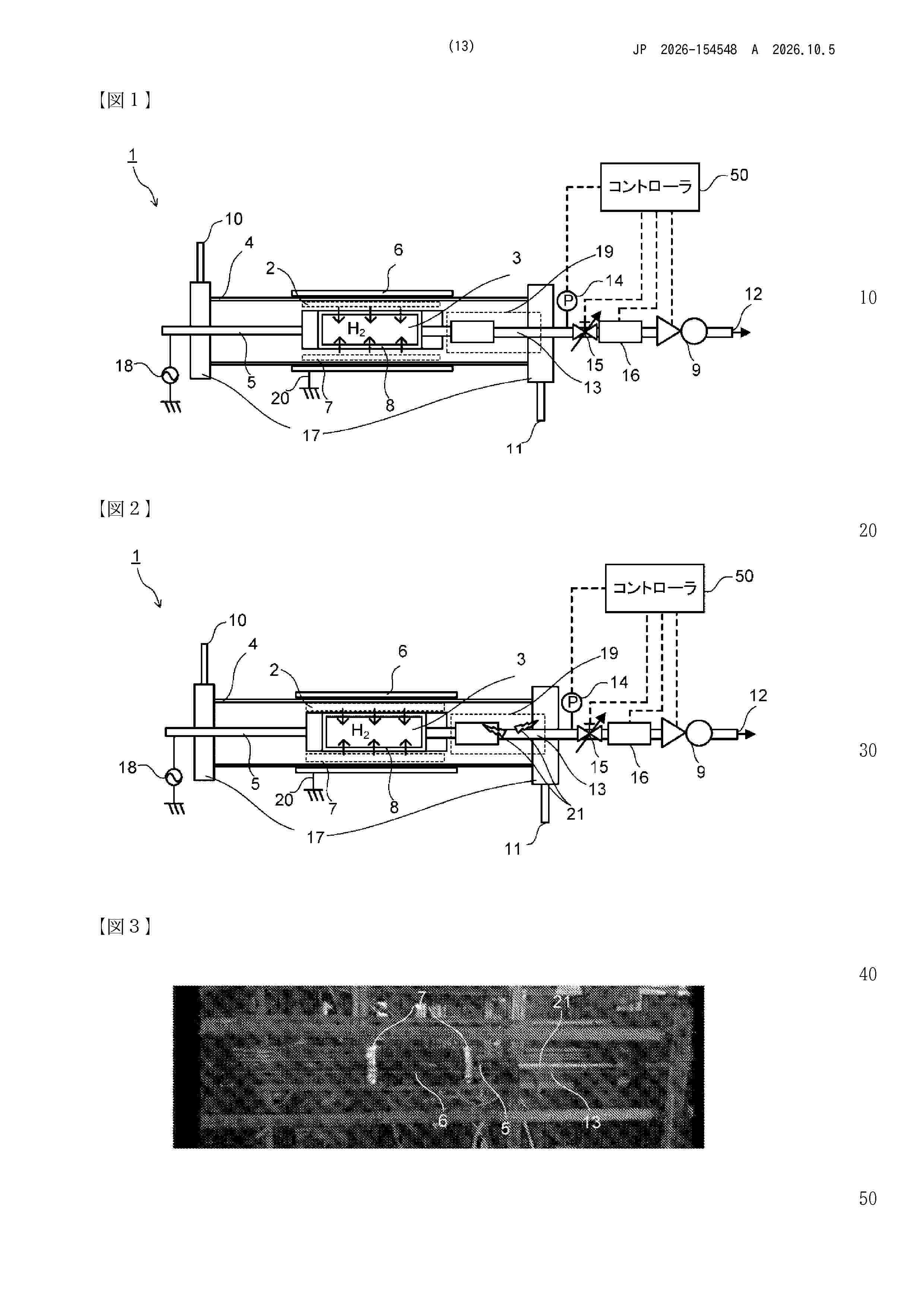
【課題】異常放電の発生を抑制する。【解決手段】水素生成装置は、交流電圧を供給する電源および接地線の一方に接続された一対の第1の電極板と、一対の第1の電極板の間に設けられ、電源および接地線の他方に接続され、水素透過膜を含む一対の第2の電極板と、一対の第1の電極板と一対の第2の電極板との間に設けられ、第1の電極板と第2の電極板との間に印加される電圧に応じて発生する放電により水素原子を含む原料ガスが分解される一対の放電室と、一対の第2の電極板の間に設けられ、原料ガスを分解することにより生成される水素が第2の電極板を介して取り出される水素収集室と、一対の第1の電極板と一対の放電室との間に設けられた一対の誘電体板と、を有する平板型スタックを具備する。【選択図】図3
Resumen de: JP2026154548A
【課題】異常放電の発生を抑制する。【解決手段】水素生成装置は、第1の電極と第2の電極との間に設けられ、第1の電極と第2の電極との間に印加される電圧に応じて発生する放電により水素原子を含む原料ガスが分解される、放電室と、第2の電極に含まれる水素透過膜で囲まれ、原料ガスを分解することにより生成される水素が第2の電極を介して取り出される、水素収集室と、水素収集室に接続され、水素収集室からの水素のガスが流れる水素収集管と、を具備する。水素収集管は、放電を遮る誘電体を収容する。【選択図】図1
Resumen de: JP2026154649A
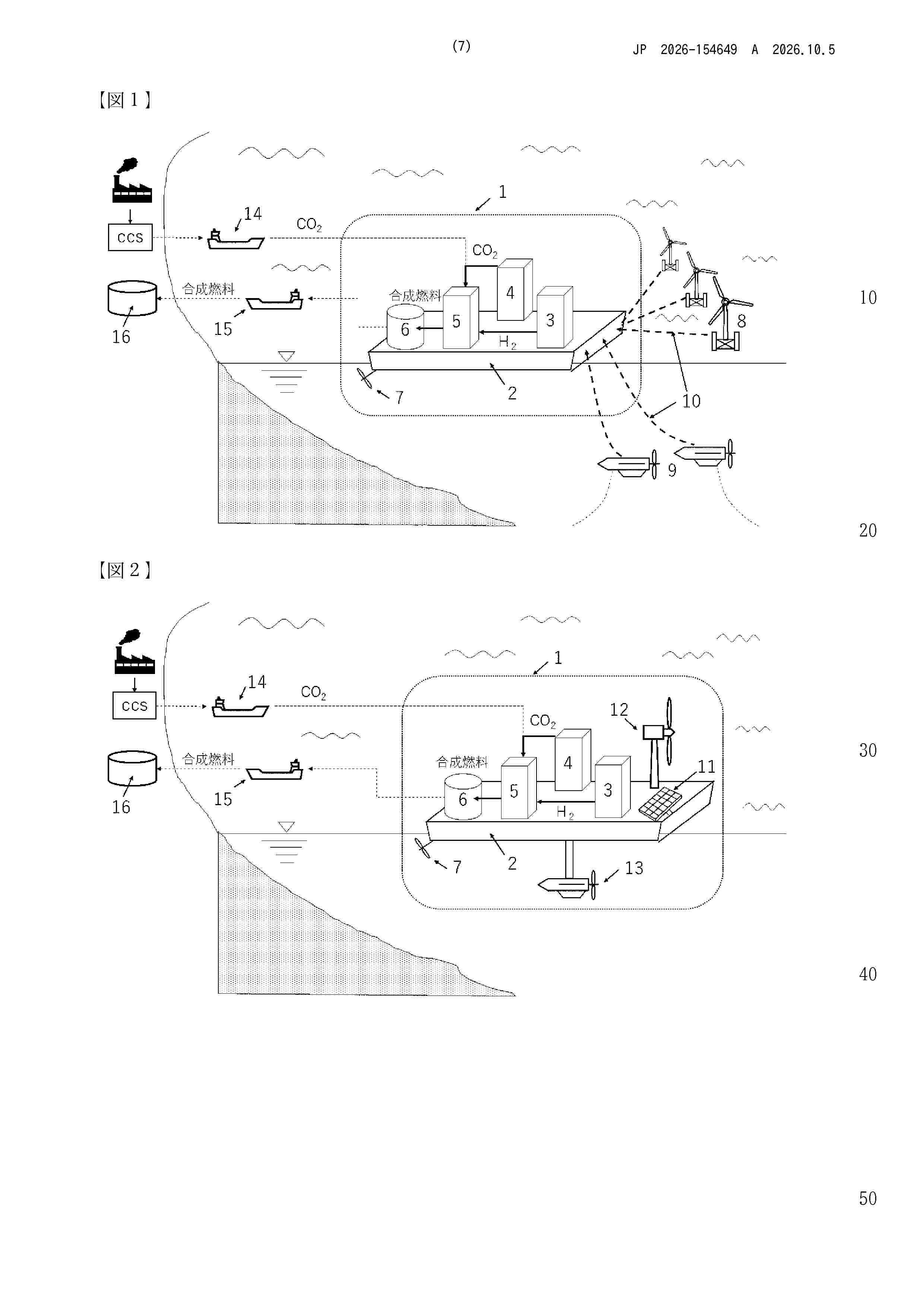
0001 【課題】海洋上の再生可能エネルギーを利用して、貯蔵や輸送が容易な合成燃料を製造するシステムを装備した海洋構造物を提供する 【解決手段】本発明の洋上合成燃料製造設備1は、洋上に浮かぶ浮体2に、水素を発生させる水電解システム3と二酸化炭素を空気中から直接回収する二酸化炭素回収システム4とを装備し、前記水電解システム3で得られた水素と前記二酸化炭素回収システム4で得られた二酸化炭素を原料として合成燃料を製造する合成燃料製造システム5を装備し、海洋上の再生可能エネルギーに由来する電力を電源とすることで合成燃料を製造する。 【選択図】図1
Resumen de: CN119727395A
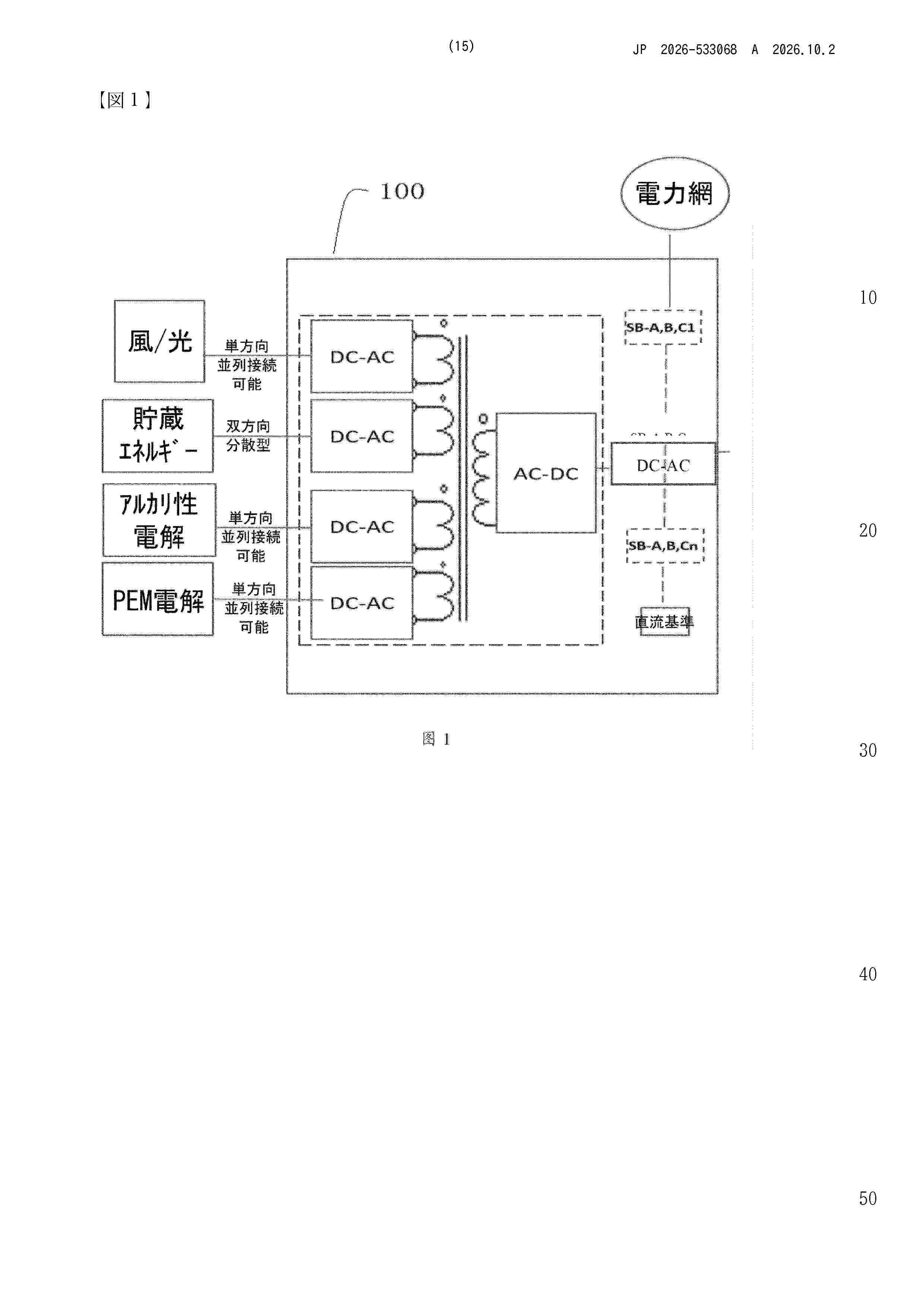
The invention provides an isolation circuit for a hydrogen production system and a renewable energy hydrogen production system comprising the same, the isolation circuit comprises at least one DC conversion module and at least one DC-AC converter, and the DC conversion module comprises a single output port and a multi-output port; a single output port of the DC conversion module is coupled with the DC side of the DC-AC converter; a plurality of output ports of the DC conversion module are coupled with a plurality of external unidirectional power flow units and/or bidirectional power flow units, and the unidirectional power flow units at least comprise hydrogen production units; and the AC end of the DC-AC converter is coupled and connected with an external AC power grid or a DC power grid in series. According to the scheme, the application requirements of two coupling situations are met at the same time, various types of external units are effectively fused, all parts in the system are fused into a whole, the cost is reduced, and meanwhile positioning and maintenance of faults are facilitated.
Resumen de: US20260196544A1
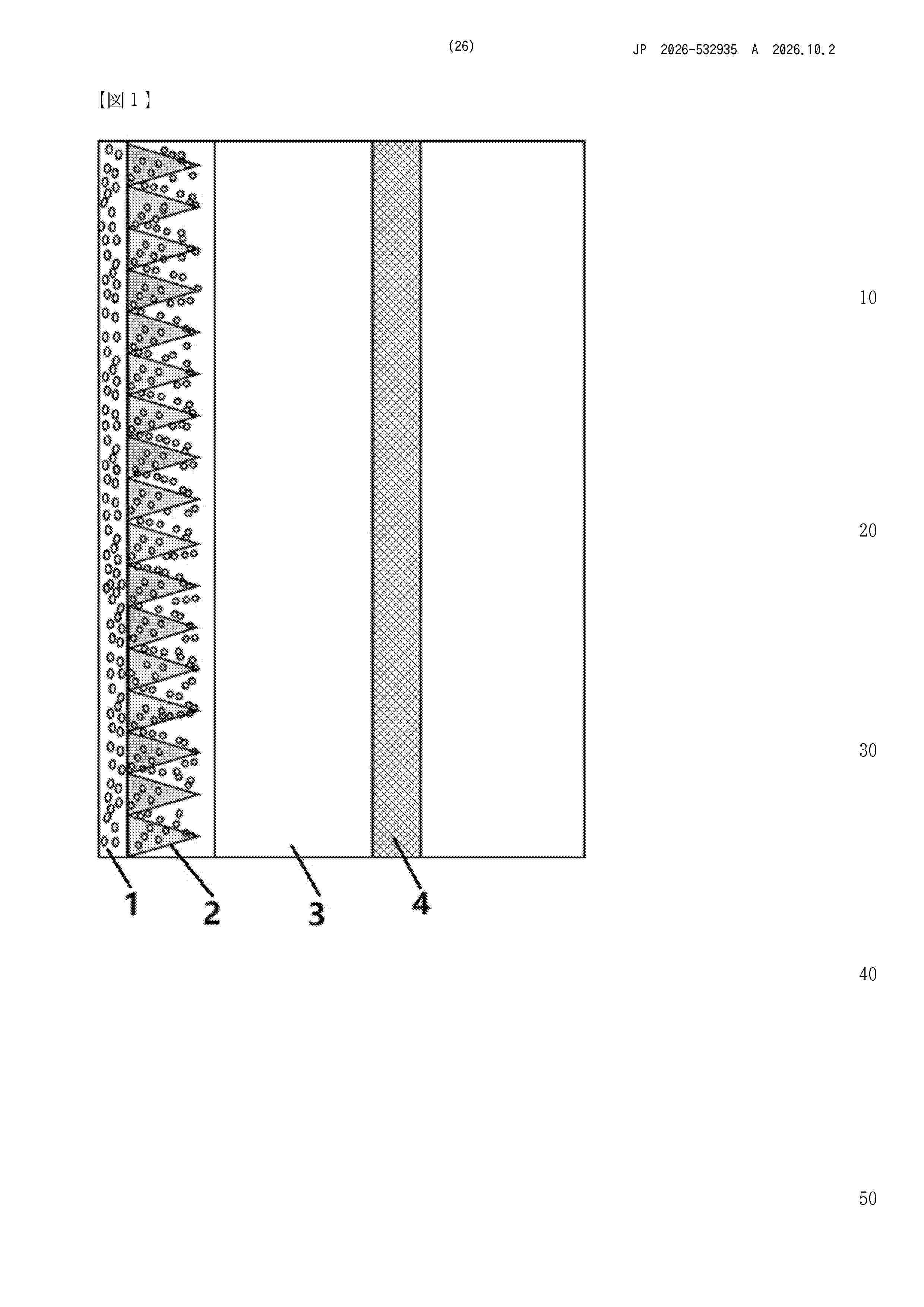
0000 The present disclosure relates to the technical field of water electrolysis, in particular to a low-hydrogen-permeability proton exchange membrane as well as a preparation method and use thereof. The proton exchange membrane comprises a Pt-based additive layer and a substrate membrane, wherein the Pt-based additive layer consists of a Pt-based additive and a fluorinated proton exchange resin and comprises an array layer and a flat layer, with the thickness ratio and active components ratios of the array layer to the flat layer ranging from 1:(0.5-30) to 1:(1-50), and the array layer is composed of an orderly arranged arrays and an array layer resin wrapping the arrays. The low-hydrogen-permeability proton exchange membrane provided by the present disclosure has the Pt-based additive layer composed of the array layer and the flat layer.
Nº publicación: CN122856236A 02/10/2026
Solicitante:
桂林电子科技大学
Resumen de: CN122856236A
0001 本发明公开了一种镍铁双金属掺杂三氧化钨析氧电催化剂及其制备方法与应用,属于电催化材料技术领域。该催化剂以泡沫镍为基底,采用一步水热法结合退火工艺制得镍铁双金属掺杂钨氧化物(Ni‑Fe‑WO<3>)自支撑电极。所述制备过程中以钨酸钠为钨源、硫酸亚铁为铁源,泡沫镍基底为镍源,并辅以草酸/硫酸钠二元导向剂,可控构筑纳米线阵列。所得催化剂保持WO<3>纳米线阵列骨架结构,Ni、Fe双金属掺杂有效调制WO<3>的局域电子结构;同时,纳米阵列结构暴露丰富的活性位点,促进电解液扩散和氧气脱附,协同增强催化剂的析氧性能。在碱性电解水析氧测试中表现出低析氧过电位、低电荷转移电阻以及良好的循环稳定性。本发明材料制备工艺简单、成本低廉、重复性好,具有一定的应用前景。
 BOPI
BOPI
 Sede Electrónica